
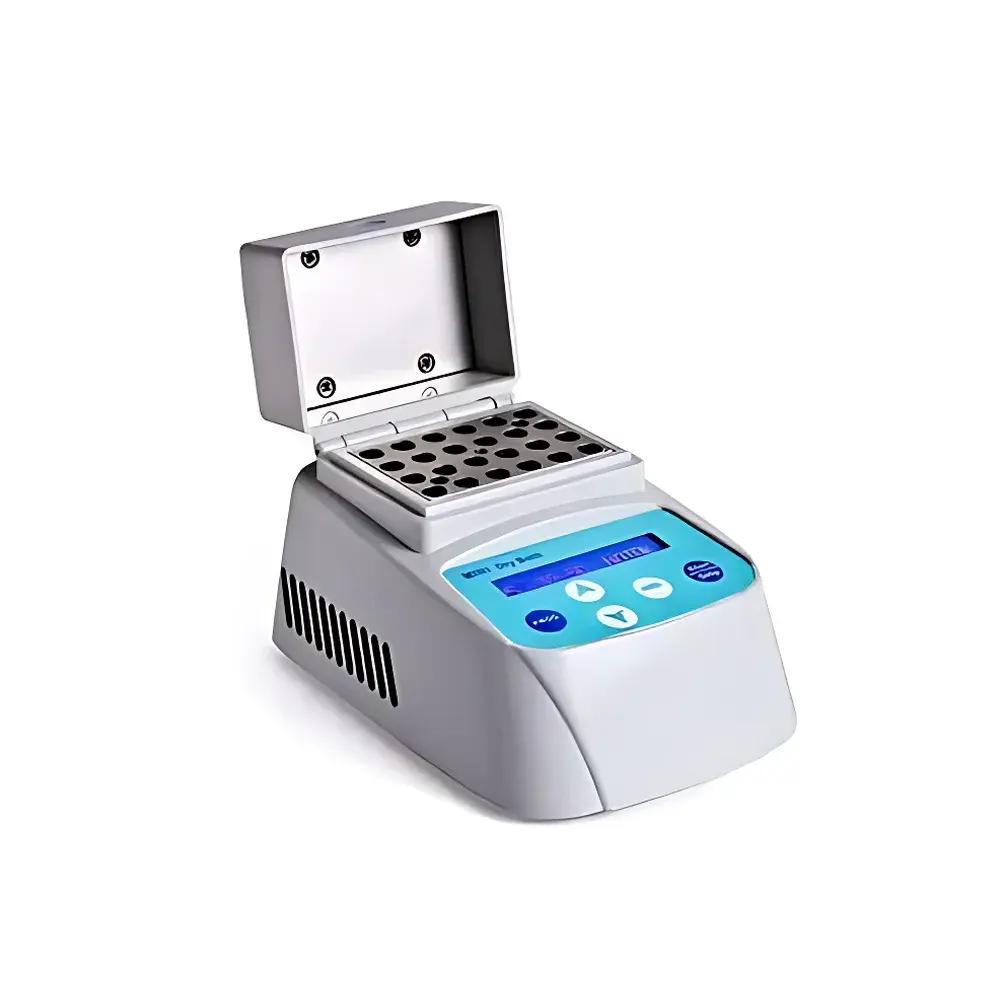
Jiayuan MINIC-100I Peltier-Cooled Compact Metal Block Thermostat
| Brand | Jiayuan |
|---|---|
| Origin | Beijing, China |
| Model | MINIC-100I |
| Temperature Range | −10 °C to 100 °C |
| Temperature Accuracy | ≤ ±0.5 °C |
| Temperature Uniformity (at 40 °C Δ) | ±0.3 °C |
| Block Stability (at 100 °C) | ≤ ±0.5 °C |
| Display Resolution | 0.1 °C |
| Heating Time (20 °C → 100 °C) | ≤ 15 min |
| Cooling Time (RT → RT−20 °C) | ≤ 30 min |
| Max Power | 120 W |
| Weight | ≤ 1.4 kg |
| Input Voltage | 24 V DC |
| Heat Lid | Yes |
| Programmable Timer | 0–999 min |
| Replaceable Blocks | MINI-A (40×0.2 mL), MINI-B (24×0.5 mL), MINI-C (15×1.5 mL), MINI-D (15×2.0 mL), MINI-E (8–12.5×12.5 mm cuvettes), MINI-F (4×15 mL), MINI-G (2×50 mL) |
Overview
The Jiayuan MINIC-100I is a compact, Peltier-cooled metal block thermostat engineered for precise thermal control in space-constrained and mobile laboratory environments. Unlike traditional water baths or heated blocks with passive cooling, the MINIC-100I integrates solid-state thermoelectric (TEC) modules to deliver active refrigeration down to −10 °C while maintaining heating capability up to 100 °C — enabling bidirectional temperature regulation without external chillers or cryogenic media. Its microprocessor-controlled architecture ensures stable setpoint maintenance across the full operating range, with real-time feedback from high-stability platinum resistance sensors embedded directly into the aluminum heating block. Designed as a dry-block alternative to water-based systems, it eliminates risks of contamination, evaporation, and condensation — making it particularly suitable for molecular biology workflows requiring consistent thermal profiles during enzyme reactions, serum coagulation, sample storage pre-conditioning, and nucleic acid stabilization.
Key Features
- Integrated Peltier thermoelectric module for simultaneous heating and active cooling (−10 °C to 100 °C)
- Dual-mode heat lid with programmable temperature control to suppress sample evaporation during prolonged incubations
- High-resolution 0.1 °C LED display with simultaneous setpoint and real-time block temperature readout
- Auto-calibration function for user-accessible temperature offset correction to maintain traceable accuracy
- Comprehensive safety architecture: over-temperature cutoff, short-circuit protection, and self-diagnostic error reporting with audible alarm
- Lightweight (≤1.4 kg) and portable design powered by 24 V DC input — compatible with vehicle power systems and battery-operated field deployments
- Fan-assisted heat dissipation for rapid cooldown (≤30 min from ambient to ambient −20 °C) and efficient thermal recovery
Sample Compatibility & Compliance
The MINIC-100I accommodates a broad range of standard lab consumables via interchangeable aluminum blocks, supporting common tube formats including 0.2 mL PCR strips (MINI-A), 0.5 mL microtubes (MINI-B), 1.5/2.0 mL Eppendorf-style tubes (MINI-C/D), rectangular cuvettes (MINI-E), and larger-volume centrifuge tubes (MINI-F/G). All blocks are precision-machined for optimal thermal coupling and feature corrosion-resistant anodized surfaces for repeated autoclaving and chemical decontamination. While not certified to ISO/IEC 17025 or ASTM E2252 for metrological validation, the device meets general-purpose laboratory equipment requirements under IEC 61010-1:2010 for electrical safety and EMC compliance. Its closed-loop temperature control supports GLP-aligned documentation when paired with external logging tools.
Software & Data Management
The MINIC-100I operates as a standalone instrument with no embedded software stack or network interface. All parameter configuration — including target temperature, timer duration, and heat lid setpoint — is performed via intuitive front-panel push-button controls. The unit retains last-used settings after power cycling and logs no internal data. For integration into regulated environments (e.g., clinical QC labs adhering to FDA 21 CFR Part 11), users may connect external USB or RS-232 data loggers to capture timestamped temperature traces. Audit trails must be generated externally; the device itself does not provide electronic signature capability, user access levels, or encrypted storage.
Applications
- Enzyme reaction incubation (e.g., restriction digests, ligations, phosphorylations) requiring stable sub-ambient or elevated temperatures
- Serum coagulation assays where precise 37 °C maintenance is critical for clot formation kinetics
- Pre-warming or pre-chilling reagents prior to assay setup to minimize thermal shock effects
- Stabilization of thermolabile samples (e.g., RNA, antibodies, cell lysates) during brief handling intervals
- Field-deployable temperature conditioning for environmental or point-of-care testing workflows
- Quality control checks of temperature-sensitive calibration standards in non-GLP benchtop verification
FAQ
Does the MINIC-100I support external temperature probes for sample monitoring?
No — the unit measures only block surface temperature. It does not accept external PT100 or thermocouple inputs.
Can the heat lid be disabled independently of the block temperature setting?
Yes — the lid temperature is adjustable separately and can be turned off entirely via menu navigation.
Is the MINIC-100I suitable for continuous operation at 100 °C?
Yes — the system is rated for indefinite operation at maximum temperature, provided ambient conditions remain within 18–28 °C and adequate ventilation is maintained.
Are replacement blocks traceably calibrated?
Blocks are manufactured to dimensional tolerances ensuring consistent thermal contact but are not individually calibrated or supplied with NIST-traceable certificates.
What is the expected service life of the Peltier module under normal use?
Based on accelerated lifetime testing per IEC 60068-2-64, the TEC assembly maintains ≥90% thermal output after 20,000 operational cycles (defined as one full −10 °C ↔ 100 °C transition).



