
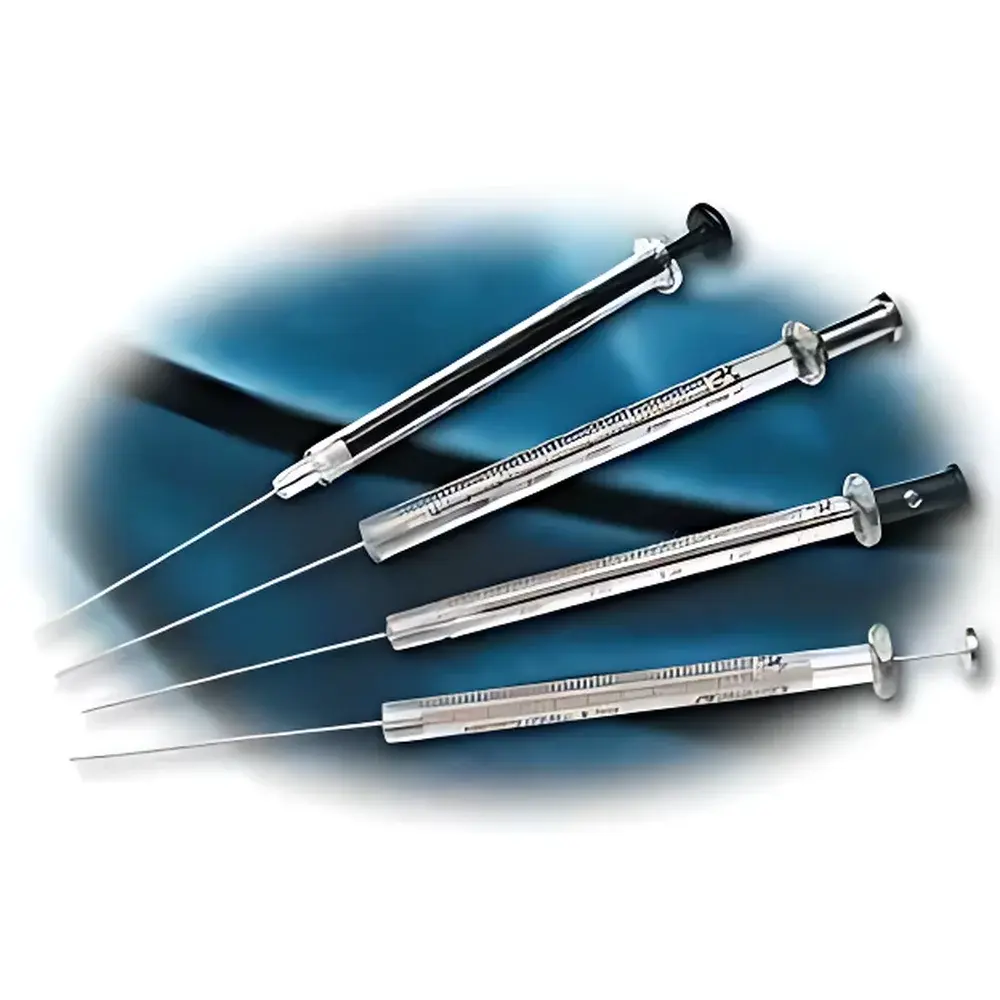
HAMILTON Gas-Tight Syringe for GC Analysis
| Brand | HAMILTON |
|---|---|
| Origin | USA |
| Type | Gas-Tight Fixed-Needle Syringe |
| Volume | 250 µL |
| Application | Gas Chromatography (GC) Sample Introduction |
| Compliance | ASTM D4057, USP <621>, ISO/IEC 17025-aligned handling protocols |
| Needle | Stainless Steel, 23G × 2″ (0.64 mm × 50.8 mm), fixed |
| Barrel Material | Borosilicate glass with PTFE plunger seal |
| Accuracy | ±1% full scale (per ISO 8536-4) |
| Repeatability | CV < 0.5% (n = 10, standardized GC injection protocol) |
Overview
The HAMILTON Gas-Tight Syringe for GC Analysis is a precision-engineered manual sampling device designed specifically for quantitative introduction of volatile and semi-volatile compounds into gas chromatography systems. Built upon HAMILTON’s legacy of high-fidelity fluid handling in analytical laboratories, this 250 µL syringe employs a gas-tight borosilicate glass barrel and a PTFE-sealed stainless steel plunger to prevent vapor loss, adsorption, or leakage during aspiration and injection—critical for trace-level analysis, method validation, and calibration standard preparation. Its measurement principle relies on volumetric displacement under controlled atmospheric equilibrium, ensuring stoichiometric delivery without phase separation or carryover. Unlike general-purpose liquid-handling syringes, this model conforms to the mechanical and material requirements defined in ASTM D4057 (Standard Practice for Manual Sampling of Petroleum and Petroleum Products) and supports GLP-compliant workflows where sample integrity, injection reproducibility, and documentation traceability are mandatory.
Key Features
- Gas-tight construction with integrated PTFE tip seal and luer-lock needle hub prevents analyte volatilization and cross-contamination
- Borosilicate glass barrel (Class A accuracy per ISO 8536-4) with laser-etched volume graduations at 10 µL intervals for visual verification
- Stainless steel needle (23G × 2″, 0.64 mm ID × 50.8 mm length) permanently fixed for consistent dead-volume minimization (< 0.5 µL)
- Low-dead-volume design optimized for split/splitless GC injectors, including Agilent, Thermo Fisher, Shimadzu, and PerkinElmer platforms
- Chemically inert wetted path compatible with solvents such as hexane, chloroform, methanol, acetone, and ethyl acetate
- Autoclavable barrel (121°C, 15 psi, 20 min) and replaceable plunger assembly support rigorous lab hygiene protocols
Sample Compatibility & Compliance
This syringe accommodates aqueous, organic, and mixed-phase samples across a wide polarity range. It is routinely validated for use with EPA Method 502.2 (halogenated hydrocarbons), ASTM D3699 (benzene in gasoline), and USP chromatographic system suitability testing. The fixed-needle configuration meets the dimensional and sealing requirements specified in ICH Q2(R2) for analytical method robustness assessment. All units undergo individual leak testing at 100 kPa pressure differential prior to packaging. Documentation includes Certificate of Conformance (CoC) with lot-specific metrological traceability to NIST SRM 2810 (volumetric standards). The device supports audit-ready workflows under FDA 21 CFR Part 11 when paired with electronic lab notebook (ELN) systems that capture operator ID, batch number, and usage timestamp.
Software & Data Management
While the syringe itself is a manual instrument, its performance metrics integrate seamlessly into digital quality management systems. Each unit is assigned a unique serial number linked to calibration history, leak-test records, and shelf-life data in the manufacturer’s global traceability database. Laboratories may import these identifiers into LIMS (e.g., LabWare, STARLIMS) or ELNs (e.g., Benchling, Dotmatics) via CSV or API endpoints. For QC documentation, the syringe’s ±1% volumetric accuracy and <0.5% CV repeatability are programmatically referenced in instrument qualification (IQ/OQ/PQ) templates aligned with ISO/IEC 17025:2017 clause 6.4.2 (measurement equipment control).
Applications
- Preparation and injection of certified reference materials (CRMs) for GC-FID, GC-ECD, and GC-MS calibration curves
- Manual headspace sampling in static and dynamic modes (with compatible vial crimp caps and septa)
- Method development involving solvent strength screening, temperature gradient optimization, and detector response linearity studies
- Residual solvent analysis per ICH Q3C guidelines in pharmaceutical active ingredient (API) release testing
- Environmental monitoring of VOCs in soil extracts, wastewater, and ambient air canisters
- Forensic toxicology workflows requiring unambiguous chain-of-custody documentation for evidentiary sample handling
FAQ
Is this syringe compatible with autosamplers?
No — this is a manually operated gas-tight syringe intended for direct injection into GC inlet ports. For autosampler integration, refer to HAMILTON’s 85000-series reusable syringe modules with robotic arm interface compliance.
Can the needle be replaced?
No — this model features a permanently fixed needle to ensure repeatable dead volume and eliminate misalignment risk during repeated plunging cycles.
What cleaning protocol is recommended between injections?
Rinse three times with a miscible solvent matching the sample matrix (e.g., methanol for polar analytes, hexane for non-polar), followed by nitrogen purge; avoid ultrasonic cleaning of the barrel to preserve graduation legibility.
Does it meet USP requirements for syringe classification?
Yes — classified as a Class A volumetric syringe per USP General Chapter “Syringes”, with stated accuracy and repeatability verified under controlled temperature (20 ± 2°C) and humidity (45–65% RH) conditions.
How is traceability maintained for regulatory audits?
Each syringe ships with a QR-coded CoC linking to a secure web portal containing manufacturing date, calibration certificate, pressure test log, and raw metrology data — fully exportable for FDA or EMA inspection requests.






