
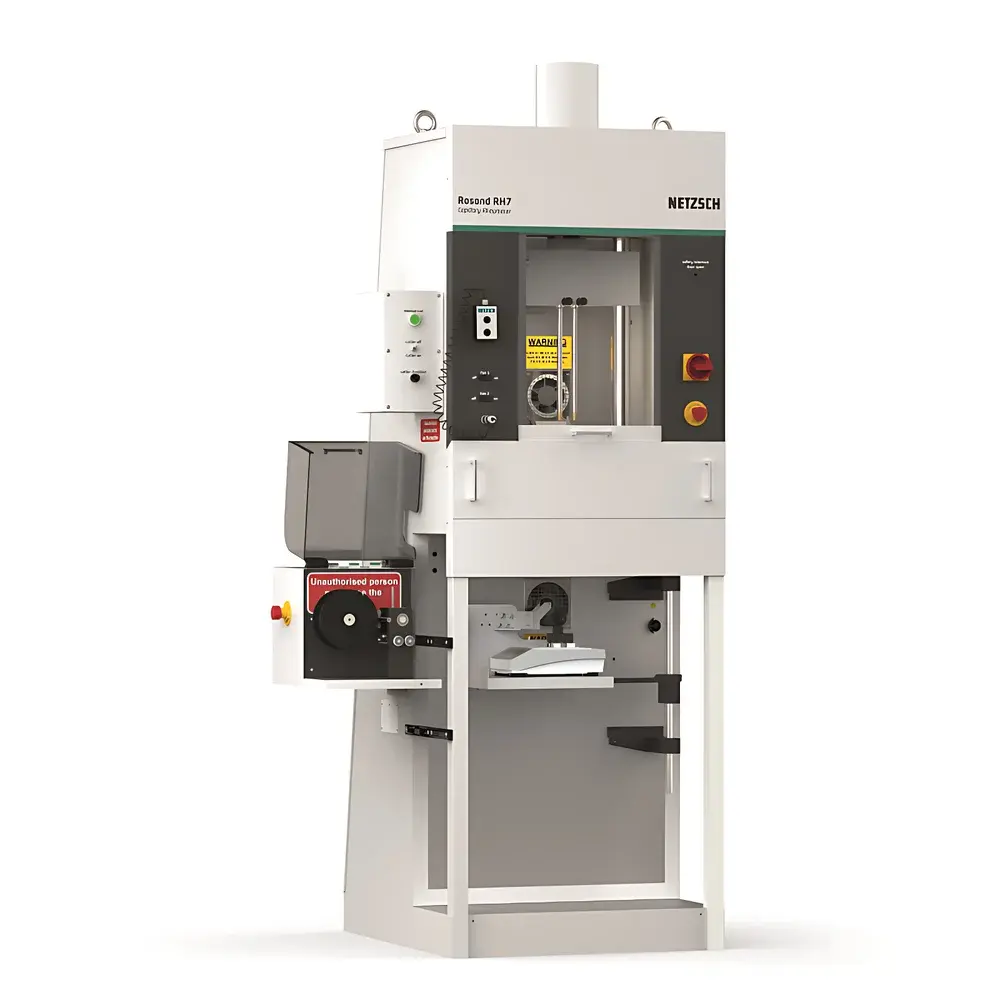
Netzsch Kinexus Rosand RH7 Capillary Rheometer
| Brand | Netzsch |
|---|---|
| Origin | Germany |
| Manufacturer Type | Authorized Distributor |
| Category | Imported Instrument |
| Model | Kinexus Rosand RH7 |
| Instrument Type | Capillary Rheometer |
| Minimum Extrusion Speed | 2.5 µm/min |
| Maximum Extrusion Speed | 600 mm/min |
| Maximum Load Capacity | 50 kN |
| Speed Dynamic Range | 240,000:1 |
| Standard Barrel Diameter | 15 mm (optional: 9.5, 12, 19, 24 mm) |
| Barrel Material | Nitrided Steel (optional: Stainless Steel or Hastelloy) |
| Die Material | Tungsten Carbide |
| Die Diameter Range | 0.5–3 mm |
| Optional Accessories | Nitrogen Purge System, Melt Strength Tester, Melt Draw-Down Fixture, Laser-Based Die Swell Measurement, Slit Dies, PVT Measurement Dies, Melt Cut-Off Knife |
Overview
The Netzsch Kinexus Rosand RH7 Capillary Rheometer is a high-precision, vertically oriented capillary rheometry system engineered for the quantitative characterization of polymer melts, thermoplastic compounds, and concentrated suspensions under realistic processing shear conditions. It operates on the fundamental principle of capillary flow rheology—measuring pressure drop across a precisely dimensioned die while controlling extrusion rate—to derive key viscoelastic parameters including apparent viscosity, shear stress, shear rate, extensional viscosity (via melt draw-down), die swell ratio, and melt strength. Designed for industrial R&D laboratories and quality control environments, the RH7 delivers metrological traceability to ISO 11443 and ASTM D3835 standards, supporting both routine QC testing and advanced process simulation for extrusion, injection molding, fiber spinning, blow molding, and additive manufacturing feedstock development.
Key Features
- H-frame mechanical architecture providing superior longitudinal stiffness (>10× higher than conventional cantilever or C-frame designs), minimizing deflection-induced measurement uncertainty during high-load extrusion.
- Dual-barrel measurement capability—enabling simultaneous short- and long-die experiments for robust Bagley correction without manual reconfiguration or downtime.
- Digital dual-mode speed control (position- and force-controlled modes), ensuring stable, jitter-free extrusion across the full dynamic range from ultra-low speeds (2.5 µm/min) to high-speed processing conditions (600 mm/min).
- Modular die and barrel system with standardized 15 mm bore (with optional 9.5, 12, 19, and 24 mm barrels) and tungsten carbide dies (0.5–3 mm diameter), supporting material-specific thermal and wear resistance requirements.
- Intuitive Kinexus software interface with real-time feedback loops, context-sensitive guidance, and integrated experiment sequencing—designed for operator efficiency while maintaining full compliance with GLP/GMP documentation workflows.
Sample Compatibility & Compliance
The RH7 accommodates thermoplastics (e.g., PE, PP, PET, PC, PEEK), elastomers, filled composites, reactive polymers, and high-viscosity suspensions up to 10⁸ Pa·s. Its nitrogen-purged barrel and die assembly prevents oxidative degradation during high-temperature testing (up to 450 °C). All hardware and firmware comply with CE, EMC, and RoHS directives. Data acquisition and reporting meet audit-trail requirements per FDA 21 CFR Part 11 when configured with electronic signatures and user access controls. Test methods align with ISO 11443 (determination of apparent viscosity), ISO 2526 (die swell), ISO 16790 (melt strength), and ASTM D3835 (capillary rheometry of thermoplastics).
Software & Data Management
Kinexus software provides full instrument control, automated Bagley and Rabinowitsch corrections, real-time viscosity curve generation, and export-ready reports in PDF, CSV, and XML formats. Raw pressure, temperature, position, and load data are timestamped at 1 kHz resolution and stored with full metadata (operator ID, calibration history, environmental logs). Version-controlled method templates support SOP-driven operation, while optional LIMS integration enables seamless data transfer to enterprise QA systems. Audit trails record all parameter changes, user logins, and report generations—ensuring full traceability for regulatory submissions and internal quality audits.
Applications
- Process simulation of extrusion-based operations: predicting pressure drop, output rate, and melt temperature profiles for twin-screw extruders and single-screw systems.
- Evaluation of extensional rheology via melt draw-down tests—critical for fiber spinning, film blowing, and thermoforming applications where strain-hardening behavior governs stability.
- Quantification of melt fracture onset and critical shear rate thresholds to optimize die design and avoid surface defects in extruded profiles.
- Thermal stability assessment through time-resolved viscosity monitoring at constant shear rate—detecting onset of thermal degradation or crosslinking.
- Die swell (extrudate swelling) analysis using laser-based optical measurement modules to determine recoverable strain and elastic contribution to flow.
- PVT (pressure–volume–temperature) characterization using specialized slit dies and compressible melt protocols for injection molding simulation inputs.
FAQ
What materials can be tested on the Kinexus Rosand RH7?
Polymer melts, thermoplastic elastomers, filled compounds, reactive resins, and high-concentration suspensions—provided they exhibit sufficient thermal stability and melt processability within the instrument’s temperature and pressure envelope.
Is Bagley correction performed automatically?
Yes—the dual-barrel configuration allows concurrent short- and long-die measurements, enabling fully automated, in-situ Bagley correction without recalibration or manual intervention.
Can the RH7 perform extensional viscosity measurements?
Yes—when equipped with the optional melt draw-down fixture and controlled-force extrusion mode, it supports uniaxial extensional testing per ISO 19927 and ASTM D7997 protocols.
What level of data integrity does the system provide for regulated environments?
With validated Kinexus software, electronic signatures, and audit-trail logging enabled, the RH7 meets FDA 21 CFR Part 11 and EU Annex 11 requirements for computerized systems in GxP settings.
Are custom dies or barrel configurations supported?
Yes—Netzsch offers application-specific die geometries (slit, conical, grooved), alternative barrel materials (Hastelloy C-276, Inconel), and high-pressure variants up to 100 MPa upon request.



