
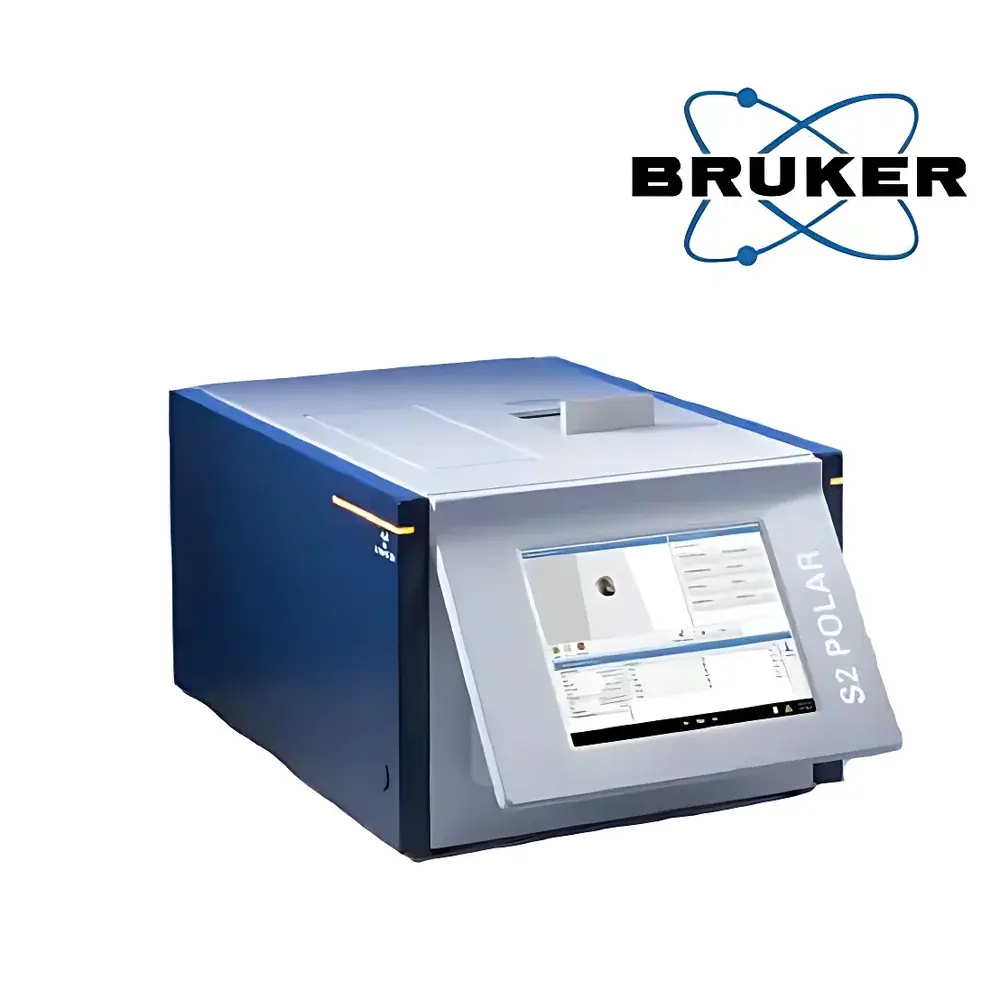
Bruker S2 POLAR Polarized Energy Dispersive X-Ray Fluorescence Spectrometer
| Brand | Bruker |
|---|---|
| Origin | Germany |
| Configuration | Benchtop/Polarized EDXRF |
| Element Range | Na (11) to Am (95), optional C (6) to Am (95) |
| Concentration Range | ppm to 100% |
| Energy Resolution | <135 eV (Mn Kα) |
| Repeatability | <0.1% RSD |
| Detector | HighSense™ Ultra-Low-Noise Silicon Drift Detector (SDD) |
| Compliance | ASTM D6481, ASTM D7751, ASTM D7220, ISO 13032, ASTM D4294, ISO 20847, ISO 8754, IP 336/496/532, JIS K2541-4, GB/T 11140 |
Overview
The Bruker S2 POLAR is a benchtop polarized energy dispersive X-ray fluorescence (P-EDXRF) spectrometer engineered for high-sensitivity, non-destructive elemental analysis across diverse sample matrices. Unlike conventional EDXRF systems, the S2 POLAR employs a patented polarization geometry—using a polarized primary X-ray beam incident on the sample and a polarization-sensitive detection path—to suppress scattered background radiation, particularly from light matrix elements (e.g., C, H, O, Si). This physical optimization yields significantly improved peak-to-background ratios, enabling sub-ppm detection limits for key elements such as S, Cl, P, Mg, Ca, Zn, Mo, and Si in low-Z matrices like fuels, lubricants, polymers, and environmental filters. The instrument operates on fundamental parameter (FP)-based quantification principles, supported by factory-calibrated, matrix-matched standards and empirical correction algorithms. Its robust architecture, compact footprint, and integrated safety interlocks make it suitable for routine QC laboratories, field-deployable mobile labs, and regulated industrial environments requiring GLP/GMP-compliant operation.
Key Features
- Polarized excitation and detection geometry minimizes Compton and Rayleigh scatter, enhancing signal-to-noise ratio for light-element analysis in organic and low-density matrices
- HighSense™ ultra-low-noise silicon drift detector (SDD) with active cooling and optimized collimation for <135 eV energy resolution at Mn Kα (5.89 keV)
- Pre-loaded, validated calibration curves for sulfur in fuels (ASTM D4294/D6481), chlorine in distillates (ASTM D7751), and multi-element lubricant analysis (Mg, P, S, Cl, Ca, Zn, Mo) per ISO 20847 and IP 532
- SampleCare™ protective system: integrated liquid-tight sample chamber, automatic shutter, and spill-resistant stage design to safeguard optics and detector from accidental spills or volatile samples
- Comprehensive X-ray safety compliance: fully interlocked housing meeting IEC 61010-1 and IEC 62471 requirements; dose rate <0.1 µSv/h at 5 cm from any surface during operation
- Modular sample handling: accommodates solids (metals, ceramics, filters), pressed powders, loose powders, liquids (in sealed cups or capillaries), and thin films — sample mass range from 10 mg to 50 g
Sample Compatibility & Compliance
The S2 POLAR supports direct analysis of heterogeneous and unprepared samples without digestion or dilution. It is routinely deployed for ASTM D4294-compliant sulfur measurement in diesel, jet fuel, and crude oil; ASTM D7751 chlorine screening in gasoline and naphtha; and ISO 13032-compliant elemental profiling of engine oils and hydraulic fluids. Regulatory alignment extends to FDA 21 CFR Part 11-ready audit trails, electronic signature support, and secure user access control. All calibrations are traceable to NIST SRMs (e.g., NIST 2781, 2782, 1633c) and certified reference materials from LGC, BAM, and IRMM. Instrument qualification includes IQ/OQ documentation packages aligned with ISO/IEC 17025 and ASTM E1621 for method validation.
Software & Data Management
The proprietary Bruker ESPRIT™ software provides intuitive workflow-driven operation—from method setup and automated calibration to real-time spectral acquisition, FP-based quantification, and statistical reporting. Data files (.spc, .csv, .pdf) include full metadata: instrument parameters, sample ID, operator, timestamp, measurement conditions, and raw spectrum. Audit trail functionality logs all user actions, parameter changes, and calibration updates with time-stamped, immutable records. Export modules support LIMS integration via ASTM E1382-compliant XML and OPC UA protocols. Remote diagnostics and firmware updates are delivered via Bruker’s secure cloud portal with TLS 1.3 encryption and two-factor authentication.
Applications
- Petroleum & refining: S/Cl/P/Si/Mg/Ca/Zn/Mo quantification in fuels, lubricants, catalysts, and feedstocks
- Environmental monitoring: heavy metal screening (Pb, Cd, Hg, As, Cr) in soils, sediments, air filters, and leachates per EPA Method 6200
- Polymers & plastics: halogen screening (Cl, Br) for RoHS/REACH compliance; filler element (Ca, Ti, Ba) verification
- Metallurgy: alloy grade identification, coating thickness and composition (Zn/Ni/Cr on steel), and inclusion analysis
- Pharmaceuticals: catalyst residue testing (Pd, Pt, Rh) in APIs; excipient elemental impurity profiling per ICH Q3D
- Academic research: rapid elemental mapping of geological specimens, archaeological artifacts, and battery electrode materials
FAQ
Does the S2 POLAR require liquid nitrogen or external cryogenic cooling?
No. The HighSense™ SDD is thermoelectrically cooled to –25 °C, eliminating the need for LN₂ or mechanical coolers.
Can the instrument analyze powdered samples without pressing into pellets?
Yes — loose powders can be analyzed directly using the optional vibration-compensated sample cup holder and auto-leveling stage.
Is method transfer possible between different S2 POLAR units?
Yes. Bruker’s standardized FP libraries and shared calibration databases ensure consistent results across instruments when operated under identical geometry and voltage conditions.
What is the typical analysis time per sample?
Standard quantitative analysis ranges from 30 seconds (screening) to 300 seconds (trace-level precision); dwell time is fully configurable per element and matrix.
How is data integrity ensured for regulatory submissions?
ESPRIT™ enforces ALCOA+ principles: attributable, legible, contemporaneous, original, accurate, complete, consistent, enduring, and available — with full 21 CFR Part 11 compliance enabled via optional license.




