
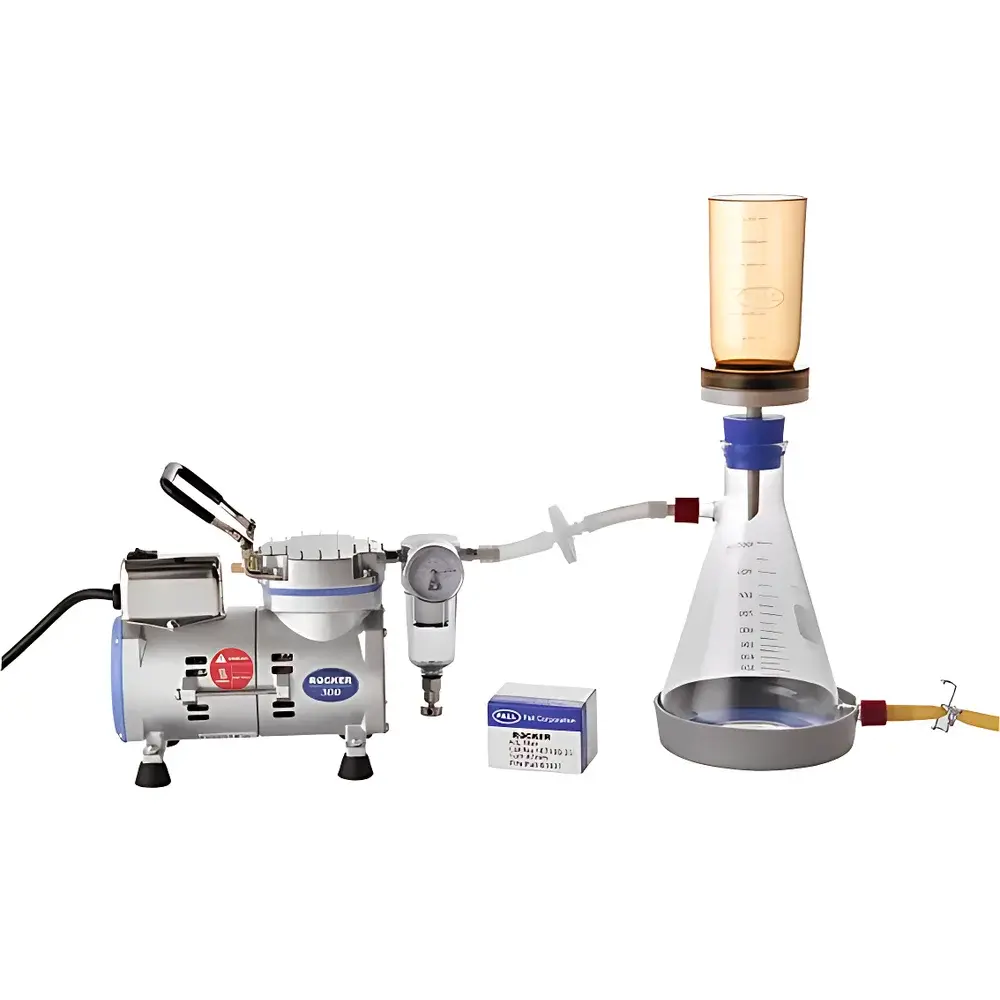
Rocker 300SS Vacuum Filtration System
| Brand | ROCKER |
|---|---|
| Origin | Taiwan |
| Model | Rocker 300SS |
| Pump Type | Oil-Free Piston Vacuum Pump |
| Filtration Capacity | Dual-Position (2-Filter Setup) |
| Filter Support | Magnetic Funnel Mounting |
| Included Components | VF1 Glass Filtration Flask Assembly, 47 mm × 1 µm Glass Fiber Filter Paper, 25 mm × 0.2 µm PTFE Disc Filter, High-Pressure Silicone Tubing (1 m) |
| Vacuum Performance | ≤80 mbar (absolute), Flow Rate: ≥20 L/min |
| Compliance | CE, RoHS |
| Warranty | 2-Year Parts Coverage |
Overview
The Rocker 300SS Vacuum Filtration System is an engineered solution for routine suspended solids (SS) analysis and general laboratory liquid clarification in environmental, wastewater, food safety, and academic research laboratories. Designed around a dry-running, oil-free piston vacuum pump, the system eliminates hydrocarbon contamination risks associated with traditional oil-lubricated pumps—ensuring sample integrity during gravimetric SS determination per standard methods including ASTM D5907, ISO 11923, and EPA Method 160.1. Its integrated dual-position filtration architecture supports parallel or sequential processing of up to two samples using standardized 47 mm filter membranes, enabling efficient throughput while maintaining procedural consistency across replicates. The system operates at a stable ultimate vacuum of ≤80 mbar (absolute) with a nominal free-air flow rate of ≥20 L/min—sufficient to achieve rapid filtration of low-to-medium viscosity aqueous matrices without membrane rupture or premature clogging.
Key Features
- Magnetic Funnel Mounting System: Eliminates mechanical clamps and threaded adapters; enables tool-free, repeatable alignment and secure sealing between the filtration funnel and flask assembly—reducing setup time and operator-induced variability.
- Oil-Free Piston Pump Architecture: Utilizes precision-machined ceramic-coated pistons and polymer seals; requires zero lubricating oil, thereby eliminating oil mist carryover, cross-contamination risk, and scheduled oil replenishment or replacement.
- Low-Noise, Low-Vibration Operation: Direct-drive motor coupling (no belt or gear transmission) combined with internal acoustic damping and elastomeric mounting isolates mechanical resonance; sound pressure level <52 dB(A) at 1 m distance—suitable for shared lab environments and laminar flow hoods.
- Integrated Inlet Air Filtration: Each pump unit includes a replaceable sintered polyethylene inlet filter rated for particulate removal down to 5 µm and moisture absorption; protects internal cylinder walls and piston surfaces from abrasive wear and condensation-induced corrosion.
- Dual-Position Filtration Platform: Accommodates simultaneous use of two 47 mm filters (e.g., glass fiber pre-filter + PTFE final filter) or independent parallel runs; compatible with standard AOAC, APHA, and USP-compliant filtration accessories.
Sample Compatibility & Compliance
The Rocker 300SS is validated for use with aqueous, mildly acidic or basic (pH 2–10), and low-organic-content solutions typical in municipal wastewater, surface water, drinking water, and biological supernatants. It supports filter media certified for total suspended solids (TSS) quantification—including Grade GF/C and GF/F glass microfiber discs (1 µm retention), as well as hydrophobic PTFE membranes (0.2 µm) for sterile or particulate-sensitive applications. All wetted components (VF1 borosilicate glass flask, PTFE funnel, silicone tubing) comply with USP Class VI biocompatibility requirements. The system meets CE marking directives (2014/30/EU EMC, 2014/35/EU LVD) and RoHS 2011/65/EU restrictions on hazardous substances—supporting GLP-aligned documentation workflows and audit-ready lab operations.
Software & Data Management
As a manually operated, non-digital vacuum platform, the Rocker 300SS does not incorporate embedded firmware, touchscreens, or data logging capabilities. This design prioritizes operational simplicity, long-term reliability, and regulatory transparency—eliminating validation overhead associated with electronic recordkeeping. Users maintain full control over filtration timing, vacuum onset, and endpoint judgment in accordance with SOP-defined visual or gravimetric endpoints. For labs implementing 21 CFR Part 11 compliance, manual logbook entries—including batch ID, operator initials, date/time, filter lot numbers, and final dry weight—are fully traceable and auditable without software dependency.
Applications
- Gravimetric determination of total suspended solids (TSS) and volatile suspended solids (VSS) in wastewater influent/effluent per EPA 160.1 and ISO 11923.
- Clarification of cell culture supernatants prior to ELISA, HPLC, or mass spectrometry analysis.
- Pre-filtration of environmental water samples before heavy metal analysis (ICP-MS/OES) or nutrient assays (e.g., nitrate, phosphate).
- Routine removal of precipitates or particulates from buffers, reagents, and extraction solvents in molecular biology and biochemistry workflows.
- Supporting ASTM D5907 (Total Solids in Water) and APHA Standard Methods 2540D for solid residue recovery.
FAQ
What vacuum level does the Rocker 300SS achieve, and how is it measured?
The pump delivers a stable ultimate vacuum of ≤80 mbar (absolute), verified using a calibrated digital pressure transducer traceable to NIST standards.
Is the system suitable for filtering organic solvents?
No—silicone tubing and standard glass fiber filters are incompatible with chlorinated or ketonic solvents; alternative fluoropolymer-compatible configurations require custom component selection.
Can I use other filter diameters or retention ratings?
Yes—the VF1 flask accepts any 47 mm disc filter; however, only 1 µm glass fiber and 0.2 µm PTFE discs are supplied as standard. Other pore sizes (e.g., 0.45 µm nylon) may be used if chemically compatible.
Does the 2-year warranty cover labor or only parts?
The warranty covers parts replacement only; labor and field service are available under separate support agreements.
How often should the inlet air filter be replaced?
Under normal lab conditions (non-dusty environment), replacement is recommended every 6–12 months or when visible particulate loading occurs—documented in maintenance logs per GLP requirements.
Related Products




