
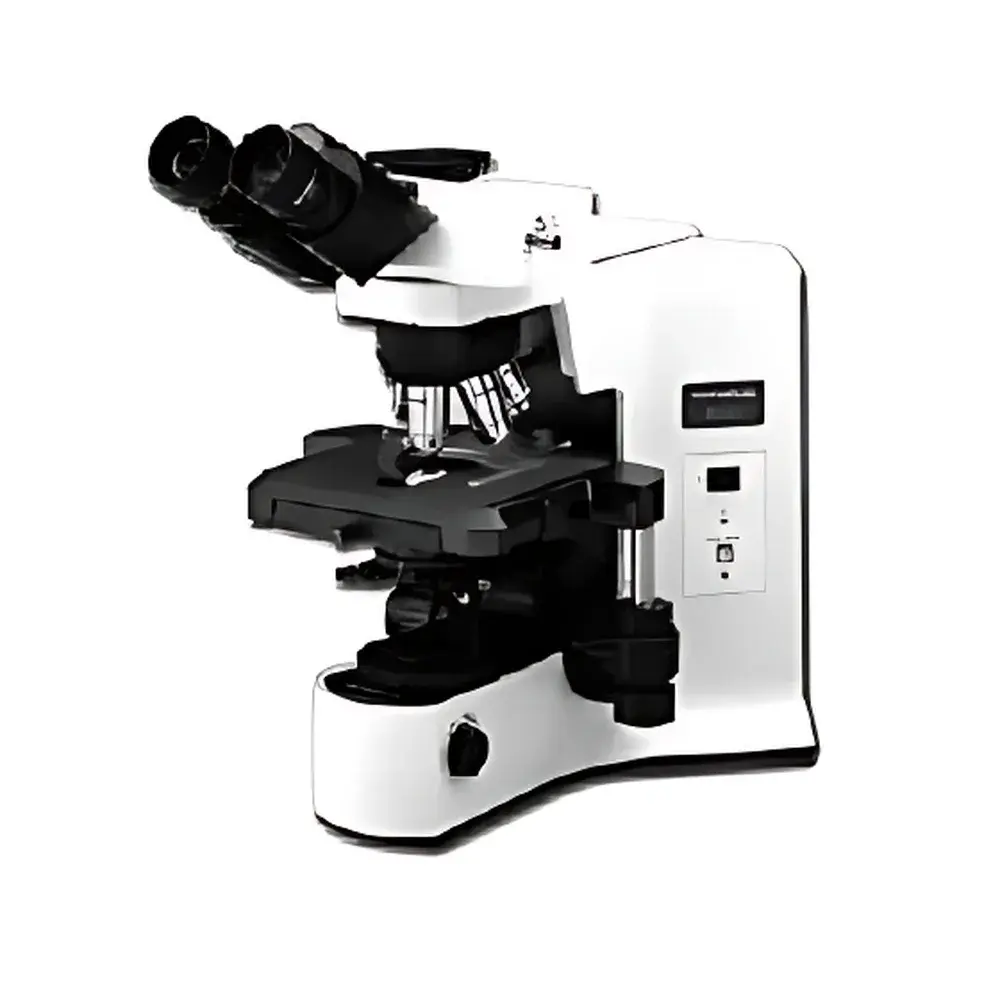
OLYMPUS BX41 Research-Grade Biological Microscope
| Brand | OLYMPUS |
|---|---|
| Origin | Japan |
| Model | BX41 |
| Light Source | 6 V / 30 W Halogen Illuminator |
| Optical System | UIS2 (Universal Infinity System) |
| Observation Tube Options | Binocular, Tilting Binocular, Trinocular |
| Objective Turret | 5-Position Revolving Nosepiece |
| Compliance | ISO 9001, JIS B 7151, CE Marked for In Vitro Diagnostic Use |
| Software Compatibility | Supports Olympus cellSens™ and third-party DICOM/GLP-compliant image acquisition platforms |
| Regulatory Status | Designed for research use only (RUO), not for clinical diagnostic use per FDA 21 CFR §809.3(a) |
Overview
The OLYMPUS BX41 is a modular, research-grade upright biological microscope engineered for high-fidelity brightfield, phase contrast, and fluorescence imaging in life science laboratories. Built upon the UIS2 (Universal Infinity System) optical platform, it delivers consistent chromatic and spherical aberration correction across magnifications from 40× to 1000×, enabling reproducible quantitative analysis of fixed and live specimens. Its rigid, low-vibration mechanical stage and precision-machined aluminum frame provide long-term dimensional stability—critical for time-lapse imaging, multi-position scanning, and co-localization studies. Unlike teaching or routine QC microscopes, the BX41 features an integrated Köhler illumination path with adjustable field and aperture diaphragms, ensuring optimal contrast, resolution, and illumination uniformity per ISO 10934-1 standards. The system supports both manual and motorized configurations, allowing seamless integration into automated workflows without compromising optical fidelity.
Key Features
- UIS2 infinity-corrected optical system with ≥98% transmission efficiency across visible spectrum (400–700 nm), optimized for digital imaging and photometric quantification
- 5-position objective turret with precise mechanical indexing and parfocal alignment tolerance ≤ ±0.01 mm
- Adjustable binocular observation tube (incl. tilting variants) compliant with ISO 14738 ergonomics guidelines for prolonged operator use
- Dedicated phase contrast modules (e.g., PHD-P11) supporting PLN series phase objectives (10×PH, 20×PH, 40×PH, 100×PH oil) with centering telescopes for rapid alignment
- Fluorescence-ready configuration (FLB3 variant) with six-position excitation filter turret, dual-band dichroic mirrors, and 100 W mercury arc lamp housing meeting IEC 62471 photobiological safety Class 3R requirements
- Modular trinocular port supporting C-mount adapters (1×/0.5×/0.35× reduction) for compatibility with sCMOS, EMCCD, and scientific CMOS cameras
- Standardized mounting interfaces (M27×0.75, M32×0.75) for DIC prisms, polarizers, and darkfield condensers including U-DCD dry darkfield unit for 10×–40× objectives
Sample Compatibility & Compliance
The BX41 accommodates standard 24 × 50 mm and 26 × 76 mm glass slides, Petri dishes (up to 100 mm diameter), and multi-well plates (6–96-well) via optional mechanical stage extensions. Its condenser height adjustment range (0–30 mm) supports thick tissue sections, organotypic cultures, and small model organisms (e.g., zebrafish embryos, C. elegans). All optical components are certified to JIS B 7151 (Japanese Industrial Standard for Microscopes) and conform to ISO 9001:2015 manufacturing controls. For regulated environments, the BX41 meets GLP audit requirements when paired with Olympus cellSens software configured with 21 CFR Part 11-compliant electronic signatures, audit trails, and user access controls. It is designated RUO (Research Use Only) under FDA guidance and excludes IVD claims unless validated with specific assay kits.
Software & Data Management
The BX41 integrates natively with Olympus cellSens Dimension software, providing calibrated measurement tools (area, length, intensity profiling), Z-stack reconstruction, multi-channel fluorescence registration, and batch processing via macro scripting (VBScript/Python API). Raw image data is saved in TIFF or OIB formats with embedded metadata (objective ID, exposure time, gain, illumination intensity), ensuring traceability per ALCOA+ principles. Third-party compatibility includes NIS-Elements (Nikon), ZEN Blue (Zeiss), and open-source platforms such as QuPath and ImageJ/Fiji through TWAIN and GenICam drivers. Exported datasets comply with MIAME and MIAPE reporting standards for publication-ready figure generation.
Applications
- Histopathology training and frozen section evaluation using brightfield and H&E-stained slides
- Live-cell phase contrast imaging of adherent mammalian cultures (e.g., HeLa, NIH/3T3) and suspension cells (e.g., Jurkat, primary lymphocytes)
- Fluorescence colocalization assays with FITC/TRITC/DAPI triple labeling in immunocytochemistry
- Microbial morphology assessment—including Gram staining, acid-fast staining, and fungal hyphae visualization
- Developmental biology studies requiring extended observation of embryonic structures under low-phototoxicity conditions
- Educational use in university core facilities where modularity supports curriculum-driven configuration changes (e.g., adding DIC or polarizing kits)
FAQ
Is the BX41 compatible with modern digital cameras?
Yes—the trinocular port accepts standard C-mount adapters with 1×, 0.5×, or 0.35× relay optics, supporting sensor sizes up to 22 mm diagonal (e.g., Hamamatsu ORCA-Fusion BT, Photometrics Prime 95B).
Can I upgrade a basic BX41 to fluorescence capability?
Yes—FLB3 fluorescence kits include excitation filter turret, dichroic mirror slider, barrier filters, and lamp housing; retrofit requires no optical realignment.
Does the BX41 support differential interference contrast (DIC)?
Yes—BX2-DIC-F04 and BX61-DIC-S08 accessories provide full Nomarski DIC with strain-free Wollaston prisms matched to UIS2 objectives.
What is the maximum working distance for oil immersion objectives?
PLN100×OH2 (oil) offers 0.13 mm working distance; all UIS2 oil objectives feature spring-loaded front lenses and anti-fungal coating per ISO 8573-1 Class 2 purity standards.
Is service and calibration available outside Japan?
OLYMPUS authorized service centers in North America, EMEA, and APAC perform ISO/IEC 17025-accredited optical alignment, illumination uniformity verification, and mechanical stage calibration.




