
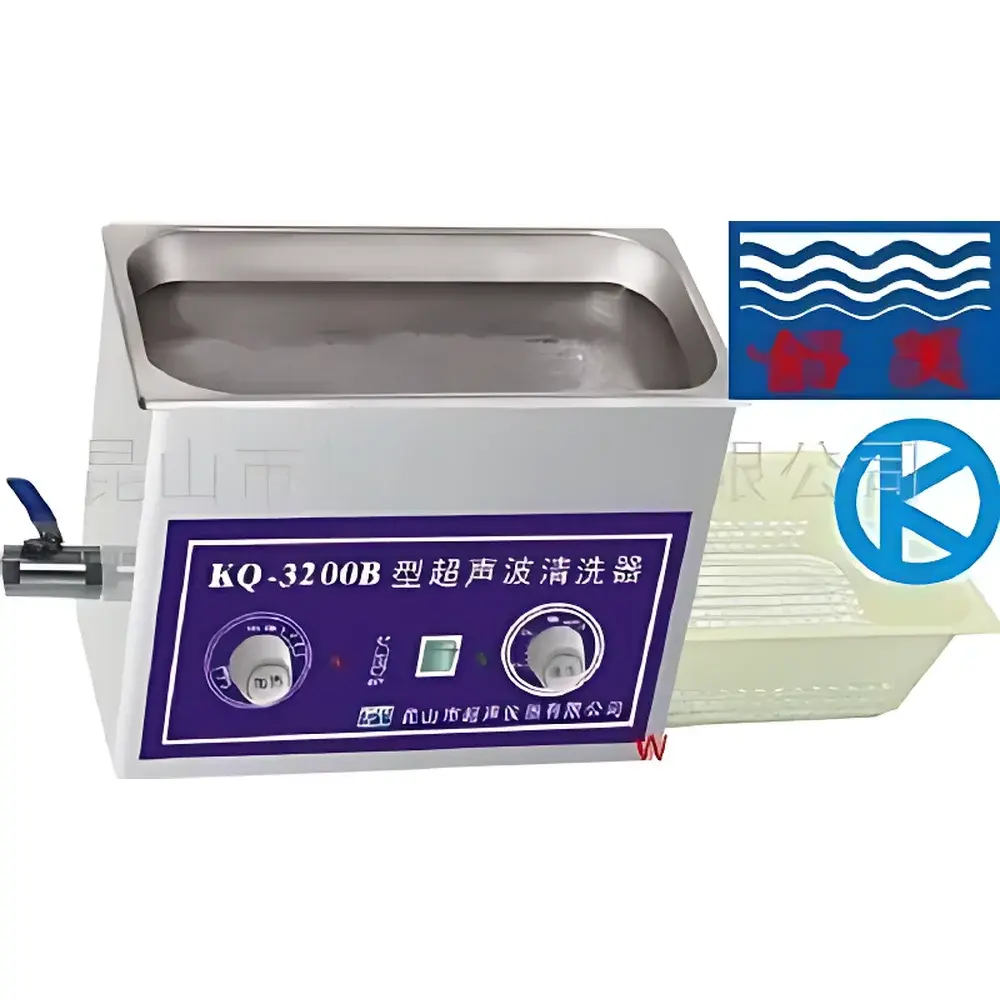
Shumei KQ-3200B Benchtop Ultrasonic Cleaner
| Brand | Shumei |
|---|---|
| Origin | Jiangsu, China |
| Model | KQ-3200B |
| Capacity | 6 L |
| Ultrasonic Frequency | 40 kHz |
| Ultrasonic Power | 150 W |
| Adjustable Power | No |
| Temperature Range | Ambient to 80 °C |
| Heating Power | 400 W |
| Timer Range | 1–20 min |
| Built-in Basket | Yes |
| Drain Valve | Manual |
| External Dimensions (L×W×H) | 320 × 174 × 320 mm |
| Tank Internal Dimensions (L×W×H) | 300 × 150 × 150 mm |
| Construction | Stainless Steel Tank & Housing (except select entry models) |
| Compliance | CE-marked for laboratory use in EU markets |
Overview
The Shumei KQ-3200B is a compact, benchtop ultrasonic cleaner engineered for precision cleaning, degassing, and sample preparation in academic laboratories, quality control environments, and R&D facilities. It operates on the principle of ultrasonic cavitation—where high-frequency sound waves (40 kHz) generate microscopic vacuum bubbles in aqueous or mild solvent-based cleaning solutions; their rapid collapse produces localized high-pressure shockwaves that dislodge particulate contaminants, biofilms, and residues from intricate surfaces without mechanical abrasion. This physics-based cleaning mechanism ensures reproducible, non-destructive treatment of delicate components such as optical lenses, microfluidic chips, HPLC columns, surgical instruments, printed circuit boards, and biological substrates. Designed for routine operation under ambient conditions, the unit integrates a thermostatically controlled heating system (ambient to 80 °C), enabling temperature-assisted cleaning protocols aligned with ASTM D2609 (Standard Practice for Ultrasonic Cleaning of Metal Parts) and ISO 13485-compliant device reprocessing workflows.
Key Features
- Integrated transducer design: Three 50-W piezoelectric transducers mounted directly to the stainless steel tank bottom ensure uniform energy distribution across the entire 6-L cleaning volume.
- Stainless steel construction: The tank and outer housing are fabricated from grade 304 stainless steel—resistant to corrosion from common alkaline and neutral detergents, compatible with autoclave-compatible cleaning agents, and compliant with GLP facility material requirements.
- Precise thermal control: A PID-regulated heating system maintains setpoint accuracy within ±2 °C over the full 20–80 °C operating range; heating power is rated at 400 W for rapid solution equilibration.
- Digital timer with memory function: Programmable cleaning duration from 1 to 20 minutes; auto-shutdown prevents overexposure and supports unattended operation during routine batch processing.
- Removable stainless steel mesh basket: Facilitates safe handling of fragile or small-part loads (e.g., watch components, dental tools, semiconductor wafers) while minimizing direct contact with tank walls.
- Manual drain valve: Located at the tank base for controlled solution removal—compatible with lab waste disposal protocols and routine maintenance cycles.
Sample Compatibility & Compliance
The KQ-3200B accommodates a broad spectrum of sample geometries and materials, including glassware (vials, cuvettes, pipette tips), metal instruments (tweezers, forceps, biopsy punches), ceramic substrates, and polymer-based microdevices. It is validated for use with standard ultrasonic cleaning solutions meeting ASTM E1212 (Standard Guide for Quality Assurance of Ultrasonic Cleaning Equipment) guidelines. While not certified for sterile reprocessing per ISO 17664 or FDA 510(k), its thermal and temporal parameters support pre-sterilization cleaning steps in ISO 13485-certified medical device manufacturing and USP compounding workflows. The unit carries CE marking for electromagnetic compatibility (EMC Directive 2014/30/EU) and low-voltage safety (LVD Directive 2014/35/EU), confirming conformity with essential health and safety requirements for laboratory equipment in the European Economic Area.
Software & Data Management
As a standalone analog-digital hybrid instrument, the KQ-3200B does not incorporate embedded firmware, network connectivity, or electronic data logging. All operational parameters—temperature setpoint, timer value, and power activation—are controlled via front-panel rotary dials and push-button switches. This architecture eliminates software validation overhead and aligns with facilities requiring minimal computerized system validation (CSV) burden under FDA 21 CFR Part 11 Annex 11 or EU GMP Annex 11. Process records (e.g., cleaning cycle logs, maintenance dates) must be manually documented in laboratory notebooks or LIMS-integrated forms to satisfy audit readiness for ISO/IEC 17025 accreditation.
Applications
- Pre-analytical sample preparation: Removal of organic residue from GC vials, LC-MS autosampler trays, and electrophoresis combs.
- Microelectronics: Particle removal from photomasks, wafer carriers, and solder paste stencils prior to inspection.
- Materials science: Degassing of nanoparticle suspensions and ceramic slurries before sintering or coating.
- Life sciences: Cell lysate clarification, tissue homogenate debubbling, and microcentrifuge tube decontamination.
- Calibration & metrology: Cleaning of reference standards, gauge blocks, and interferometry optics without surface scratching.
FAQ
Is the KQ-3200B suitable for cleaning delicate optical components?
Yes—when operated at 40 kHz with low-surface-tension, non-ionic detergent solutions and controlled temperature (≤45 °C), it effectively removes submicron contaminants without damaging coated lenses or fused silica substrates.
Can this unit be used with flammable solvents?
No—this model lacks explosion-proof certification and is intended exclusively for aqueous or water-miscible solutions. Flammable solvent use violates IEC 61010-1 safety requirements and voids warranty.
Does the unit include a degassing mode?
While not labeled as a dedicated “degas” function, initiating ultrasonication at ambient temperature for 2–3 minutes prior to heating achieves effective dissolved gas removal from cleaning baths.
What maintenance is required for long-term reliability?
Monthly inspection of the drain valve seal integrity, quarterly descaling of the heater element using 5% citric acid solution, and annual verification of transducer adhesion integrity using impedance testing per ASTM E1001.



