
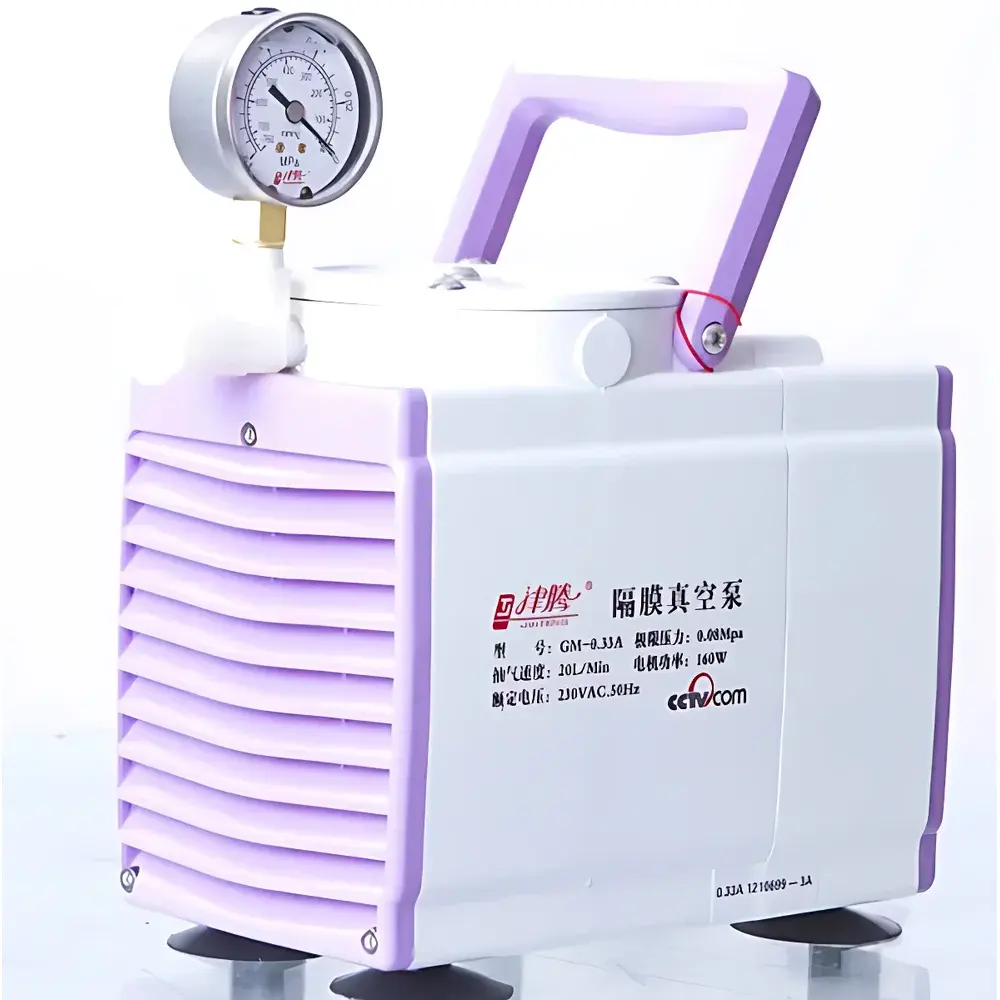
JINTENG GM-0.33A Diaphragm Vacuum Pump
| Brand | JINTENG |
|---|---|
| Origin | Tianjin, China |
| Model | GM-0.33A |
| Pump Type | Oil-Free Diaphragm Vacuum Pump |
| Ultimate Vacuum | 200 mbar |
| Flow Rate | 20 L/min |
| Motor Power | 60 W |
| Dimensions (L×W×H) | 235 × 120 × 215 mm |
| Weight | 7.5 kg |
| Inlet/Outlet Port Diameter | Ø6 mm |
| Operating Temperature Range | 7–40 °C |
| Maximum Pump Surface Temperature | <60 °C |
| Noise Level | <55 dB(A) |
| Compliance | CE-marked for laboratory use under IEC 61000-6-3 & IEC 61000-6-2 |
Overview
The JINTENG GM-0.33A Diaphragm Vacuum Pump is an oil-free, corrosion-resistant laboratory vacuum source engineered for reliable, maintenance-free operation in analytical and preparative workflows. Utilizing a precision-machined PTFE-coated diaphragm and stainless steel valve assembly, it generates consistent negative pressure via reciprocating mechanical displacement—eliminating hydrocarbon contamination risks associated with rotary vane or piston pumps. Its ultimate vacuum of 200 mbar (≈150 Torr) and stable 20 L/min free-air flow rate make it suitable for moderate-vacuum applications including solvent evaporation, vacuum filtration, degassing of solvents or samples, and as a dedicated vacuum supply for HPLC degassers, GC autosamplers, and benchtop vacuum ovens. The pump operates without lubricants or cooling fluids, ensuring compliance with ISO 8573-1 Class 0 air purity requirements for instrument-grade vacuum environments.
Key Features
- Oil-free diaphragm technology ensures zero hydrocarbon carryover—critical for trace-level analysis in pharmaceutical QC, environmental testing, and forensic chemistry.
- Die-cast aluminum housing with epoxy-polyester anti-corrosion coating provides structural rigidity, thermal stability, and resistance to organic solvents and acidic vapors.
- Low-noise operation (<55 dB[A] at 1 m) enables integration into shared laboratory spaces, laminar flow hoods, and ISO Class 5–7 cleanrooms without acoustic interference.
- Thermally protected 60 W induction motor delivers high torque at low RPM, minimizing mechanical wear and extending service life beyond 10,000 hours under continuous duty.
- Compact footprint (235 × 120 × 215 mm) and lightweight design (7.5 kg) support flexible placement on lab benches, inside fume hoods, or integrated into OEM analytical platforms.
- Standardized Ø6 mm barbed inlet/outlet ports accept common Tygon® or Viton® tubing (ID 4–6 mm), compatible with standard vacuum manifolds, filter flasks, and trap assemblies.
Sample Compatibility & Compliance
The GM-0.33A is designed for non-aggressive vapor environments typical of aqueous, alcoholic, and moderately polar organic solvent systems (e.g., methanol, acetonitrile, ethyl acetate). It is not rated for halogenated solvents (e.g., chloroform, DCM), strong oxidizers (e.g., nitric acid fumes), or condensable vapors exceeding 30% relative humidity at operating temperature. The pump meets electromagnetic compatibility (EMC) requirements per IEC 61000-6-3 (emission) and IEC 61000-6-2 (immunity), and carries CE marking for conformity with the EU Machinery Directive 2006/42/EC and Low Voltage Directive 2014/35/EU. While not certified to UL/CSA standards, its construction aligns with general laboratory safety practices outlined in ANSI Z9.5–2022 (Laboratory Ventilation) and ISO/IEC 17025:2017 clause 6.4.3 (equipment suitability verification).
Software & Data Management
As a standalone analog vacuum source, the GM-0.33A operates without embedded firmware, digital interfaces, or data logging capabilities. It features a single-pole single-throw (SPST) mains switch and requires no software configuration or driver installation. This architecture eliminates cybersecurity vulnerabilities, avoids firmware update dependencies, and ensures deterministic response time—making it ideal for GLP/GMP-regulated environments where auditability and operational transparency are prioritized over automation. Users may integrate it with external vacuum controllers (e.g., pressure transducers + PID modules) for closed-loop regulation, provided third-party hardware complies with IEC 61508 functional safety requirements.
Applications
- Vacuum-assisted filtration of biological suspensions, particulate-laden water samples, and precipitated APIs using Buchner or Hirsch funnels.
- Removal of dissolved gases from mobile phase solvents prior to HPLC or UHPLC analysis—reducing baseline noise and preventing bubble formation in detectors.
- Supporting solid-phase extraction (SPE) manifold systems requiring stable sub-atmospheric pressure across multiple cartridges.
- Providing primary vacuum for rotary evaporators operating above 40 °C bath temperature (when paired with cold traps).
- Enabling vacuum desiccation of hygroscopic reference standards and calibration materials in analytical balance enclosures.
- Serving as backup vacuum for mass spectrometer roughing lines in multi-instrument labs where intermittent duty suffices.
FAQ
Is the GM-0.33A suitable for use with aggressive solvents such as chloroform or acetone?
No. The diaphragm material (nitrile rubber composite) and internal valve seals are not chemically resistant to halogenated or highly volatile ketones. Use only with alcohols, esters, and low-polarity hydrocarbons below their dew point.
Can this pump achieve high vacuum (<1 mbar)?
No. With a rated ultimate vacuum of 200 mbar, it is intended for rough vacuum applications only. For high-vacuum needs, a two-stage rotary vane or turbomolecular pump is required.
Does the pump include a built-in vacuum gauge or pressure regulator?
No. It is a fixed-output vacuum source. External analog or digital vacuum gauges (e.g., capacitance manometers) must be installed upstream for process monitoring.
What is the recommended maintenance interval?
Under normal laboratory conditions, inspect inlet filters quarterly and replace the diaphragm every 12–18 months based on cumulative runtime—no routine oil changes or bearing servicing required.
Is the GM-0.33A compliant with FDA 21 CFR Part 11 for electronic records?
Not applicable—the device contains no electronic data storage, user-accessible software, or audit trail functionality. It satisfies predicate rule requirements for “simple instruments” under Annex 11 guidance when used in validated processes.



