
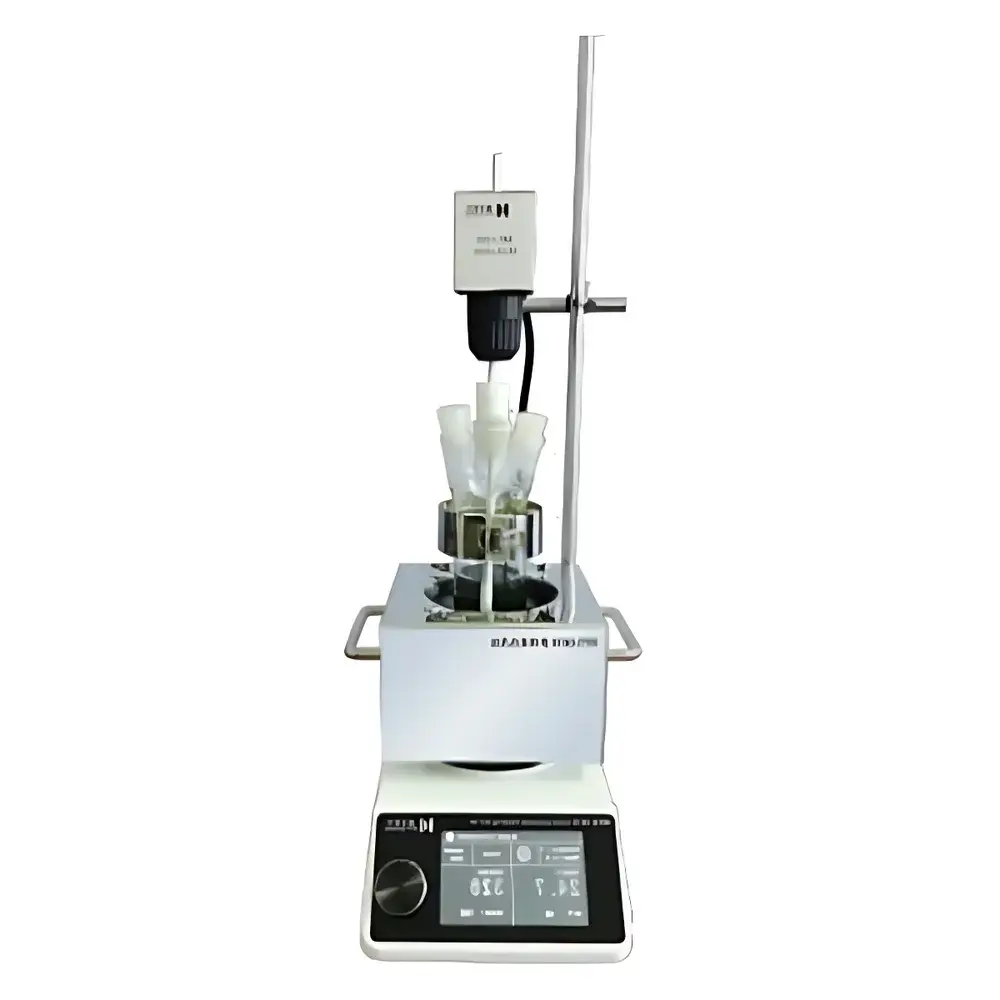
Hanking MTS-6610 Multifunctional Synthesis Platform
| Brand | Hanking |
|---|---|
| Origin | China |
| Manufacturer Type | Authorized Distributor |
| Model | MTS-6610 |
| Capacity | 1 mL to 1000 mL (interchangeable reactor vessels) |
| Temperature Range | −40 °C to 250 °C |
| Control Modes | 6 programmable heating profiles (2 rapid, 2 precise, 2 ramp-hold sequences) |
| Stirring | Dual-mode — high-energy magnetic stirring + modular mechanical stirring with penetrable shaft design |
| Optional Module | External cryogenic coolant circulation unit (compatible with −40 °C isothermal control and automated ramp/soak protocols) |
Overview
The Hanking MTS-6610 Multifunctional Synthesis Platform is an engineered solution for modern synthetic chemistry laboratories requiring scalable, reproducible, and thermally precise reaction execution. Built upon a fixed-heating modular architecture, the system decouples thermal actuation from vessel geometry—enabling seamless interchange of reactor vessels ranging from 1 mL micro-vials to 1000 mL jacketed glass reactors without recalibration or hardware reconfiguration. This design eliminates the need for multiple dedicated instruments across synthesis scales, supporting both discovery-phase screening and process-development workflows within a single platform. Its core operation relies on closed-loop PID temperature regulation enhanced by AI-fused adaptive algorithms, coupled with real-time thermal load compensation via an integrated refrigerant flow control valve. The platform operates under principles consistent with ASTM E2913 (Standard Practice for Thermal Stability Testing) and supports GLP-compliant experimental documentation when paired with validated software modules.
Key Features
- Dual Stirring Architecture: Independent selection between high-magnetic-energy stirring (≥800 G·cm³ energy product) for low-to-medium viscosity media and a mechanically driven stirrer with interchangeable shafts and impeller geometries—optimized for viscous slurries, heterogeneous catalysis, or crystallization suspensions.
- Thermal Flexibility: Six preconfigured heating profiles—including two rapid-ramp modes (up to 15 °C/min), two high-stability isothermal modes (<±0.3 °C deviation over 2 h), and two multi-segment program modes with up to 10 ramp/hold steps—each fully editable via touchscreen interface.
- Modular Vessel Compatibility: Standardized quick-lock flange interface accommodates borosilicate glass, PTFE-lined, and Hastelloy-C276 reactors (1–1000 mL); all vessels maintain identical thermal coupling efficiency and pressure rating (≤10 bar at 200 °C).
- Intelligent Human-Machine Interface: 7-inch capacitive touchscreen with haptic feedback and rotary encoder for parameter fine-tuning; supports multi-user login, password-protected method storage, and audit-trail logging per FDA 21 CFR Part 11 requirements when connected to compliant LIMS.
- Cryogenic Expansion Capability: Optional external refrigerant circulation module (R-404A or R-507 compatible) enables sub-ambient isothermal control (−40 °C), exotherm suppression during Grignard or lithiation reactions, and automated cooling ramps down to −20 °C/min.
Sample Compatibility & Compliance
The MTS-6610 accommodates diverse chemistries including air/moisture-sensitive organometallic transformations (under inert gas purge via standard Schlenk ports), acid-catalyzed esterifications, base-mediated condensations, and solid-liquid heterogeneous catalysis. All wetted parts comply with USP Class VI biocompatibility standards and ISO 10993-5 cytotoxicity testing. Reactor vessels meet ASTM E2872 specifications for laboratory glassware dimensional tolerances and thermal shock resistance. The platform’s firmware and optional data acquisition software are designed to support 21 CFR Part 11 electronic signatures, ALCOA+ data integrity principles, and ISO/IEC 17025 traceability frameworks when deployed in regulated QC/QA environments.
Software & Data Management
The embedded control firmware supports CSV export of time-stamped temperature, stirring speed, and setpoint logs. When interfaced with Hanking’s optional SynthTrack™ Desktop Suite (v3.2+), users gain access to automated DOE template generation (based on ICH Q5C guidelines), batch-level metadata tagging, version-controlled method libraries, and PDF report generation with digital signature fields. Raw sensor data is stored locally in encrypted SQLite format with SHA-256 checksum verification; cloud synchronization (AWS S3-backed) is available under GxP-configured deployment models.
Applications
- Lead compound optimization through parallel synthesis of 4–12 variants under identical thermal/stirring conditions
- Reaction calorimetry screening using controlled exotherm capture via integrated temperature derivative analysis
- Solvent/catalyst matrix evaluation in early-stage route scouting (e.g., Buchwald-Hartwig amination solvent space mapping)
- Crystallization kinetics studies with programmable anti-solvent addition timing synchronized to temperature hold phases
- Scale-down validation for API manufacturing processes per ICH Q8(R2) Quality by Design principles
- High-throughput catalyst immobilization experiments requiring precise thermal ramping under nitrogen blanket
FAQ
What vessel sizes are supported without recalibration?
All vessels from 1 mL vials to 1000 mL reactors are calibrated as a unified thermal system; no recalibration is required when switching volumes.
Is the platform compatible with glovebox integration?
Yes—the main unit features sealed feedthroughs for inert gas lines, electrical conduits, and optional vacuum manifolds; full integration kits are available for MBraun and Vacuum Atmospheres gloveboxes.
Can temperature profiles be exported and shared between instruments?
Yes—profile files (.synthp) are cross-platform compatible across all MTS-66xx series instruments and support version-controlled repository management via Git-based workflow plugins.
Does the mechanical stirrer support overhead drive coupling?
No—the mechanical stirrer uses a vertically aligned, motor-integrated shaft design; overhead coupling is not supported. For larger-scale agitation, users should select the 500–1000 mL reactor configuration with optimized impeller geometry.
What refrigerants are approved for use with the optional cold module?
R-404A, R-507, and R-134a are certified; use of non-approved refrigerants voids warranty and violates ASHRAE Standard 15 safety compliance.
Related Products



