
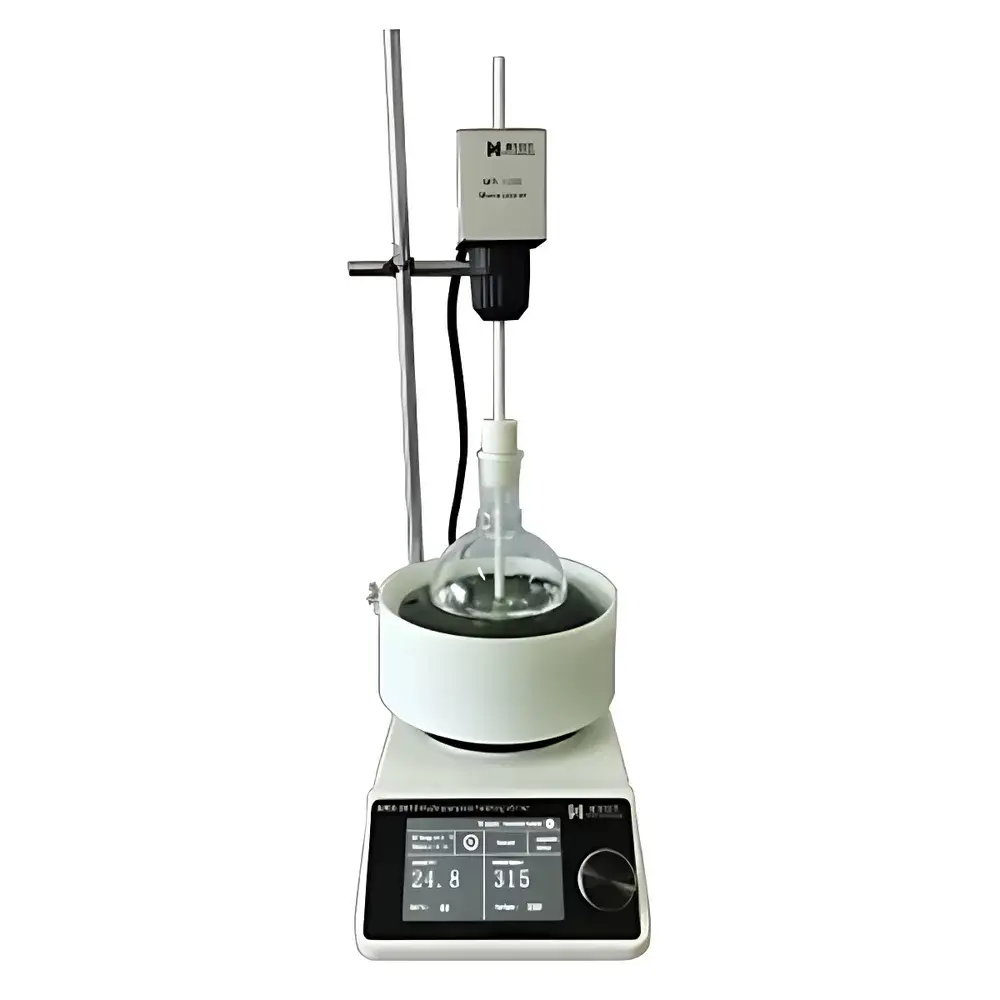
Hanking HTC Series Dry-Block Heating Stirrer
| Brand | Hanking |
|---|---|
| Origin | Shanghai, China |
| Model | HTC Series |
| Stirring Capacity | 25–2000 mL |
| Heating Method | Dry-block (aluminum block), oil-free and water-free |
| Control Unit | MRS-2610 Integrated Temperature & Speed Controller |
| Stirring Mechanism | Dual-motor MR-1200 Mechanical Stirrer |
| Block Material | Anodized Aluminum with Hard-Coated Surface |
| Safety Cover | PTFE-coated Transparent Shield |
| Compliance | Designed for GLP-compliant labs |
Overview
The Hanking HTC Series Dry-Block Heating Stirrer is an integrated laboratory instrument engineered for simultaneous precise temperature control and robust mechanical agitation in sealed or open-vessel configurations. Unlike conventional oil or water baths, this system employs a solid-state aluminum heating block—thermally optimized via anodization and hard-surface coating—to deliver rapid, uniform heat transfer without thermal fluid hazards. Its operational principle combines Peltier-assisted or resistive heating (depending on configuration) with dual independent motor-driven stirring, enabling reproducible kinetic control over heterogeneous reactions, dissolution studies, polymerization initiations, and temperature-dependent solubility assessments. The system is designed for continuous-duty operation at temperatures up to 150 °C (configurable range), supporting both single-point and multi-vessel parallel processing under stable thermal gradients (<±0.3 °C stability at setpoint). It serves as a core platform for synthetic chemistry, pharmaceutical process development, and materials science laboratories where trace contamination, fire risk, and operator exposure must be minimized.
Key Features
- Dry-block heating architecture eliminates flammable oil media and water-based corrosion risks—fully compliant with OSHA 1910.1200 and CLP hazard communication standards.
- Modular anodized aluminum block with ceramic-reinforced surface coating ensures long-term thermal stability, chemical resistance to acids/bases (pH 2–12), and electrical insulation (>10⁹ Ω).
- MRS-2610 digital controller provides dual-channel PID regulation: independent real-time monitoring of block temperature and stirring speed (0–1200 rpm), with ±0.1 °C resolution and ±0.5 °C accuracy.
- MR-1200 dual-drive stirrer supports coaxial or offset shaft configurations; accommodates magnetic stir bars (optional) and mechanical impellers (Rushton, pitched-blade, anchor types) via standardized 10 mm hex coupling.
- PTFE-coated transparent safety shield meets EN 61000-6-3 EMC requirements and provides splash containment, vapor suppression, and UV-blocking transparency for visual reaction monitoring.
- Programmable ramp-soak profiles (up to 10 segments) with auto-hold and end-of-cycle alarm—exportable timestamped logs support 21 CFR Part 11 audit trails when paired with validated LIMS interfaces.
Sample Compatibility & Compliance
The HTC Series accommodates standard laboratory glassware (round-bottom flasks, screw-cap vials, jacketed reactors) from 25 mL to 2000 mL volumes. Block inserts are available in borosilicate glass, stainless steel (316L), and PTFE-lined variants for aggressive reagents (e.g., HF, fuming nitric acid). All electrical components conform to IEC 61010-1:2010 safety standards for laboratory equipment. The system supports GLP documentation through CSV-validated firmware (v3.2+), including electronic signature capability, user access levels (admin/operator/auditor), and immutable event logging. It is routinely deployed in facilities operating under ISO 9001, ISO 14001, and USP analytical instrument qualification frameworks.
Software & Data Management
The MRS-2610 controller features RS-485 Modbus RTU and USB-C connectivity for integration into centralized lab automation networks. Optional PC software (HTC-Control Suite v2.4) enables remote parameter setting, real-time graphing of temperature/stir speed vs. time, and automated report generation in PDF/XLSX formats compliant with ALCOA+ data integrity principles. All raw sensor outputs—including thermocouple voltage, motor current draw, and encoder pulse counts—are recorded at 1 Hz sampling rate and stored locally on removable microSD card (included). Audit trail metadata includes operator ID, timestamp, parameter change reason code, and checksum-verified file integrity.
Applications
- Parallel synthesis of small-molecule APIs under controlled thermal profiles (ASTM E2892-21 reaction calorimetry support mode).
- Hydrothermal nanomaterial synthesis requiring sustained 120–140 °C conditions with shear-sensitive nucleation control.
- Enzymatic digestion protocols demanding precise 37 °C maintenance with gentle orbital agitation to preserve protein conformation.
- Solvent-free esterification and transesterification reactions where oil-bath cross-contamination must be excluded per ICH Q5C guidelines.
- Accelerated stability testing (ICH Q1A) of formulated suspensions using programmable thermal cycling between 25 °C/60% RH and 40 °C/75% RH equivalents.
FAQ
Can the HTC Series be used for reflux applications?
Yes—when paired with optional air-cooled condenser modules and Teflon-lined reflux adapters, the system maintains steady-state boiling points with <±1.5 °C thermal deviation across 2 h continuous operation.
Is calibration traceable to NIST standards?
Factory calibration certificates include NIST-traceable references for PT100 sensors and optical encoder verification; on-site recalibration kits (Cat. No. HTC-CAL-KIT) are available with documented uncertainty budgets.
What maintenance intervals are recommended for the MR-1200 stirrer?
Motor brushes require replacement every 2000 operating hours; gear lubrication is lifetime-sealed and requires no servicing under normal ambient conditions (15–30 °C, <70% RH).
Does the system support inert gas purging?
Yes—integrated gas inlet/outlet ports (¼″ Swagelok) allow continuous nitrogen or argon sparging; pressure-rated up to 0.3 bar gauge for Schlenk-line compatibility.
How is temperature uniformity verified across the block surface?
Uniformity is certified per ASTM E220-20 Annex A2: nine-point mapping (center + eight radial positions) shows ≤0.8 °C spatial deviation at 100 °C steady state.
Related Products



