
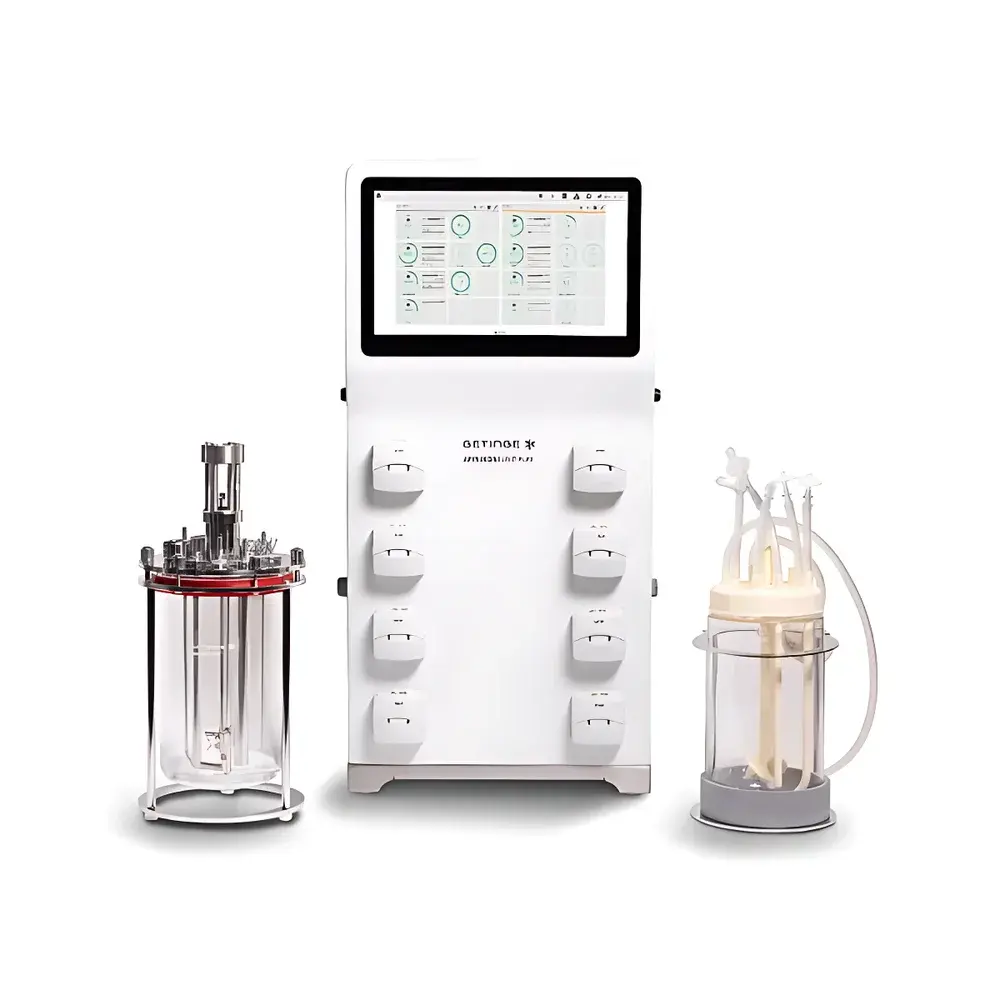
Livit Flex Biological Process Control System
| Brand | Getinge |
|---|---|
| Origin | Sweden |
| Type | Single- or Dual-Channel Configurable Bioprocess Controller for Single-Use and Conventional Bioreactors |
| Connectivity | Ethernet-based Centralized Monitoring and Control Platform |
| Compliance | Designed for GMP-relevant R&D environments |
Overview
The Livit Flex Biological Process Control System is a modular, Ethernet-connected bioprocess controller engineered for precision and flexibility in upstream bioprocessing development. Developed by Getinge—a global leader in life science technologies—the system implements closed-loop control logic grounded in real-time sensor feedback integration (pH, DO, temperature, agitation, gas flow, and level) to maintain critical process parameters within user-defined setpoints. Unlike legacy standalone controllers, Livit Flex operates as a unified control node within a distributed architecture, enabling centralized supervision of multiple bioreactor units—whether stainless steel, glass, or single-use—via a single IP network infrastructure. Its design philosophy centers on reproducibility, audit readiness, and seamless interoperability with third-party sensors and actuators compliant with standard 4–20 mA, 0–10 V, RS485, and Modbus RTU protocols.
Key Features
- Modular Channel Architecture: Configurable as either a single-channel or dual-channel controller—each channel independently managing distinct bioreactor vessels with full parameter autonomy (e.g., separate pH/DO cascades, independent temperature ramps, and individual gas blending profiles).
- Single-Use Ready Integration: Native support for disposable bioreactor instrumentation including pre-calibrated single-use pH and DO sensors, bag-level detection via capacitance or pressure differential, and sterile quick-disconnect I/O interfaces compliant with ISO 13485–certified assembly practices.
- Web-Based Human-Machine Interface (HMI): Responsive HTML5 interface accessible from any modern browser—no client installation required. Supports role-based access control (RBAC), real-time trend visualization, alarm acknowledgment logs, and export of time-stamped CSV datasets.
- Embedded Data Integrity Framework: Built-in timestamping with NTP synchronization, electronic signatures (per FDA 21 CFR Part 11 Annex 11 guidance), and immutable audit trails for all configuration changes, setpoint adjustments, and manual overrides.
- Scalable Communication Stack: Native Modbus TCP server/client functionality; optional OPC UA server add-on for enterprise-level integration with MES, LIMS, or SCADA systems; supports TLS 1.2 encrypted data transmission.
Sample Compatibility & Compliance
Livit Flex is validated for use across mammalian, microbial, and cell-culture-based processes—from 500 mL benchtop bioreactors to 2,000 L pilot-scale single-use systems. It accommodates standard sensor inputs per ASTM E2500-13 (Good Practice for Specification, Design, and Verification of Pharmaceutical and Biopharmaceutical Manufacturing Systems) and aligns with ICH Q5D, Q5A(R2), and EU GMP Annex 11 requirements for computerized system validation. All firmware updates undergo version-controlled release testing and are documented per ISO 13485:2016 clause 7.5.4 (Control of Production and Service Provision). The system does not perform analytical measurements itself but serves as the deterministic control layer interfacing with calibrated analytical devices meeting USP standards.
Software & Data Management
Livit Flex runs on a Linux-based real-time OS with deterministic scheduling for sub-second control loop execution. Configuration is managed through the web HMI using intuitive drag-and-drop PID tuning panels and recipe-driven batch sequencing. All operational data—including raw sensor values, calculated derived parameters (e.g., OUR, CER, kLa), and event logs—are stored locally on an industrial-grade SSD with automatic daily backup to network-attached storage (NAS) or cloud endpoints via SFTP. Data exports comply with ALCOA+ principles: Attributable, Legible, Contemporaneous, Original, Accurate, Complete, Consistent, Enduring, and Available. Optional software modules include automated deviation reporting (for CAPA linkage) and electronic batch record (EBR) generation aligned with ISA-88 and ISA-95 models.
Applications
- Process characterization studies under Quality by Design (QbD) frameworks
- Scale-down model development and comparability assessments
- Media optimization and feeding strategy evaluation in fed-batch and perfusion cultures
- GMP-aligned Phase I/II clinical manufacturing support with full traceability
- Technology transfer between R&D, pilot plant, and commercial facilities
- Training platform for bioprocess engineers due to its transparent control architecture and real-time diagnostics
FAQ
Is Livit Flex suitable for GMP manufacturing environments?
Yes—when deployed with appropriate validation documentation (IQ/OQ/PQ), change control procedures, and configured with audit trail and electronic signature enabled, it meets core requirements of FDA 21 CFR Part 11 and EU Annex 11 for computerized systems in regulated biomanufacturing.
Can it interface with third-party bioreactors such as Sartorius BIOSTAT® or Thermo Fisher HyPerforma™?
Yes—via analog I/O, Modbus RTU/TCP, or optional OPC UA, provided the target device exposes compatible control signals and adheres to published communication specifications.
Does Livit Flex include built-in data archiving or require external servers?
It includes local SSD storage (32 GB minimum) with configurable retention policies and automated offload to external NAS or cloud storage—no mandatory external server dependency for basic operation.
What level of cybersecurity hardening is implemented?
The system ships with disabled default accounts, TLS 1.2 encryption for web traffic, firewall rules limiting inbound ports, and regular security patch cycles aligned with Getinge’s Product Security Incident Response Team (PSIRT) policy.
Is remote support or firmware update capability available?
Remote diagnostics and secure firmware updates are supported via Getinge’s authorized service portal—access requires customer-initiated session tokens and multi-factor authentication.



