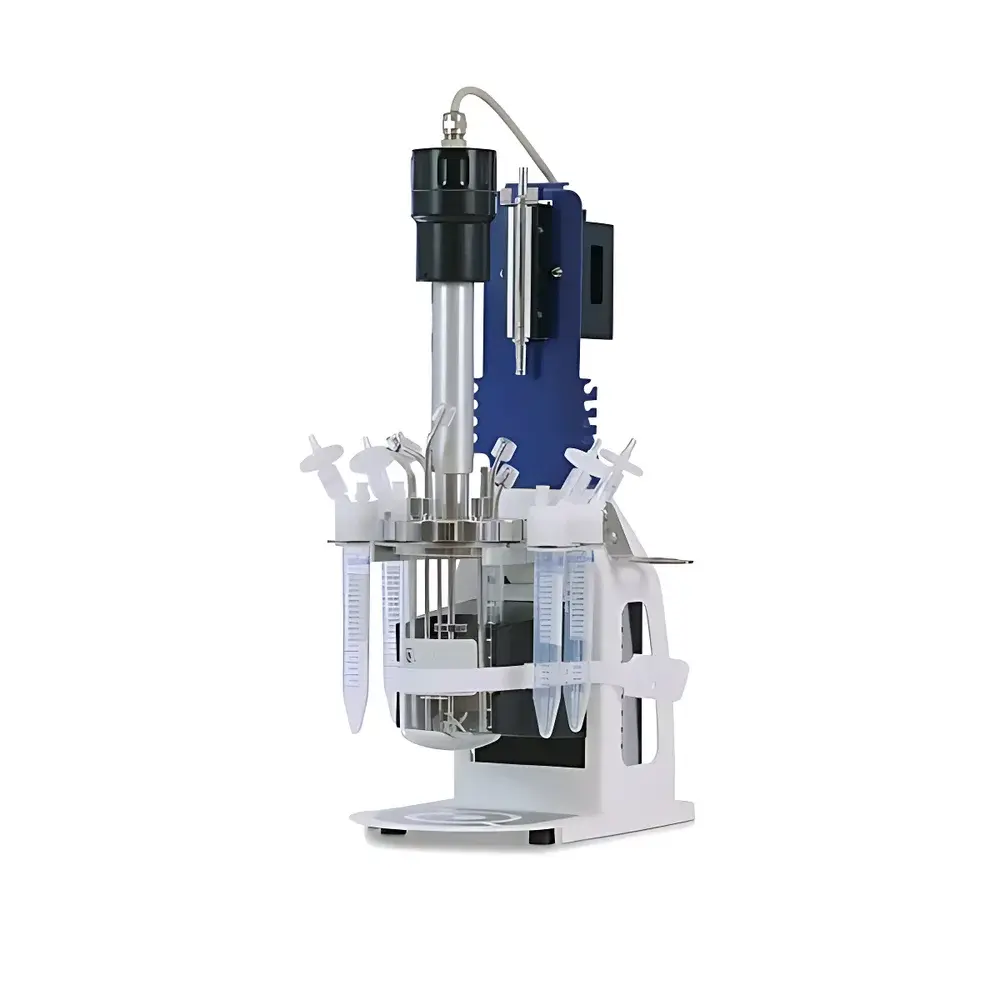
Applikon MiniBio 250/500/1000 Benchtop Bioreactor System
| Brand | Getinge |
|---|---|
| Origin | Sweden |
| Model Variants | MiniBio 250, MiniBio 500, MiniBio 1000 |
| Vessel Working Volume | 250 mL, 500 mL, and 1000 mL (respectively) |
| Configuration | Modular, Sterile-Ready Benchtop Bioreactor Platform |
| Control Architecture | Integrated PID-based Process Control with Analog/Digital I/O Expansion Capability |
| Compliance | Designed to Support GLP/GMP-aligned workflows and ASTM E2500-23 risk-based qualification principles |
Overview
The Applikon MiniBio 250/500/1000 is a modular, benchtop-scale bioreactor system engineered for high-fidelity process simulation and scalable bioprocess development in academic, R&D, and early-stage manufacturing environments. Unlike generic miniaturized stirrer vessels, the MiniBio platform implements core bioreactor engineering principles—including controlled gas sparging (air/O₂/N₂), precise temperature regulation via jacketed vessel or Peltier-based thermal management, pH and dissolved oxygen (DO) feedback control using sterilizable inline sensors, and torque-based agitation monitoring—within a compact footprint. Its design adheres to fundamental bioreaction mass-transfer and mixing criteria (e.g., power input per unit volume, kLa optimization, and Reynolds number consistency), enabling meaningful correlation between MiniBio runs and larger-scale bioreactors (e.g., Applikon’s DASbox® or production-scale ADI systems). The system supports both microbial (E. coli, yeast, bacillus) and mammalian (CHO, HEK293) cell cultures under aerobic or microaerobic conditions, making it suitable for upstream process characterization, media optimization, feeding strategy screening, and clone selection.
Key Features
- Modular architecture with interchangeable vessel sizes (250 mL, 500 mL, and 1000 mL working volumes), each validated for consistent shear environment and mass-transfer performance.
- Sterilizable-in-place (SIP) design compliant with ISO 13485 and aligned with FDA 21 CFR Part 11 data integrity requirements when paired with optional audit-trail-enabled software.
- Integrated analog/digital I/O ports supporting third-party sensor integration (e.g., glucose, lactate, viable cell density probes) and external actuator control (peristaltic pumps, gas mass flow controllers).
- PID-based real-time control of critical process parameters: temperature (±0.1 °C), pH (±0.05 units), DO (±1% air saturation), agitation (±1 rpm), and gas blending ratios (N₂/O₂/Air).
- Compact footprint (≤0.3 m² per unit) optimized for laminar-flow hoods and shared lab benches—reducing media consumption by up to 90% compared to standard 5–10 L lab reactors without compromising physiological relevance.
- Pre-qualified mechanical and electrical components per IEC 61000-6-2/6-4, ensuring electromagnetic compatibility in multi-instrument laboratory settings.
Sample Compatibility & Compliance
The MiniBio system accommodates suspension and adherent cell cultures, recombinant protein expression systems, microbial fermentation, and anaerobic or microaerophilic cultivations via configurable headplate gas manifolds. All wetted parts—including vessel body, impeller shafts, spargers, and sensor housings—are constructed from USP Class VI-certified materials (e.g., borosilicate glass, 316L stainless steel, and pharmaceutical-grade silicone tubing). Vessels are supplied with ISO-KF or SMS sanitary flange interfaces for seamless integration into closed-system workflows. The platform meets essential requirements for ISO 14644-1 Class 5 cleanroom operation when used within appropriate containment enclosures and supports qualification documentation packages (DQ/IQ/OQ) per ASTM E2500-23 and EU Annex 15 guidelines.
Software & Data Management
Control and data acquisition are managed through AppliConnect™ software—a Windows-based application supporting simultaneous monitoring and control of up to 16 MiniBio units. The software provides configurable alarm thresholds, automated event logging (start/stop, parameter deviation, sterilization cycle completion), and export of time-stamped CSV/Excel files compliant with ALCOA+ principles. Optional 21 CFR Part 11 compliance modules include electronic signatures, role-based access control, and immutable audit trails. Raw sensor data is sampled at ≥1 Hz, with interpolated trend visualization and batch comparison overlays for statistical analysis (e.g., growth rate, specific productivity, yield coefficients).
Applications
- Early-phase bioprocess development: media screening, pH/DO setpoint optimization, and feed profile evaluation for monoclonal antibodies and viral vector production.
- Strain or clone ranking based on volumetric productivity and metabolic stability across parallel MiniBio runs.
- Technology transfer support: bridging lab-scale findings to pilot-scale (e.g., 10–50 L) and commercial bioreactors via scalable operating parameters.
- Training and education: hands-on instruction in bioreactor operation, process analytical technology (PAT), and quality-by-design (QbD) frameworks.
- Regulatory filing support: generation of robust, reproducible datasets for IND/IMPD submissions where small-scale bioreactor data informs process understanding.
FAQ
What is the maximum operating pressure for MiniBio vessels?
Standard MiniBio configurations operate at ambient pressure; optional pressure-rated vessels (up to 1.5 bar(g)) are available upon request for specialized applications requiring elevated headspace control.
Can MiniBio be integrated with existing SCADA or MES systems?
Yes—via Modbus TCP or OPC UA protocols using the optional Industrial Communication Module, enabling bidirectional data exchange with enterprise-level manufacturing execution systems.
Is autoclaving supported for all components?
Vessels, impellers, and sensor sleeves are fully autoclavable (121 °C, 20 min); electronics and control units are not autoclavable and must remain external to sterilization cycles.
How is calibration traceability maintained for pH and DO sensors?
Each sensor includes a factory calibration certificate traceable to NIST standards; in-house recalibration is supported using certified buffer solutions and zero-oxygen standards per ISO 17025-compliant procedures.
What validation documentation is provided with the system?
A comprehensive User Requirement Specification (URS)-aligned validation package—including Functional Specification (FS), Design Specification (DS), Factory Acceptance Test (FAT), and Site Acceptance Test (SAT) protocols—is supplied as part of the delivery scope.