
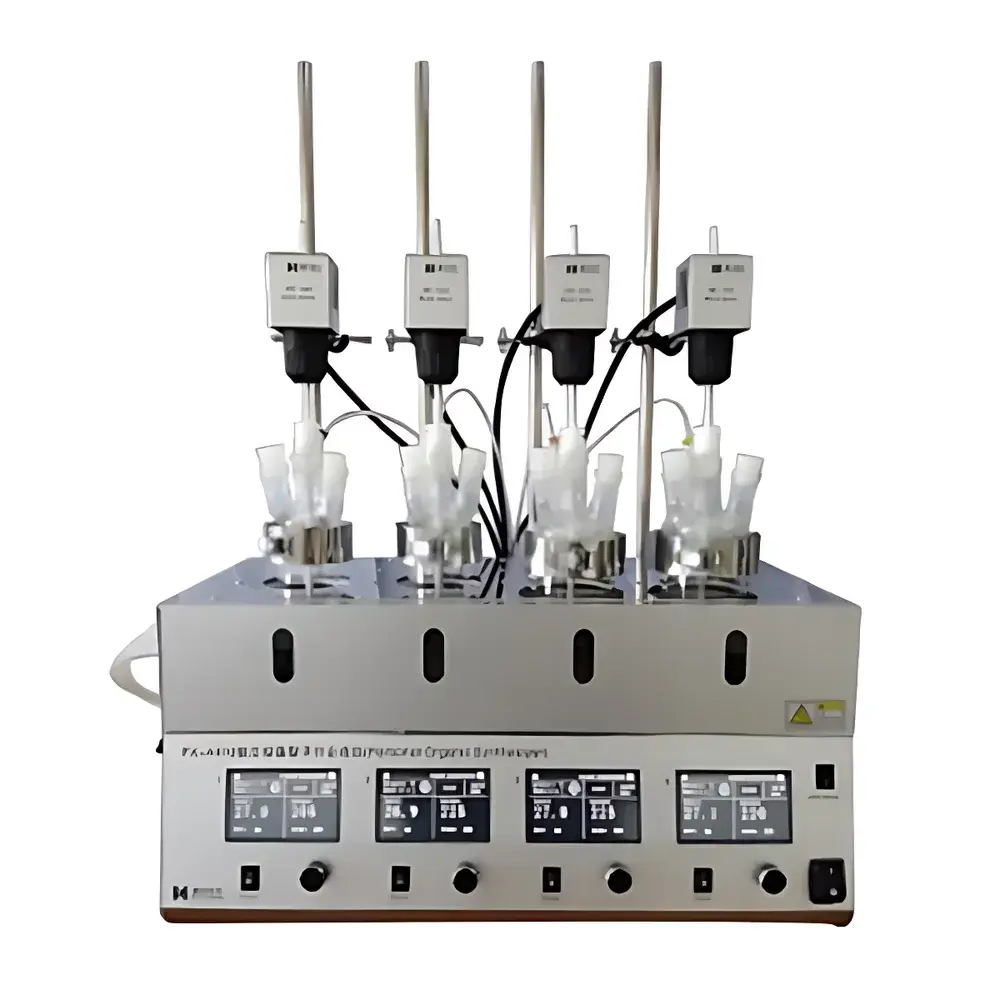
Hanking PX Series Independent Temperature-Controlled Parallel Synthesis Reactor
| Brand | Hanking |
|---|---|
| Model | PX Series |
| Type | Parallel Synthesis Reactor |
| Temperature Range | -40 °C to 250 °C |
| Reaction Volumes | 0.5 mL – 1000 mL (1000 mL on custom request) |
| Independent Channels | 4 or 5 |
| Control Modes | 6 programmable temperature profiles (isothermal, constant-temperature, and ramp/hold with dual variants) |
| Temperature Programming | Up to 10 gradient segments per channel |
| Stirring | Dual-mode (high-energy magnetic stirring + optional through-shaft mechanical stirring) |
| Safety Features | Dual over-temperature cutoff, real-time exotherm-triggered emergency cryo-cooling, current overload protection, post-run high-temp alert, self-diagnostic alarm system |
| Compliance | Designed for GLP-compliant lab environments |
Overview
The Hanking PX Series Independent Temperature-Controlled Parallel Synthesis Reactor is an engineered platform for high-throughput, thermally precise synthetic experimentation in research and process development laboratories. Built upon Couette-type thermal management architecture and modular multi-channel reactor design, it enables simultaneous execution of up to five chemically independent reactions—each with fully decoupled temperature regulation, agitation control, and safety monitoring. Unlike conventional jacketed or oil-bath parallel reactors, the PX Series employs a closed-loop refrigerant circulation system with AI-regulated flow valves, delivering dynamic thermal response across its full operational range (–40 °C to 250 °C). This architecture ensures minimal thermal crosstalk between channels and sub-±0.3 °C temperature stability under steady-state conditions—critical for kinetic studies, crystallization screening, and exothermic reaction optimization.
Key Features
- Independent Channel Control: Each of the 4 or 5 reaction stations operates with dedicated PID-controlled heating/cooling, stir speed adjustment (0–1200 rpm for magnetic drive; mechanical option supports viscous media >10,000 cP), and real-time internal temperature feedback via immersed Pt100 sensors.
- Multi-Mode Thermal Programming: Six preconfigured control strategies—including dual isothermal modes (fast-settle vs. ultra-stable), dual constant-temperature modes (ambient-referenced and setpoint-referenced), and two ramp-and-hold variants—allow method-specific thermal trajectory definition without scripting.
- Emergency Cryo-Intervention System: Proprietary exotherm-detection algorithm continuously compares setpoint deviation against rate-of-rise thresholds. Upon detection of uncontrolled thermal runaway, the system autonomously initiates high-flow refrigerant delivery (<2 s response latency) to suppress temperature escalation—functioning as a hardware-enforced safety layer compliant with IEC 61508 SIL-2 principles.
- Dual Agitation Architecture: Integrated high-magnetic-energy stir plates (≥0.45 T surface field) support standard PTFE-coated stir bars; optional through-shaft mechanical agitators accommodate heterogeneous slurries, viscous polymerizations, and gas-liquid mass-transfer-limited reactions.
- Human-Centric Interface: 7-inch capacitive touchscreen with haptic rotary encoder enables glove-compatible parameter entry, live channel status overlay, and intuitive navigation between setup, run, and diagnostic menus—designed for extended use in fume hood environments.
- Modular Volume Scalability: Standard reaction blocks accept vials from 0.5 mL to 50 mL; larger formats (100–1000 mL) are supported via custom-engineered reactor modules with reinforced thermal manifolds and pressure-rated seals (ASME B31.3 compliant for optional pressurized operation).
Sample Compatibility & Compliance
The PX Series accommodates a broad spectrum of reaction media—including protic/aprotic solvents, aqueous emulsions, organometallic precursors, and solid-supported catalysts—across glass, stainless steel (316L), and Hastelloy C-276 reactor vessels. All wetted materials meet USP Class VI biocompatibility standards. The system’s thermal and electrical architecture complies with EN 61010-1:2019 for laboratory equipment safety. When paired with Hanking’s optional LIMS-integrated data acquisition module, full electronic record retention—including parameter logs, alarm events, and operator actions—is traceable and exportable in CSV/PDF formats, satisfying ALCOA+ data integrity requirements for GLP and early-phase GMP environments.
Software & Data Management
The embedded controller firmware records timestamped temperature, stir speed, refrigerant flow rate, and safety event flags for each channel at 1 Hz resolution. Raw data is stored locally on industrial-grade microSD (encrypted) and synchronizes wirelessly to a Windows-based host application via TLS 1.2–secured Wi-Fi. The application supports method templating, batch-level metadata tagging (e.g., DOE matrix IDs, compound registration numbers), and automated report generation aligned with ASTM E2500-22 guidelines for analytical instrument qualification. Audit trail functionality meets FDA 21 CFR Part 11 requirements when configured with role-based user accounts and digital signature enforcement.
Applications
- Design of Experiments (DoE) for reaction condition space mapping
- Crystallization polymorph screening under controlled supersaturation profiles
- Catalyst and ligand evaluation across temperature-dependent selectivity windows
- Scale-down process development for API synthesis (including hydrogenation, amidation, and cross-coupling)
- Antibody–drug conjugate (ADC) linker stability assessment under accelerated thermal stress
- Solvent effect studies in photoredox and electrochemical synthesis
- High-viscosity polymerization kinetics under shear-controlled initiation
FAQ
What is the minimum and maximum reaction volume per channel?
Standard configurations support 0.5 mL to 50 mL vials; custom modules extend capacity to 1000 mL upon engineering review.
Can the system operate under inert or pressurized atmospheres?
Yes—optional gas-tight reactor heads with Swagelok®-compatible fittings and pressure relief valves (up to 10 bar g) are available.
Is remote monitoring supported?
Real-time channel status and historical trends are accessible via secure web interface or OPC UA integration into existing MES/SCADA infrastructure.
How is temperature calibration verified?
Each channel includes a NIST-traceable Pt100 sensor; annual verification protocols follow ISO/IEC 17025–accredited procedures using dry-block calibrators.
Does the system support third-party automation integration?
RS-485 Modbus RTU and Ethernet/IP interfaces enable seamless coordination with robotic liquid handlers, autosamplers, and chromatographic systems.



