
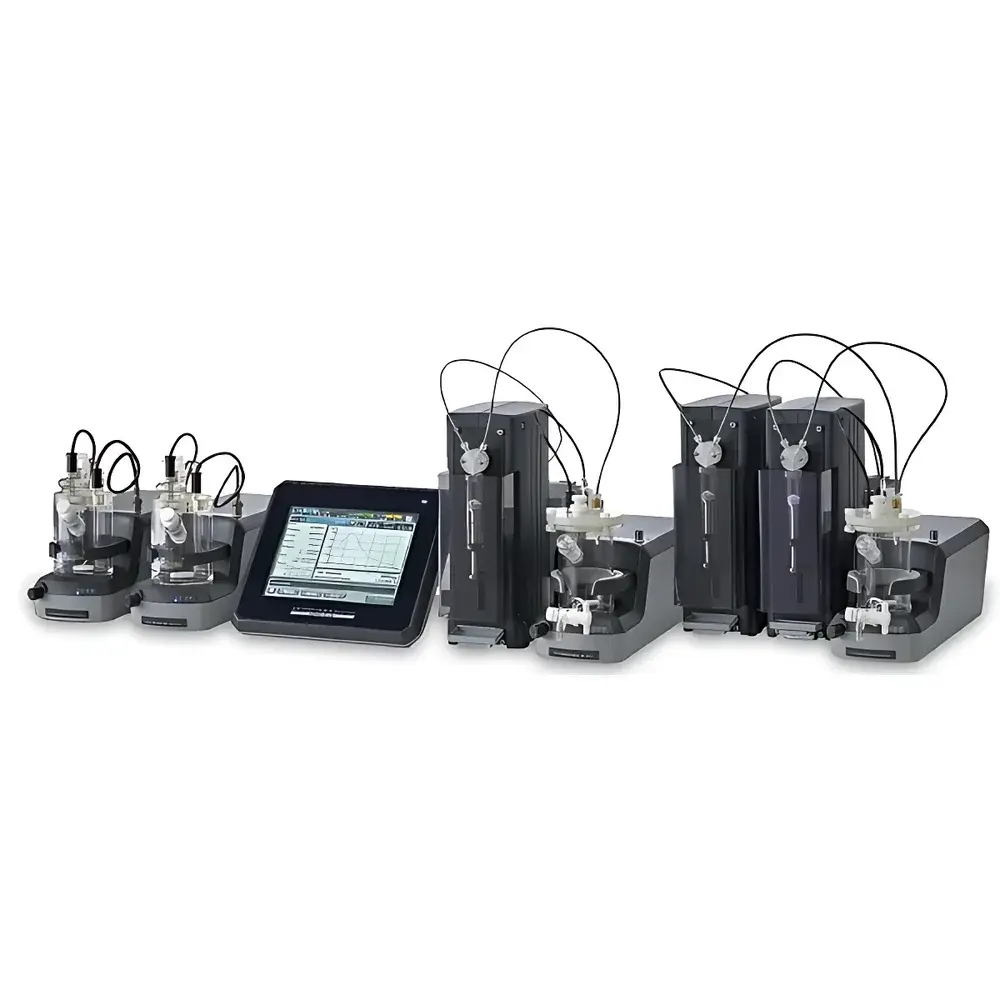
Mitsubishi Chemical CA-310 Karl Fischer Moisture Titrator (Coulometric & Volumetric Dual-Mode)
| Brand | Mitsubishi Chemical |
|---|---|
| Origin | Japan |
| Model | CA-310 (Coulometric & Volumetric Modes) |
| Display | 8.4-inch color touchscreen (Chinese UI) |
| Electrode Options | Membrane-free or membrane-type generator electrode |
Overview
The Mitsubishi Chemical CA-310 is a dual-mode Karl Fischer (KF) moisture analyzer engineered for high-precision quantification of water content across pharmaceutical, chemical, polymer, and battery material laboratories. It supports both coulometric titration (for trace-level moisture: 1 µg – 200 mg H₂O) and volumetric titration (for higher moisture ranges: 100 µg – 200 mg H₂O), enabling method flexibility without hardware reconfiguration. The system operates on the fundamental electrochemical principle of iodine generation (coulometric mode) or standardized KF reagent delivery (volumetric mode), both governed by the stoichiometric reaction: I₂ + SO₂ + H₂O + 3RN + CH₃OH → 2RN·HI + RN·HSO₄CH₃. Its architecture integrates real-time endpoint detection via bi-potentiometric sensing, ensuring robust reproducibility (<2% RSD at 10 µg level) under controlled environmental conditions (20–25°C, <60% RH).
Key Features
- Adaptive stepwise temperature control: The integrated sample oven dynamically adjusts heating profiles based on real-time evaporation kinetics—minimizing thermal degradation of thermolabile compounds while maximizing water release efficiency.
- Dual-electrode compatibility: Supports both membrane-free generator electrodes (optimized for routine analysis using single-component AQUAMICRON reagents, reducing maintenance downtime) and membrane-type electrodes (enabling accurate determination in challenging matrices such as ketones, low-hydroxyl acids, and certain aldehydes).
- Automated pre-start stabilization: Scheduled power-on and internal conditioning routines ensure the titration cell reaches electrochemical equilibrium prior to user intervention—eliminating manual warm-up delays and improving daily throughput.
- High-speed electrolysis protocol: Accelerated current ramping and optimized cell geometry reduce titration time by up to 35% versus conventional coulometric systems, directly lowering reagent consumption and electrode wear.
- Master-console architecture: A single control unit manages up to four independent measurement channels—facilitating parallel analysis, cross-channel validation, and statistical comparison of replicate results.
- Wireless channel control (optional): Enables remote monitoring and operation of peripheral titration units via secure 2.4 GHz RF communication—ideal for distributed lab environments or containment-based workflows.
Sample Compatibility & Compliance
The CA-310 accommodates solid, liquid, and gaseous samples—including hygroscopic powders, viscous oils, solvents, active pharmaceutical ingredients (APIs), and lithium-ion battery electrolytes. Its solvent compatibility extends to methanol, chloroform, and specialized KF-compatible solvents (e.g., HYDRANAL™-Solv). Regulatory alignment includes full support for Good Laboratory Practice (GLP) and Good Manufacturing Practice (GMP) requirements: audit-trail-enabled event logging, user-access levels with password protection, electronic signature capability (per FDA 21 CFR Part 11 when paired with validated LIMS integration), and immutable data storage on internal flash memory or external USB drives.
Software & Data Management
The embedded firmware provides an intuitive Chinese-language interface on its 8.4-inch capacitive touchscreen—featuring drag-and-drop SOP configuration, real-time titration curve visualization, and customizable report templates (PDF/CSV export). Each stored Standard Operating Procedure includes step-by-step operator prompts, parameter locks (e.g., drift threshold, titration speed), and mandatory confirmation checkpoints—ensuring procedural consistency across shifts and operators. All measurement data, calibration records, and system logs are timestamped, digitally signed, and exportable via USB 2.0 host/device ports. Raw data files retain full metadata: ambient temperature/humidity, electrode status, reagent batch ID, and operator ID.
Applications
- Pharmaceutical QC: Water content verification in lyophilized products (USP <921>), excipients, and sterile drug substances.
- Chemical manufacturing: Moisture control in catalysts, monomers (e.g., acrylates), and silicone precursors where residual H₂O induces premature polymerization.
- Electronics materials: Quantification of trace moisture in lithium hexafluorophosphate (LiPF₆) electrolytes and separator films—critical for battery cycle life prediction.
- Polymer science: Monitoring hydrolytic degradation in polyesters (PET, PBT) and polyamides during accelerated aging studies.
- Food & flavor chemistry: Validation of anhydrous conditions in essential oil distillation and encapsulated flavorant production.
FAQ
What is the difference between coulometric and volumetric modes on the CA-310?
Coulometric mode generates iodine electrochemically for ultra-trace analysis (1 µg–200 mg H₂O); volumetric mode delivers standardized KF reagent for higher moisture concentrations (100 µg–200 mg H₂O). The instrument auto-detects mode via electrode configuration.
Does the CA-310 meet FDA 21 CFR Part 11 requirements?
Out-of-the-box, it provides audit trails, electronic signatures, and data immutability. Full Part 11 compliance requires documented validation of the entire IT environment—including network configuration, backup protocols, and LIMS interface.
Can I validate my own SOPs on this instrument?
Yes. SOPs can be created, tested, version-controlled, and locked with user permissions. Each execution generates a unique run ID linked to all raw data and operator actions.
Is the wireless channel control function compliant with ISO/IEC 17025?
Wireless operation does not affect measurement uncertainty. Calibration and performance verification must be performed per ISO/IEC 17025 Annex A.3 using wired connections during accreditation audits.
How often does the generator electrode require replacement?
Membrane-free electrodes typically last 6–12 months under normal use; membrane-type electrodes require annual replacement or sooner if baseline drift exceeds ±5 µA for >30 minutes.
Related Products




