
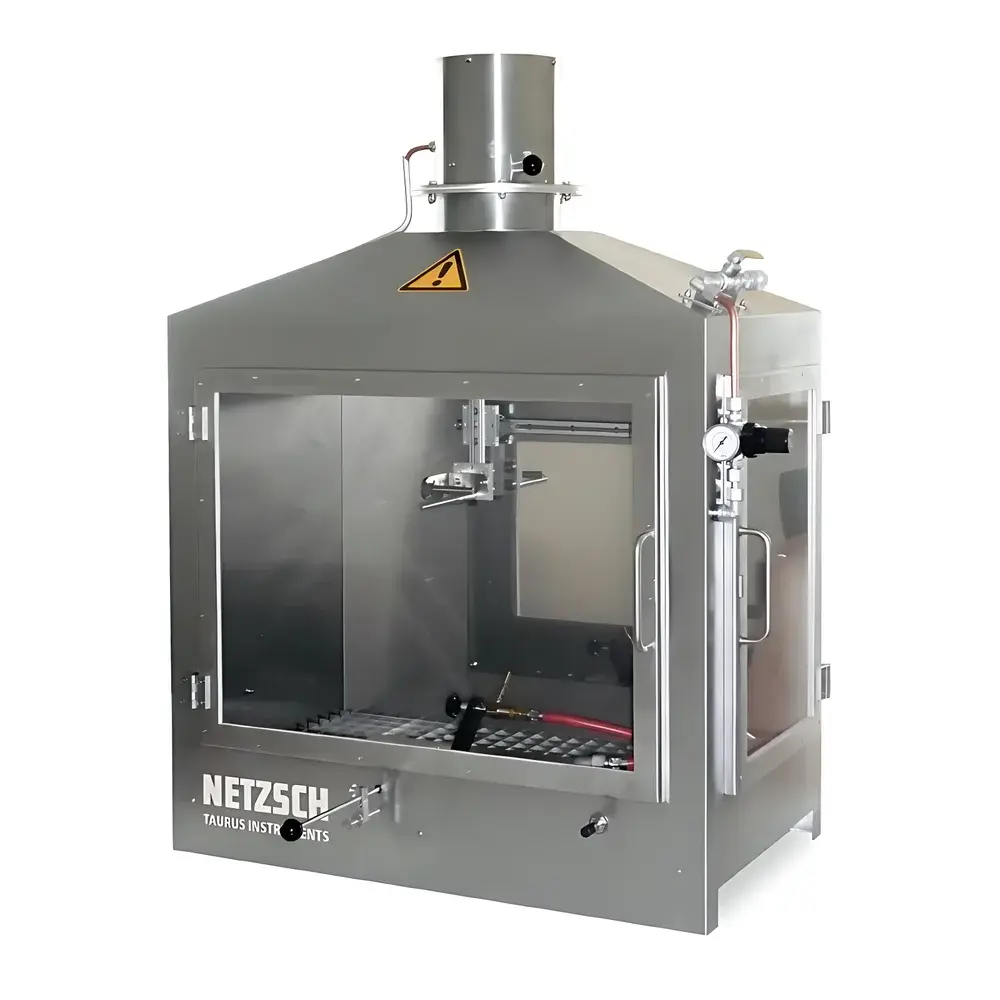
Netzsch SBK Flammability Test Chamber for Toys
| Brand | Netzsch |
|---|---|
| Origin | Germany |
| Model | SBK Flammability Test Chamber for Toys |
| Compliance | EN 71-2 |
| Sample Dimensions (H × W) | 610 (310) × 100 mm |
| Sample Holder | Adjustable in Horizontal and Vertical Planes |
| Fuel | Propane (≥95% purity) |
| Gas Pressure | 4.0 bar |
| Operating Temperature | +23 ± 5 °C |
| Chamber Dimensions (W × D × H) | 70 × 70 × 121 cm |
| Construction | Corrosion-Resistant Stainless Steel |
| Viewing | Dual Large Fire-Rated Glass Doors |
| Gas Control | Front-Mounted Main Shut-Off Valve and Fine-Tuning Burner Control Valve |
| Pressure Monitoring | Integrated Pressure Gauge Regulator |
| Burner Positioning | Contaminant-Shielded Burner Displacement Mechanism |
| Application Scope | Textiles, Furnishings, Toy Accessories (e.g., Wigs, Facial Hair Simulants, Plush Trim) |
Overview
The Netzsch SBK Flammability Test Chamber for Toys is a precision-engineered combustion test apparatus designed to evaluate the ignition resistance and flame propagation behavior of toy-related materials under controlled single-flame exposure conditions. Based on the fundamental principle of standardized radiant and convective heat transfer from a defined propane flame source, the SBK chamber implements the test methodology specified in EN 71-2:2020 “Safety of toys — Part 2: Flammability”. It is specifically validated for assessing fibrous, pile, or tufted substrates—including synthetic wigs, beards, mustaches, eyelashes, and plush trim—commonly used in children’s toys and costume accessories. The system ensures repeatable flame geometry, consistent gas flow dynamics, and thermally stable ambient conditions, enabling compliance-aligned pass/fail determinations required by EU market access regulations.
Key Features
- Adjustable sample holder with independent horizontal and vertical positioning capability, enabling precise alignment of test specimens relative to the burner tip per EN 71-2 dimensional tolerances.
- Dual large-format fire-rated glass observation doors—engineered to withstand sustained thermal exposure while maintaining optical clarity—facilitate real-time visual monitoring and post-test residue inspection without chamber opening.
- Front-access gas control architecture: main isolation valve and micro-adjustable burner control valve are ergonomically mounted for intuitive operation and rapid shutdown response.
- Integrated pressure-regulated propane supply system featuring a calibrated pressure indicator, ensuring stable 4.0 bar delivery to the burner assembly across varying ambient conditions.
- Contaminant-shielded burner displacement mechanism prevents soot accumulation on critical flame orifices and maintains consistent burner geometry over extended operational cycles.
- Chamber enclosure fabricated from high-grade austenitic stainless steel (AISI 316 or equivalent), providing long-term corrosion resistance against combustion by-products and routine cleaning agents used in regulated laboratory environments.
Sample Compatibility & Compliance
The SBK chamber accommodates flat, flexible, or semi-rigid specimens up to 610 mm (or 310 mm for reduced-scale testing) in height and 100 mm in width—dimensions aligned with EN 71-2 Annex A specimen preparation requirements. Compatible material categories include acrylic, polyester, nylon, modacrylic, and blended fiber wigs; faux fur trims; textile-based facial hair simulants; and non-woven plush components. The system supports both upright (vertical) and laid-flat (horizontal) mounting configurations, replicating realistic wear orientations during flammability assessment. All mechanical, thermal, and gas delivery parameters are traceably aligned to EN 71-2 clause 4.2 (apparatus specifications) and clause 5 (test procedure). No additional calibration certificates are required when operated within specified environmental conditions (+23 ± 5 °C ambient, <70% RH).
Software & Data Management
The SBK Flammability Test Chamber operates as a manually supervised, operator-driven test platform—consistent with the procedural nature of EN 71-2. While it does not incorporate embedded digital controllers or automated data logging, its design fully supports GLP-compliant documentation workflows. Users may integrate external timing devices, high-resolution thermal imaging cameras (e.g., FLIR Axxx series), or video capture systems synchronized with test initiation for audit-ready evidence generation. All physical controls, pressure gauges, and positional indicators are calibrated per ISO/IEC 17025-accredited procedures. Test records—including specimen identification, orientation, flame application duration (10 s ± 0.5 s), afterflame time, afterglow duration, and char length—are documented using paper-based or LIMS-linked electronic forms compliant with ISO 17025 Clause 7.8 and FDA 21 CFR Part 11 (when paired with qualified e-signature tools).
Applications
- Pre-market safety validation of toy accessories subject to EU CE marking obligations under Directive 2009/48/EC.
- Internal R&D screening of novel fiber blends, flame-retardant coatings, or substrate architectures intended for children’s product applications.
- Third-party certification testing for Notified Bodies (e.g., TÜV Rheinland, SGS, Intertek) performing EN 71-2 conformance assessments.
- Root-cause analysis of non-conforming batches in textile and soft goods manufacturing facilities operating under ISO 9001 or IATF 16949 quality management systems.
- Comparative evaluation of flame inhibition efficacy between untreated and treated plush materials in home furnishings and nursery product development.
FAQ
Does the SBK chamber support automated flame timing or data export?
No—the SBK is a manually operated test station aligned with EN 71-2’s procedural requirements. Timing and observation are performed by trained personnel using certified stopwatches and visual assessment protocols.
Can the chamber be used for standards other than EN 71-2?
It is specifically configured for EN 71-2. Adaptation to ASTM F963 Section 4.8 or ISO 8191-1 would require hardware modification and revalidation, which is not supported out-of-the-box.
Is propane the only approved fuel gas?
Yes—EN 71-2 mandates ≥95% pure propane delivered at 4.0 bar. Butane or mixed hydrocarbon fuels invalidate test compliance.
What maintenance intervals are recommended for the burner assembly?
Burner nozzles should be inspected and ultrasonically cleaned after every 25 test cycles or weekly—whichever occurs first—to prevent carbon fouling and ensure laminar flame profile repeatability.
Is the stainless steel chamber compatible with common laboratory disinfectants?
Yes—AISI 316 stainless steel resists degradation from ethanol, isopropanol, and quaternary ammonium solutions used in regulated lab hygiene protocols. Avoid chloride-based cleaners.



