
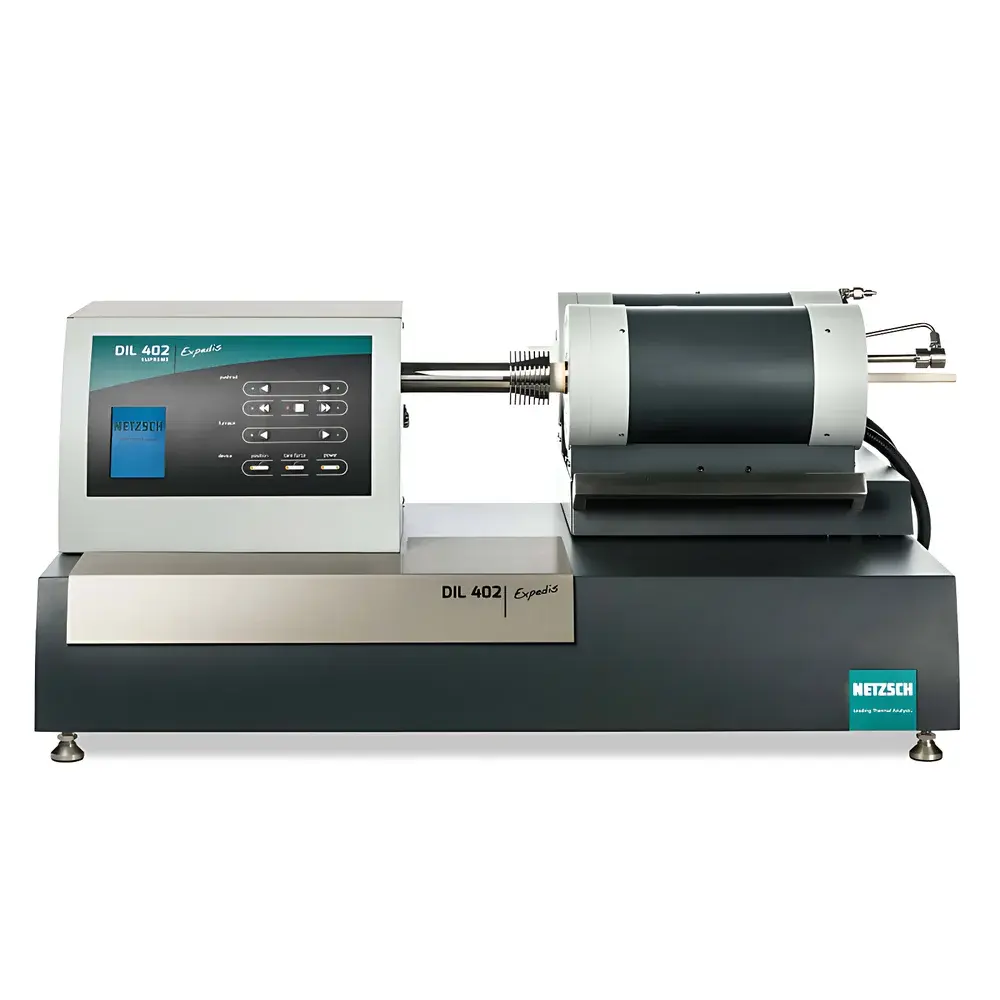
NETZSCH DIL 402 Expedis Supreme Thermal Dilatometer
| Brand | NETZSCH |
|---|---|
| Origin | Germany |
| Model | DIL 402 Expedis Supreme |
| Temperature Range | −180 to 2800 °C |
| Heating Rate | 0–50 K/min (up to 100 K/min with specific furnace options) |
| Temperature Accuracy | ±1 °C |
| Sample Length | 0–52 mm |
| Measurement Range | ±25,000 µm |
| Resolution | 0.1 nm |
| Atmosphere Options | Oxidizing, Reducing, Inert, Vacuum |
| Force Control | Adjustable from 10 mN to 3 N (optional) |
| Sample Types | Solid, Powder, Liquid |
| Furnace Configurations | Single or dual interchangeable furnaces |
| Patented Technologies | NanoEye displacement sensor, MultiTouch sample positioning, c-DTA® (optional), Identify spectral library (optional), Rate-Controlled Sintering (RCS, optional) |
Overview
The NETZSCH DIL 402 Expedis Supreme Thermal Dilatometer is a high-precision, modular instrument engineered for quantitative measurement of dimensional changes in materials as a function of temperature. It operates on the principle of contact-based linear thermal expansion analysis, utilizing a calibrated pushrod mechanism coupled with an ultra-stable, optically referenced NanoEye displacement transducer. This architecture enables traceable, high-fidelity detection of length variations across extreme thermal domains—from cryogenic conditions at −180 °C to ultra-high temperatures up to 2800 °C—making it suitable for advanced research and industrial process development in metallurgy, ceramics, glass science, composites, and nuclear materials. The system’s dual-furnace capability, programmable force control, and atmosphere-integrated vacuum-sealed furnace design ensure reproducible measurements under rigorously controlled thermal and chemical environments.
Key Features
- NanoEye optical displacement sensing system delivering 0.1 nm resolution and exceptional linearity over the full ±25,000 µm measurement range
- Interchangeable furnace modules supporting operation from −180 °C (cryo-furnace with liquid nitrogen cooling) to 2800 °C (graphite or molybdenum furnace), with heating rates up to 100 K/min in selected configurations
- MultiTouch sample positioning technology enabling precise, vibration-damped alignment and mechanical stabilization of specimens during thermal cycling
- Digitally adjustable contact force (10 mN to 3 N, optional motorized actuator), minimizing creep-induced artifacts and preventing deformation of soft, brittle, or low-melting-point samples
- Integrated automatic sample length detection via laser triangulation prior to each run, eliminating manual calibration drift and improving inter-run comparability
- Vacuum-tight furnace housing compatible with pressures down to 10⁻⁴ mbar, certified for use with oxidizing (e.g., air, O₂), reducing (e.g., H₂, CO), inert (e.g., Ar, N₂), and reactive gas atmospheres
Sample Compatibility & Compliance
The DIL 402 Expedis Supreme accommodates diverse physical forms—including rods, discs, powders (in crucibles), thin films, and viscous liquids—using application-specific sample holders made from high-purity alumina, fused silica, or graphite. All furnace and sensor components comply with DIN 51006 and ISO 11359-1/2 standards for dilatometry. Data acquisition and reporting support audit-ready workflows aligned with GLP and GMP requirements, including electronic signatures, user access levels, and full metadata logging (temperature ramp history, atmosphere composition, force profile, and environmental parameters). Optional c-DTA® functionality provides simultaneous differential thermal analysis without additional hardware, facilitating correlation of dimensional transitions with endo-/exothermic events per ASTM E1142 and ISO 11357-6.
Software & Data Management
Control and analysis are executed via NETZSCH Proteus® Software, a Windows-based platform offering real-time visualization, multi-step temperature programming, and automated baseline correction. The software supports ICH Q5A-compliant data export formats (CSV, XML, PDF), embedded uncertainty propagation modeling, and comparative overlay of up to 32 curves with statistical deviation mapping. Advanced modules include Identify (spectral pattern matching against >2,500 reference dilatometric signatures), Rate-Controlled Sintering (RCS) for dynamic densification optimization, and custom script integration via Python API for lab automation systems. All raw and processed data files are timestamped, version-controlled, and compliant with FDA 21 CFR Part 11 when configured with electronic signature and audit trail modules.
Applications
- Determination of linear coefficient of thermal expansion (CTE) across multi-phase temperature regimes
- Characterization of glass transition (Tg), softening point (Ts), and crystallization onset in amorphous oxides and polymers
- In-situ monitoring of sintering kinetics, densification behavior, and pore closure in ceramic and metal powder compacts
- Thermal stability assessment of composite interfaces, coatings, and refractory linings under simulated service conditions
- Reaction-coupled expansion analysis in redox-active systems (e.g., oxide reduction, carbothermic reactions)
- Validation of thermomechanical models used in finite element simulation of casting, forging, and additive manufacturing processes
FAQ
What temperature ranges are achievable with standard furnace configurations?
Standard configurations cover −180 to 2000 °C; extended-range graphite or MoSi₂ furnaces enable operation up to 2800 °C with appropriate purge and vacuum protocols.
Can the system measure both expansion and contraction simultaneously?
Yes—the ±25,000 µm symmetric range and bidirectional NanoEye sensor allow unambiguous detection of both positive and negative dimensional changes within a single experiment.
Is c-DTA® compatible with all furnace types?
c-DTA® is available with all high-temperature furnaces (≥1000 °C) and requires no additional sensors; it derives thermal event signals from high-resolution derivative analysis of the displacement vs. temperature curve.
How is measurement traceability ensured?
The NanoEye sensor is factory-calibrated against NIST-traceable interferometric standards; annual recalibration services include certificate of conformity per ISO/IEC 17025.
Does the system support automated batch testing?
Yes—Proteus® supports sequence-based method templates, robotic sample changer integration (via RS-232/Modbus TCP), and scheduled unattended operation with email alerting on completion or fault conditions.



