
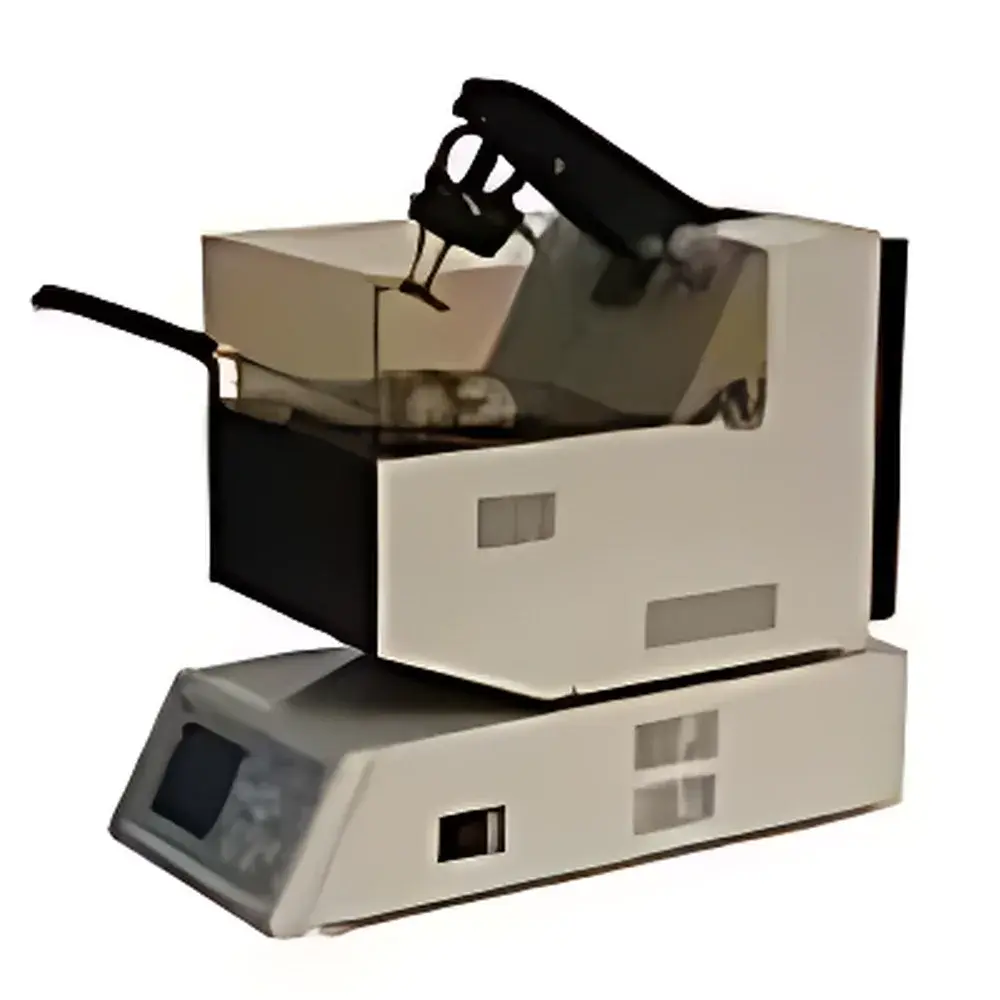
Xufeng FP-P1A Automatic Pensky-Martens Closed Cup Flash Point Tester
| Brand | Xufeng |
|---|---|
| Origin | Shanghai, China |
| Model | FP-P1A |
| Temperature Range | 0–360 °C (Operating: 40–360 °C) |
| Temperature Sensor | Pt100 Platinum Resistance Thermometer |
| Pressure Sensor | Silicon-based Barometric Sensor |
| Ignition Source | Gas-fired Pilot Flame |
| Detection Method | Thermocouple-based Flash Detection |
| Display | LCD Panel |
| Heater Power | 500 W |
| Cooling | Forced Air |
| Interface | RS-232C Serial Port |
| Dimensions (Test Unit) | 215(W) × 410(D) × 270(H) mm |
| Dimensions (Control Unit) | 215(W) × 480(D) × 110(H) mm |
| Weight | 16 kg |
| Compliance | GB/T 261–2008, ASTM D93 (Methods A & B) |
Overview
The Xufeng FP-P1A Automatic Pensky-Martens Closed Cup Flash Point Tester is an engineered solution for precise and repeatable flash point determination of petroleum products, lubricants, biodiesel blends, and other flammable liquids with boiling points above 40 °C. It operates on the fundamental principle of the Pensky-Martens closed-cup method—where a sample is heated incrementally in a sealed test cup while a flame is periodically introduced across the vapor space; the lowest temperature at which the vapor-air mixture ignites momentarily under controlled conditions is recorded as the flash point. This thermodynamic endpoint serves as a critical safety parameter in refining, transportation, storage, and regulatory compliance workflows. Designed to meet both GB/T 261–2008 and ASTM D93 (including both Method A for distillate fuels and Method B for residual fuels), the FP-P1A ensures cross-jurisdictional validity—supporting laboratories subject to CNAS, ISO/IEC 17025, and international quality management systems.
Key Features
- Microprocessor-controlled operation with five selectable test protocols: PA (ASTM D93 Method A), PB (ASTM D93 Method B), PC (legacy GB/T 261–1991), PS (search mode for unknown flash points), and PQ (rapid ramp mode for high-expected flash points ≥100 °C above initial sample temperature)
- Integrated environmental compensation: real-time barometric pressure measurement via silicon pressure sensor, ambient temperature input, and automatic flash point correction per ASTM D93 Annex A3 and GB/T 261 Clause 7.3
- Automated mechanical sequence: motor-driven lid actuation, precision flame positioning arm, synchronized ignition and extinguishing cycles, and post-test forced-air cooling activation
- Onboard data handling: non-volatile memory for up to 99 test records, statistical processing (mean, max, min, range) across triplicate determinations, and timestamped result logging
- Modular architecture: physically separated control unit and test unit—enhancing thermal isolation, service accessibility, and electromagnetic compatibility in shared lab environments
- Human interface: tactile touch-panel controls, high-contrast LCD display with multilingual menu navigation (English default), and intuitive status feedback throughout test execution
Sample Compatibility & Compliance
The FP-P1A accommodates standard Pensky-Martens test cups (included: two stainless-steel cups conforming to ASTM D93 Figure 1 and GB/T 261 Figure 1). It supports viscous samples up to 100 mm²/s at 40 °C without preheating or dilution, provided they remain fluid during testing. The instrument satisfies essential regulatory traceability requirements: all temperature measurements are referenced to Pt100 calibration curves traceable to national standards (e.g., NIM, NIST SRM 1750a); pressure readings comply with IEC 61290-1 for barometric transducers. Its operational validation aligns with ISO 5725 (accuracy and precision), ASTM E2554 (method validation for flash point), and supports GLP-compliant audit trails when interfaced with validated LIMS platforms.
Software & Data Management
Data export is facilitated via RS-232C serial interface (DB9 male connector, TTL-level compatible), enabling bidirectional communication with laboratory PCs running custom or third-party acquisition software. ASCII-formatted output includes test ID, date/time stamp, atmospheric pressure (kPa), observed flash point (°C), corrected flash point (°C), ramp rate (°C/min), ignition count, and pass/fail flag per ASTM D93 Section 10. Optional driver packages support Windows OS integration with configurable polling intervals and CSV log generation. While the FP-P1A does not embed FDA 21 CFR Part 11-compliant electronic signatures, its deterministic firmware behavior, immutable test logs, and hardware-enforced sequence locking provide foundational elements for Part 11 readiness when deployed within validated IT infrastructure.
Applications
- Quality assurance of diesel fuel, jet fuel (Jet A-1, JP-8), heating oil, and marine distillates per ISO 3405 and EN ISO 2719
- Flash point verification of base oils, hydraulic fluids, and transformer insulating oils under IEC 60156 and ASTM D92 (cross-method correlation studies)
- Regulatory submission testing for REACH, CLP, and GHS hazard classification (UN GHS Category 2 or 3 flammability assignment)
- In-process monitoring in refinery blending units and terminal receiving operations
- Research applications involving biofuel blends (FAME, HVO), synthetic lubricants, and solvent formulations where volatility profiling impacts handling safety
FAQ
What gas supply is required for operation?
The FP-P1A requires externally supplied propane or butane with regulated pressure (0.02–0.05 MPa) via the included Φ8 mm oxygen-rated hose. Alternative versions with integrated piezoelectric spark ignition are available upon request—eliminating external gas dependency.
Is calibration verification supported?
Yes. The instrument provides manual temperature offset adjustment and supports periodic verification using certified reference materials (e.g., n-decane, xylene) per ASTM D6300 Annex A1. Calibration certificates for Pt100 and pressure sensors can be issued by accredited metrology labs.
Can multiple FP-P1A units be managed from one PC?
Yes. RS-232 addressing allows daisy-chaining up to four units via multiplexer or individual COM ports. Software must implement device-specific handshaking and buffer management to prevent command collision.
Does the FP-P1A meet explosion-proof requirements for hazardous areas?
No. It is rated for general laboratory use (IEC 61010-1 Class II, Pollution Degree 2) and must be operated in ventilated, non-classified spaces. External gas lines must terminate outside Zone 2 if installed near flammable vapor sources.
How is atmospheric pressure correction applied?
Measured barometric pressure is used in real time to adjust the flash point result using the empirical equation in ASTM D93 Section 8.2.3—ensuring comparability across altitudes and weather conditions without manual recalculations.





