
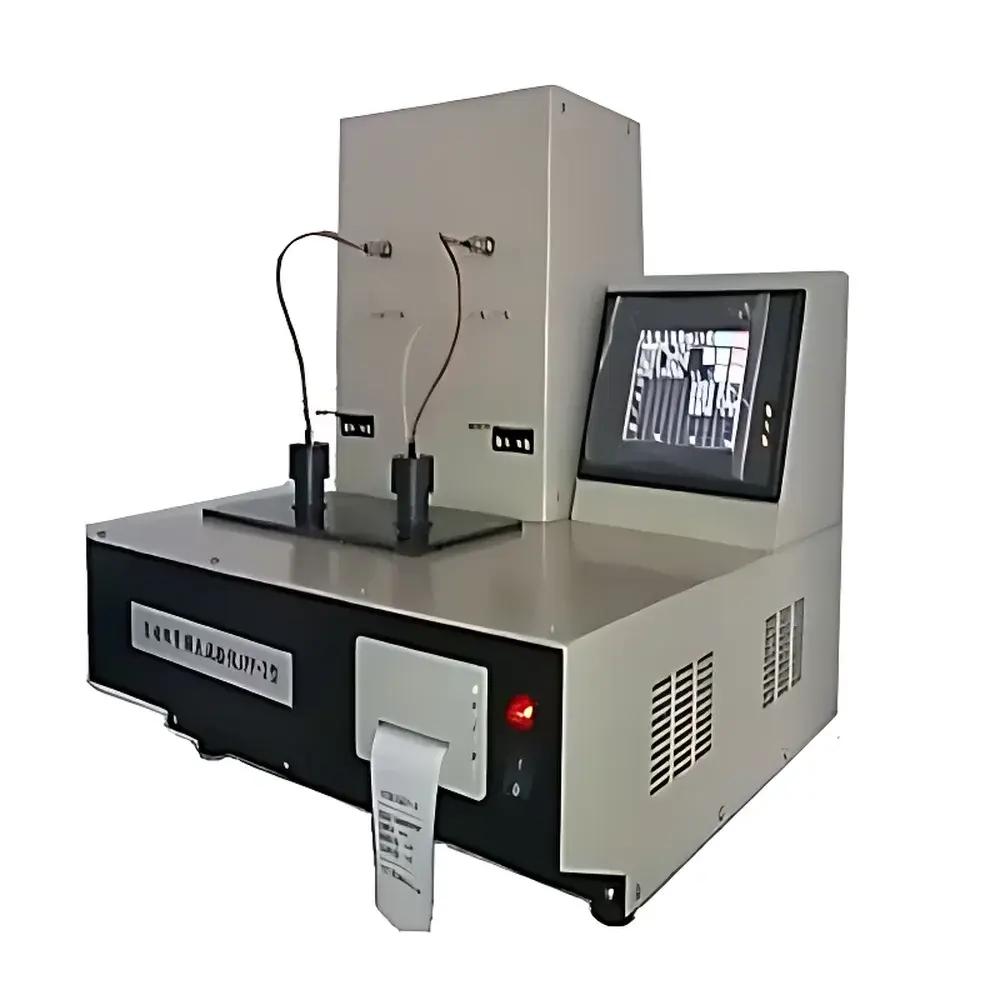
Xufeng XF-97B Automatic Dual-Cup Pour Point Tester (Air Pressure Method)
| Brand | Xufeng |
|---|---|
| Origin | Shanghai, China |
| Model | XF-97B |
| Temperature Range | −20 °C to 50 °C |
| Temperature Resolution | 0.1 °C |
| Cooling System | Internal Semiconductor Cascade Cooler |
| Detection Method | Fiber-Optic Sensor-Based Air Pressure Monitoring |
| Compliance | ASTM D6749, ASTM D97, GB/T 3535 |
| Power Supply | AC 220 V, 50/60 Hz, 1500 W |
| Dimensions (Test Unit) | 300 × 300 × 250 mm (W × D × H) |
| Weight | ~10 kg |
| Sample Volume | 5 mL per cup |
| Interface | RS-232C, Touchscreen GUI, Built-in Dot-Matrix Printer |
Overview
The Xufeng XF-97B Automatic Dual-Cup Pour Point Tester is an engineered solution for precise, repeatable determination of the pour point of petroleum products—including crude oils, lubricants, diesel fuels, and residual fuels—according to internationally recognized standard methods. It operates on the air pressure detection principle defined in ASTM D6749, which measures the lowest temperature at which a sample remains flowable under controlled cooling and pneumatic monitoring. Unlike traditional manual or thermally monitored methods (e.g., ASTM D97), the XF-97B employs real-time fiber-optic sensing of air pressure changes within sealed sample cups to detect solidification onset with high temporal resolution. This eliminates subjective visual interpretation and significantly improves inter-laboratory reproducibility. The instrument features dual independent test stations, enabling parallel analysis of two samples under identical thermal profiles—critical for QC laboratories performing comparative testing or method validation. Its compact benchtop architecture integrates a semiconductor cascade cooling system, eliminating the need for external cryogenic fluids while maintaining stable, programmable temperature control across the full operational range of −20 °C to +50 °C.
Key Features
- Dual-cup configuration supports simultaneous, independent pour point determinations—reducing throughput time by up to 50% compared to single-station instruments.
- Integrated semiconductor cascade refrigeration provides rapid, oil-free, maintenance-light cooling without liquid nitrogen or refrigerant handling.
- High-sensitivity fiber-optic pressure transducer delivers sub-second response to viscosity-induced flow cessation, ensuring accurate endpoint detection per ASTM D6749 Section 8.2.
- 7-inch capacitive touchscreen with Windows-based GUI enables intuitive parameter entry, real-time curve visualization (temperature vs. time), and step-by-step protocol guidance.
- Onboard microprocessor controls ramp rates, hold times, and detection thresholds in full compliance with ASTM D6749 Annex A1 (programmable cooling sequence).
- Built-in dot-matrix printer automatically outputs test conditions, raw temperature data, detected pour point, and pass/fail status—supporting GLP-compliant record retention.
- RS-232C serial interface allows bidirectional communication with LIMS or laboratory PCs for automated data archiving and audit trail generation.
- Self-diagnostic firmware continuously monitors sensor integrity, thermal stability, and power regulation—triggering audible alarms and on-screen fault codes (e.g., “Cooling Failure”, “Sensor Drift”) per IEC 61000-4-3 immunity requirements.
- Stainless steel chassis ensures chemical resistance and mechanical durability in refinery, petrochemical, and third-party testing environments.
Sample Compatibility & Compliance
The XF-97B is validated for use with transparent and opaque petroleum liquids having kinematic viscosities up to 100,000 mm²/s at 40 °C. It accommodates standard ASTM D6749 sample tubes (15–18 mm OD, 120 mm length) and requires only 5 mL per test cup—minimizing sample consumption and waste disposal burden. Regulatory alignment includes full technical equivalence to ASTM D97 (manual tilt method), ASTM D6749 (automated air pressure method), and GB/T 3535 (Chinese national standard). Instrument design incorporates traceable calibration pathways: platinum resistance thermometer (Pt100) sensors are NIST-traceable, and temperature uniformity across both cups is verified per ASTM E74 and ISO/IEC 17025 clause 5.5.2. Data output meets FDA 21 CFR Part 11 requirements when paired with compliant LIMS software via RS-232C handshake protocols.
Software & Data Management
The embedded operating system stores up to 200 test records locally, each containing timestamped temperature readings (recorded every 15 seconds), cooling rate profiles, pressure differential trends, and final pour point assignment. All data fields are immutable post-test; edits require administrator-level authentication and generate automatic audit logs. Export options include CSV via USB flash drive or ASCII transmission over RS-232C. Optional PC-based Xufeng LabLink™ software (sold separately) enables remote instrument control, multi-unit fleet monitoring, statistical process control (SPC) charting, and PDF report generation with digital signature fields. Raw data files conform to ASTM WK64273 metadata schema for interoperability with enterprise quality systems.
Applications
- Refinery QC labs verifying pour point specifications for finished diesel, jet fuel, and marine distillates per ISO 8217 or ASTM D396.
- Lubricant manufacturers assessing low-temperature operability of engine oils and gear oils during formulation development.
- Independent testing laboratories performing contract analyses for API RP 1172 or ISO 17025-accredited services.
- Research institutions studying wax crystallization kinetics in waxy crudes using synchronized dual-cup thermal profiling.
- Storage terminal operators conducting incoming inspection of bunker fuels prior to tank transfer.
FAQ
What standards does the XF-97B fully comply with?
ASTM D6749 (primary), ASTM D97 (equivalent performance), and GB/T 3535—with documented verification reports available upon request.
Is external refrigeration required for operation?
No—the XF-97B incorporates an internal semiconductor cascade cooler rated for −20 °C minimum; no liquid nitrogen or chiller connections are needed.
Can test data be exported to LIMS without manual transcription?
Yes—via RS-232C serial interface using ASCII protocol; optional LabLink™ software adds TCP/IP and HL7 support.
How is measurement traceability maintained?
Temperature sensors are Pt100 elements calibrated against NIST-traceable references; factory calibration certificates include uncertainty budgets per ISO/IEC 17025.
What maintenance is required for long-term reliability?
Annual verification of sensor drift and cooling efficiency is recommended; no consumables or routine fluid replacements are specified.






