
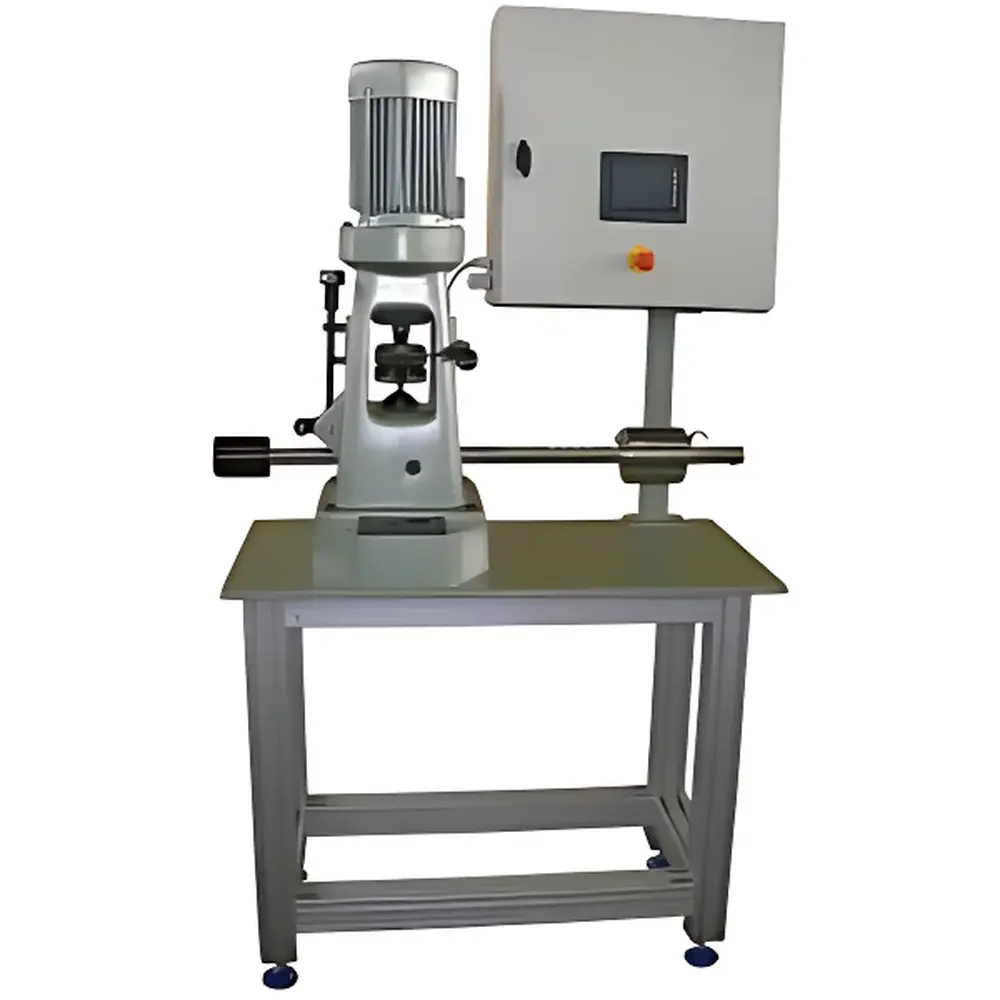
HANSA VKA 110 Four-Ball Tribological Tester
| Brand | HPM HANSA PRESS- und MASCHINENBAU GmbH |
|---|---|
| Origin | Germany |
| Manufacturer Type | Authorized Distributor |
| Origin Category | Imported |
| Model | VKA 110 |
| Price Range | USD 13,500 – 68,000 |
| Instrument Type | Four-Ball Friction and Wear Tester |
| Maximum Friction Load | 12,000 N |
| Friction Force Resolution | 0.1 N |
| Maximum Test Temperature | 150 °C |
| Rotational Speed Range | 10–5800 rpm |
| Loading Method | Dead-weight (mass-based) |
| Temperature Range | −30 to +150 °C |
| Contact Geometry | Point contact (ball-on-ball) |
| Measured Parameters | Friction torque, specimen temperature, transition resistance, rotational cap diameter |
| Compliance Standards | DIN 51350-1 to -6, VW PV 1444, VW PV 1454, ASTM D2783, D2266, D4172, IP 239/85 |
Overview
The HANSA VKA 110 Four-Ball Tribological Tester is a precision-engineered benchtop instrument designed for standardized evaluation of friction, wear, and extreme pressure (EP) performance of lubricants and solid lubricating coatings under controlled mechanical and thermal conditions. Based on the classical four-ball configuration—three stationary balls held in a triangular cup and one rotating upper ball—the system operates according to the fundamental principles of elastohydrodynamic (EHD) and mixed-mode tribology. Its architecture enables reproducible generation of point-contact stress fields representative of real-world rolling-sliding interfaces found in gears, bearings, and cam-follower systems. Developed in close collaboration with Shell and Volkswagen AG, the VKA 110 serves as the physical platform upon which key industry test protocols—including VW PV 1444 (pitting resistance of sliding/rolling components) and DIN 51350 series (lubricant welding load, wear scar, shear stability, and EP characterization)—were codified and validated. As a legacy instrument from HPM HANSA PRESS, a German engineering firm active in tribometer development since the 1960s, the VKA 110 embodies decades of metrological refinement and adherence to DIN-standardized mechanical design.
Key Features
- Robust four-ball test geometry compliant with ISO 20623, DIN 51350, and ASTM D2783 specifications
- High-force loading capability up to 12,000 N via calibrated dead-weight system, ensuring traceable force application without hydraulic or servo-induced drift
- Friction torque measurement with 0.1 N resolution, enabling detection of subtle boundary lubrication transitions and film breakdown events
- Integrated temperature control spanning −30 °C to +150 °C, supporting low-temperature startup simulation and high-temperature oxidative stability assessment
- Variable rotational speed range (10–5800 rpm) for precise replication of sliding-to-rolling ratio (SRR) conditions relevant to gear meshing and bearing kinematics
- Multi-parameter synchronous acquisition: friction torque, specimen temperature, transition resistance (for conductive lubricant monitoring), and rotational cap geometry tracking
- Modular adapter system supporting DIN-compliant wear testing, pitting evaluation (VW PV 1444), axial thrust bearing thermal profiling (VW PV 1454), and KRL/AKRL shear stability protocols
Sample Compatibility & Compliance
The VKA 110 accommodates standard 12.7 mm (½ inch) steel balls per ASTM E2338 and DIN 51350, including reference-grade balls conforming to SKF AB specifications. It supports both fluid lubricants (mineral, synthetic, bio-based) and solid lubricant dispersions (e.g., MoS₂-, PTFE-, or graphene-enhanced formulations). All test procedures executed on the VKA 110 are fully aligned with internationally recognized regulatory and quality frameworks: DIN EN ISO/IEC 17025 for laboratory competence, ASTM E29 for significant digits in reporting, and FDA 21 CFR Part 11 requirements when paired with compliant data acquisition software. The instrument’s mechanical calibration protocol satisfies traceability to national metrology institutes (e.g., PTB Germany), and its test reports are routinely accepted for GLP-compliant submissions in automotive OEM qualification dossiers.
Software & Data Management
Data acquisition is performed using vendor-supplied Windows-based software featuring real-time plotting, automated endpoint detection (e.g., weld onset, pitting initiation), and configurable pass/fail logic per test standard. Raw sensor outputs—including torque, temperature, and resistance—are logged at ≥10 Hz with embedded time-stamping and hardware-level audit trail. Export formats include CSV, XML, and PDF report templates pre-formatted for DIN 51350 and VW PV series compliance. Optional integration with LIMS platforms is supported via OPC UA or TCP/IP protocols. Software validation documentation—including IQ/OQ/PQ test scripts—is available upon request to support GMP or ISO 9001 internal audits.
Applications
- Extreme pressure (EP) additive screening and ranking per ASTM D2783 and DIN 51350-2
- Anti-wear performance quantification of engine oils, gear oils, and greases (ASTM D4172, DIN 51350-3)
- Pitting resistance evaluation of transmission fluids under combined sliding/rolling contact (VW PV 1444)
- Thermal equilibrium characterization of axial thrust bearings (VW PV 1454)
- Solid lubricant film integrity assessment (DIN 51350-4/5)
- Shear stability testing of polymer-thickened lubricants (DIN 51350-6, KRL/AKRL variants)
- Boundary lubrication regime mapping via transition resistance monitoring during film collapse
FAQ
Is the VKA 110 compatible with ASTM D2266 for anti-wear testing?
Yes—the instrument meets all mechanical and procedural requirements specified in ASTM D2266, including ball grade, load application method, and wear scar measurement methodology.
Can the system operate below 0 °C for cold-start lubricant evaluation?
Yes—its cryogenic cooling module maintains stable operation down to −30 °C, enabling simulation of arctic-grade oil performance.
Does the VKA 110 support automated data export to Excel or LIMS?
Yes—CSV and XML exports are native; LIMS integration is achieved via OPC UA or custom TCP/IP API endpoints.
What calibration documentation is provided with delivery?
Each unit ships with a factory calibration certificate traceable to PTB (Physikalisch-Technische Bundesanstalt), including torque, temperature, and load verification records.
Are replacement balls and reference oils supplied by HANSA?
Yes—certified reference balls (SKF Grade 10), standard reference oils (e.g., SRV-1, SRV-2), and calibration weights are available as original-equipment accessories.



