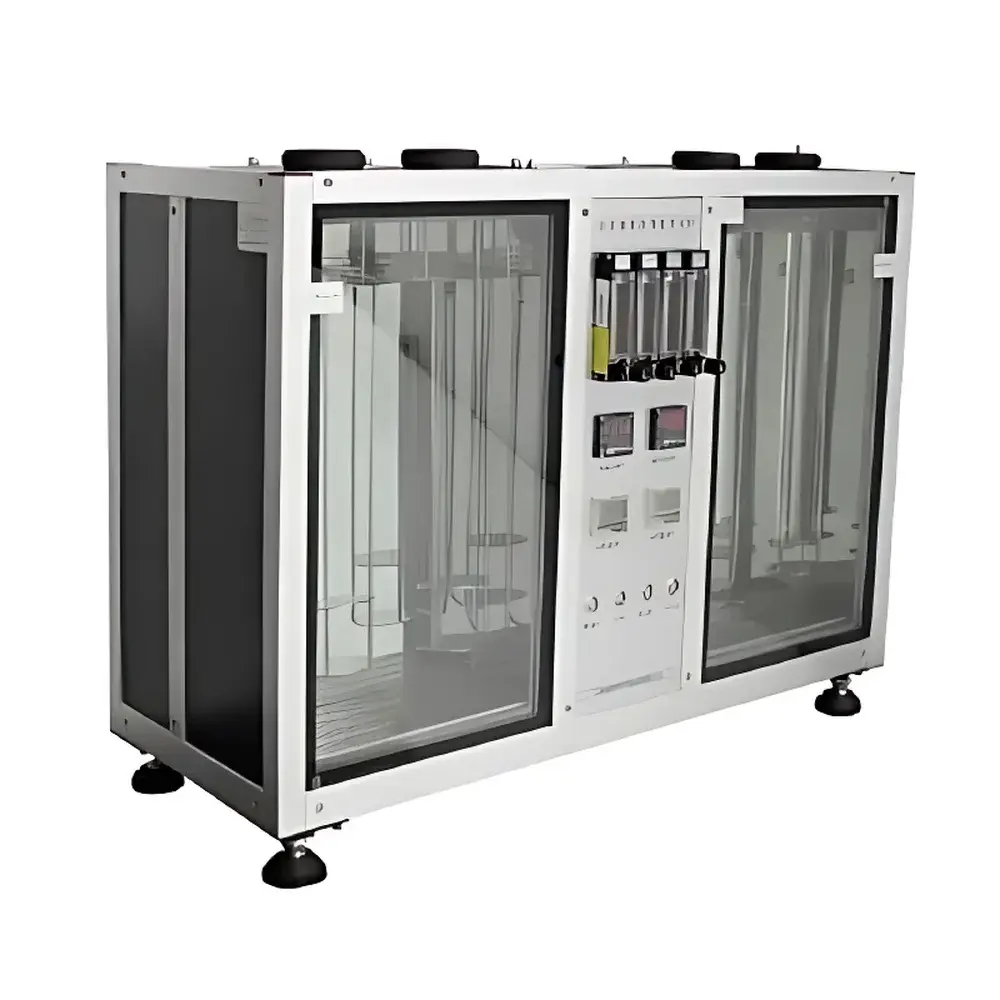
Xufeng XF-12579 Lubricating Oil Foam Characteristics (Antifoaming) Tester
| Brand | Xufeng |
|---|---|
| Origin | Shanghai, China |
| Model | XF-12579 |
| Standards Compliance | GB/T 12579, SH/T 0722-2002, ASTM D892, JIS K 2518-91 |
| Temperature Control Range | 10°C to 150°C |
| Temperature Accuracy | ±0.1°C (at 24°C, 93.5°C, and 150°C) |
| Air Flow Rate | 94 ±5 mL/min (adjustable via precision needle-valve float flowmeter) |
| Safety Interlocks | Low-Liquid-Level & Over-Temperature Protection |
| Power Supply | 220 V / 50 Hz |
| Dimensions (L×W×H) | 886 × 378 × 720 mm |
| Glass Cylinder Size | Φ300 × 180 × 580 mm (×2) |
Overview
The Xufeng XF-12579 Lubricating Oil Foam Characteristics (Antifoaming) Tester is an engineered laboratory instrument designed for the precise, standardized evaluation of foam tendency (FT) and foam stability (FS) in lubricating oils under controlled thermal and aerodynamic conditions. It operates on the principle of air sparging through calibrated porous diffusers into a defined volume of oil sample, followed by quantitative measurement of foam volume at specified time intervals—directly implementing the physical test protocols outlined in GB/T 12579, SH/T 0722-2002, ASTM D892, and JIS K 2518-91. The instrument’s dual-bath architecture enables simultaneous testing at two critical industry-relevant temperatures—24°C (representing ambient operating conditions) and 93.5°C (simulating elevated service temperatures)—with optional expansion to 150°C for high-temperature formulation validation per SH/T 0722. Its integrated Peltier-based cooling system eliminates dependency on external chillers for maintaining the 24°C bath, enhancing lab space efficiency and operational reliability.
Key Features
- Dual independent stainless steel heating baths with PID-controlled Pt100 temperature sensors, delivering ±0.1°C stability at 24°C, 93.5°C, and (with optional third bath) 150°C
- Digitally adjustable temperature setpoint across full operational range (10°C to 150°C), displayed continuously during test execution
- Precision air delivery system featuring imported needle-valve float flowmeters, calibrated to deliver 94 ±5 mL/min airflow with uniform distribution across all diffusers
- Four standardized sintered-glass diffuser ports (two per bath), each conforming to pore size and permeability requirements specified in ASTM D892 and GB/T 12579
- Modular 2+2 cylinder port configuration with integrated locking clamps for secure positioning of graduated glass cylinders (Φ300 × 180 × 580 mm) and temperature probe sleeves
- Self-contained timing module with audible end-of-test alert; supports automatic start/stop synchronization with air flow initiation
- Full stainless steel structural frame and heater assemblies ensure long-term corrosion resistance and thermal integrity in oil-laden environments
- Embedded safety interlocks monitor liquid level and bath temperature in real time, automatically disabling heating if thresholds are breached
Sample Compatibility & Compliance
The XF-12579 is validated for use with mineral-based, synthetic, and semi-synthetic lubricating oils—including engine oils, gear oils, hydraulic fluids, and turbine oils—across viscosity grades from ISO VG 10 to VG 680. Its design fully satisfies the mechanical, thermal, and metrological requirements of multiple international standards: ASTM D892 (Foaming Characteristics of Lubricating Oils), GB/T 12579 (Determination of Foam Characteristics of Lubricating Oils), SH/T 0722-2002 (High-Temperature Foam Characteristics of Lubricating Oils), and JIS K 2518-91 (Foam Test Method for Lubricating Oils). The instrument supports GLP-compliant workflows through traceable temperature logging, repeatable air flow calibration, and unambiguous endpoint definition per standard-defined time points (e.g., foam volume recorded at 0, 5, and 10 minutes post-airflow cessation). All wetted components—including glass cylinders, diffusers, and cylinder caps—are chemically inert and compatible with common solvent cleaning protocols used in petroleum QC labs.
Software & Data Management
While the base XF-12579 operates as a stand-alone hardware platform with digital front-panel controls and real-time temperature display, it is fully compatible with optional PC-based data acquisition modules that support CSV export, timestamped test logs, and batch report generation. These modules provide audit-trail functionality compliant with FDA 21 CFR Part 11 requirements when configured with user authentication, electronic signatures, and immutable data archiving. Temperature and timer events are logged at 1-second intervals, enabling retrospective analysis of thermal drift or airflow deviation. Calibration records—including flowmeter verification certificates and Pt100 sensor traceability documentation—can be stored within the system metadata, facilitating internal QA audits and external regulatory inspections under ISO/IEC 17025 or API RP 1529 frameworks.
Applications
- Quality control of finished lubricant formulations for foam suppression performance
- Development and screening of antifoam additives (e.g., silicone polymers, alkyl acrylates)
- Comparative assessment of foam behavior between OEM-specified oils and aftermarket alternatives
- Investigation of foam-related field failures—such as pump cavitation, reduced heat transfer, or lubricant starvation—in hydraulic and circulating systems
- Supporting ASTM D943 oxidation stability testing where foam formation is a secondary degradation indicator
- Regulatory submission testing for OEM approval programs requiring documented FT/FS data per SAE J183 or DIN 51563
FAQ
What standards does the XF-12579 comply with?
The instrument is fully aligned with GB/T 12579, SH/T 0722-2002, ASTM D892, and JIS K 2518-91 for foam tendency and stability measurement in lubricants.
Can the XF-12579 perform tests at 150°C without modification?
No—the base model supports 24°C and 93.5°C baths; a dedicated 150°C heating bath is available as an optional upgrade, converting the system to a triple-bath configuration.
Is external refrigeration required to maintain 24°C?
No—the unit integrates a solid-state Peltier cooling system for the low-temperature bath, eliminating the need for external chillers or coolant loops.
How is airflow accuracy ensured over time?
Each flowmeter is factory-calibrated against NIST-traceable standards; users may perform routine verification using certified rotameter check standards or volumetric displacement methods per ASTM D4057.
What distinguishes the XF-12579+ variant?
The XF-12579+ replaces the standard air diffuser heads and flowmeters with fully imported components offering enhanced long-term repeatability and reduced maintenance frequency, particularly under continuous high-throughput lab operation.