
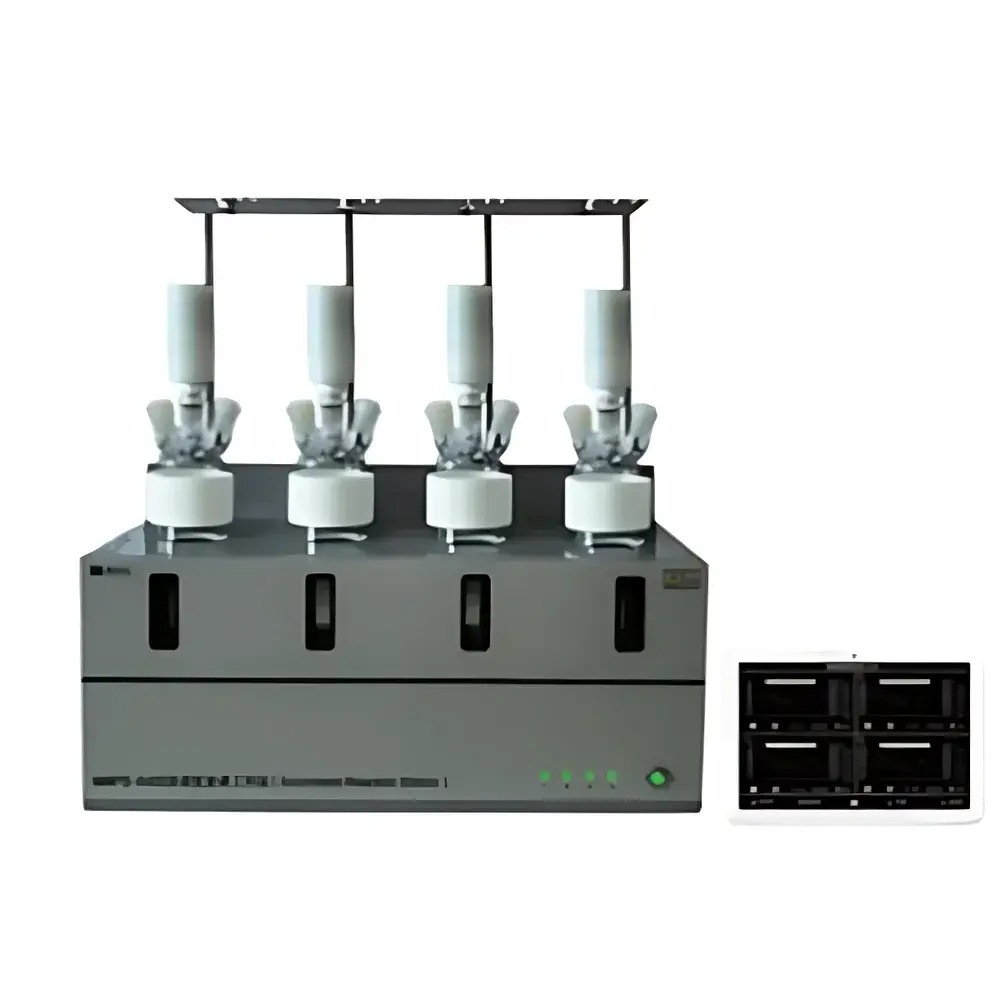
Hanking MAPS-6400 Automated Synthesis Workstation
| Brand | Hanking |
|---|---|
| Origin | Shanghai, China |
| Model | MAPS-6400 |
| Maximum Vessel Capacity | 500 mL (standard reaction vessel) |
| Temperature Control Range | −40 °C to +180 °C |
| Cooling Rate | ≥25 °C/min (emergency mode) |
| Stirring Modes | Magnetic (50–1600 rpm) and Mechanical (100–1100 rpm), switchable via touchscreen |
| Temperature Program | Up to 10-segment per channel, non-linear ramping (max. 20 °C/min) |
| Safety | Dual-mode thermal feedback-triggered emergency cooling, flow-limiting valve auto-closure, Peltier-based rapid cooldown |
| Software | OTA-upgradable control platform, LAN and wireless industrial tablet interface (≥15 m range) |
| Compliance | Designed for GLP-compliant lab environments |
Overview
The Hanking MAPS-6400 Automated Synthesis Workstation is an engineered platform for parallel and sequential chemical synthesis under precisely controlled thermal, mechanical, and environmental conditions. Built on a modular reactor architecture, it integrates Peltier-based active thermoregulation with AI-assisted thermal modeling to deliver high-fidelity temperature execution across up to four independent reaction zones. Unlike conventional jacketed or oil-bath reactors, the MAPS-6400 employs a dual-sensor thermal monitoring system—measuring both heater block surface temperature and real-time bulk material temperature—to dynamically compensate for thermal lag and conduction resistance. This enables accurate execution of complex, multi-stage temperature profiles—including non-linear ramps, holds, and step transitions—critical for kinetic studies, crystallization screening, and exothermic reaction optimization. The workstation is purpose-built for laboratories engaged in pharmaceutical process development, catalyst evaluation, and high-throughput reaction scouting where reproducibility, traceability, and operational safety are governed by internal SOPs and external regulatory expectations (e.g., ICH Q5, Q7, and FDA 21 CFR Part 11 readiness).
Key Features
- Four-channel independent Peltier temperature control: Each zone operates autonomously within −40 °C to +180 °C, enabling simultaneous reactions at divergent setpoints without cross-talk or thermal interference.
- Dual-mode stirring system: Switchable magnetic (50–1600 rpm) and mechanical (100–1100 rpm) agitation—programmable per channel—ensures optimal mass transfer for heterogeneous, viscous, or solid-loading reactions.
- Real-time thermal feedback loop: Integrated dual thermocouple array per channel feeds dynamic correction into the PID algorithm, minimizing overshoot and stabilizing temperature within ±0.3 °C at steady state.
- Emergency thermal mitigation protocol: Triggered by user-defined ΔT thresholds between heater and sample, the system automatically closes fluidic limit valves and initiates maximum-power Peltier cooling (≥25 °C/min), reducing risk of thermal runaway.
- Optical reaction monitoring interface: 70 mm diameter borosilicate viewport with adjustable cold-white LED illumination supports visual assessment of phase separation, precipitate formation, and color change without opening the reactor lid.
- Modular expansion capability: Standard USB-C and RS485 interfaces support integration of optional peripherals—including peristaltic reagent dosing modules, precision syringe pumps, pH electrodes, and NTU-based turbidity sensors for automated endpoint detection.
Sample Compatibility & Compliance
The MAPS-6400 accommodates standard laboratory glassware including round-bottom flasks (up to 500 mL), sealed pressure-rated vessels (with compatible sealing kits), and custom-designed reactor inserts fabricated from borosilicate glass or PTFE-lined stainless steel. All wetted materials comply with USP Class VI and ISO 10993-5 biocompatibility requirements. The system’s control software architecture supports configurable electronic logbooks and time-stamped parameter recording—enabling alignment with GLP documentation standards and facilitating 21 CFR Part 11 compliance when deployed with validated user authentication, audit trail, and electronic signature modules. It meets the design verification criteria outlined in ASTM E2500-23 for laboratory automation systems and conforms to CE electromagnetic compatibility (EMC) Directive 2014/30/EU.
Software & Data Management
The workstation runs on a Linux-based embedded OS with a responsive 10.1″ capacitive touchscreen HMI. Its native control suite allows creation and storage of synthesis protocols—including temperature gradients, stir speed profiles, and timed event triggers—with version-controlled project archiving. Data export is supported in CSV and HDF5 formats for downstream analysis in MATLAB, Python (Pandas), or commercial cheminformatics platforms. Remote operation is enabled via secure HTTP(S) API endpoints accessible over local Ethernet or Wi-Fi (WPA2-Enterprise), supporting integration into centralized lab informatics systems (e.g., ELN/LIMS). Over-the-air (OTA) firmware updates are delivered quarterly, incorporating performance refinements, new peripheral drivers, and enhanced cybersecurity patches—no hardware intervention required.
Applications
- Pharmaceutical route scouting and DoE-driven process optimization
- Catalyst screening under varied thermal and mixing regimes
- Crystallization kinetics and polymorph mapping using NTU-correlated turbidity thresholds
- Continuous-flow precursor synthesis with synchronized reagent addition and quenching
- Material science polymerization studies requiring strict temperature ramp fidelity
- Academic and industrial labs conducting GLP-aligned method development per ICH Q5/Q7 guidelines
FAQ
What types of reaction vessels are supported?
Standard 50–500 mL round-bottom flasks (ISO 2955 taper), custom jacketed reactors, and pressure-rated vessels (up to 10 bar) with optional sealing assemblies.
Is the system compliant with 21 CFR Part 11?
Yes—when configured with role-based access control, electronic signatures, and immutable audit trail logging (enabled via optional validation package).
Can temperature programs be imported from external scripts?
Yes—CSV-formatted time-temperature-stir profiles can be uploaded and parsed directly into the scheduler.
What safety certifications does the MAPS-6400 hold?
CE marking (LVD 2014/35/EU, EMC 2014/30/EU), RoHS 2011/65/EU, and UL/CSA recognition pending final regional certification testing.
How is calibration traceability maintained?
Each unit ships with NIST-traceable calibration certificates for all integrated temperature and rotational sensors; field recalibration tools and procedures are provided in the service manual.



