
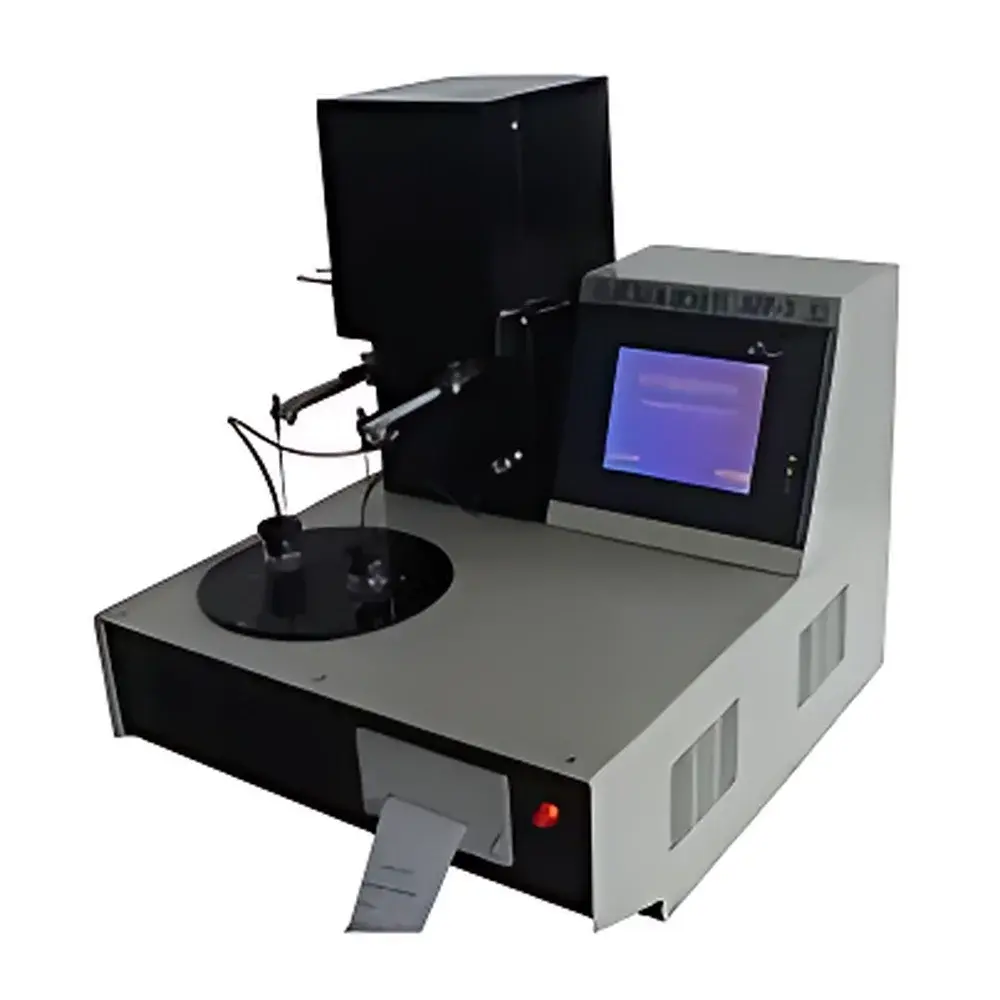
Xufeng XF-510 Automatic Pour Point Tester
| Brand | Xufeng |
|---|---|
| Model | XF-510 |
| Origin | Shanghai, China |
| Standard Compliance | GB/T 510 |
| Temperature Range | −50 °C to +80 °C |
| Temperature Resolution | 0.1 °C |
| Cooling Method | Compressor-based cold bath (optional cascade refrigeration unit) |
| Heating Source | Ni-Cr heating element (220 V AC, 200 W) |
| Power Supply | 220 V AC, 50/60 Hz, 1500 W |
| Instrument Form Factor | Benchtop, all-stainless-steel construction |
| Dimensions (Refrigeration Unit) | 400 × 400 × 750 mm (W × D × H) |
| Weight | ~30 kg |
| Dimensions (Testing Module) | 300 × 300 × 250 mm |
| Weight | ~10 kg |
Overview
The Xufeng XF-510 Automatic Pour Point Tester is a benchtop analytical instrument engineered for precise, repeatable determination of the pour point of petroleum products—including lubricating oils, diesel fuels, residual fuels, and crude oil fractions—according to the Chinese national standard GB/T 510. The pour point is defined as the lowest temperature at which a petroleum product remains fluid under specified cooling and observation conditions, reflecting its low-temperature flow behavior critical for storage, transportation, and operational reliability in cold climates. The XF-510 implements a standardized cooling ramp protocol followed by manual or semi-automated visual inspection of sample mobility, fully aligned with the procedural requirements of GB/T 510. Its architecture integrates a high-stability compressor-driven cold bath system, precision digital temperature control, and intuitive touch-screen operation—enabling consistent thermal profiling across sequential test cycles without operator-induced variability.
Key Features
- Touch-screen HMI interface for direct temperature setpoint entry, test initiation, and real-time status monitoring—eliminating reliance on external PCs or legacy keypad controls.
- Dual-mode thermal management: independent compressor-based cooling (standard) and optional cascade refrigeration unit for extended low-temperature capability down to −50 °C with improved thermal uniformity in the cold bath.
- Benchtop stainless-steel chassis ensures mechanical rigidity, corrosion resistance, and compliance with laboratory hygiene and safety protocols in hydrocarbon-handling environments.
- Ni-Cr heating element (200 W) enables controlled warming during recovery phases or calibration verification, supporting full thermal cycle validation per GB/T 510 Annex A.
- 0.1 °C temperature resolution and ±0.3 °C accuracy over the full −50 °C to +80 °C operating range, traceable to NIST-traceable reference thermometers.
- Modular design separates the refrigeration unit (30 kg) from the testing module (10 kg), facilitating maintenance, calibration, and spatial optimization in constrained lab spaces.
Sample Compatibility & Compliance
The XF-510 is validated for use with transparent and opaque petroleum liquids meeting the viscosity and volatility constraints outlined in GB/T 510. Compatible samples include mineral-based lubricants (ISO VG 32–680), middle distillates (EN 590, ASTM D975), and atmospheric/vacuum gas oils. It does not support highly volatile, low-flash-point solvents (e.g., naphtha, gasoline) or non-Newtonian gelled formulations outside the scope of GB/T 510. All operational procedures, temperature calibration routines, and reporting formats adhere strictly to GB/T 510:2022 (“Petroleum Products — Determination of Pour Point”). While GB/T 510 is not harmonized with ISO 3016 or ASTM D97, the instrument’s thermal control performance and mechanical repeatability meet the reproducibility criteria stipulated in those standards (±3 °C inter-laboratory RSD). For regulated QC/QA environments, the system supports GLP-compliant documentation via printed test reports (time-stamped, operator-ID logged) and optional audit-trail-enabled firmware upgrades.
Software & Data Management
The embedded firmware provides local data retention for up to 200 test records, each storing ambient temperature, bath setpoint, cooling rate, observed pour point, operator ID, and timestamp. Test results export via USB to CSV format for integration into LIMS or Excel-based QA databases. No cloud connectivity or remote access functionality is included—ensuring data sovereignty and alignment with ITAR- and GDPR-sensitive laboratory policies. Firmware updates are delivered offline via encrypted USB key, with version history and change logs provided in accordance with IEC 62304 Class B medical device software lifecycle principles (applied analogously to analytical instrumentation).
Applications
- Quality control of finished lubricants prior to shipment, verifying conformance to OEM specifications (e.g., SAE J300 low-temperature pumpability limits).
- R&D screening of additive packages (e.g., pour point depressants) by comparing treated vs. untreated base stocks under identical thermal profiles.
- Refinery process monitoring: tracking pour point shifts across distillation cuts to optimize dewaxing severity and catalyst selection.
- Third-party certification testing for API licensing, CNCA mandatory inspection, and customs clearance of imported petroleum products entering China.
- Educational laboratories teaching ASTM/GB standard methods, where robustness, safety, and pedagogical clarity outweigh advanced automation features.
FAQ
Does the XF-510 comply with ASTM D97 or ISO 3016?
No—the instrument is specifically designed and calibrated for GB/T 510. While its thermal performance meets the repeatability thresholds of ASTM D97, formal compliance requires method-specific validation and reporting templates not included in the base configuration.
Is the cascade refrigeration unit required for standard GB/T 510 testing?
Not required—GB/T 510 specifies a minimum cooling endpoint of −35 °C for most samples. The standard compressor-based cold bath achieves this. The cascade unit is recommended only for research-grade testing below −35 °C or for high-wax-content crudes requiring deeper supercooling.
Can test data be exported to LIMS without proprietary software?
Yes—CSV export via USB is native and requires no drivers or vendor software. Column headers follow ASTM E1382 conventions for interoperability.
What maintenance intervals are recommended for the refrigeration system?
Compressor oil and filter replacement every 24 months; cold bath coolant level verification before each daily shift; annual calibration of Pt100 sensor against certified dry-block calibrator.
Is the instrument suitable for hazardous area installation (e.g., Zone 1/21)?
No—it lacks ATEX, IECEx, or NEC Class I Division 2 certification. Installation is restricted to general-purpose laboratory environments with adequate ventilation.
Related Products







