
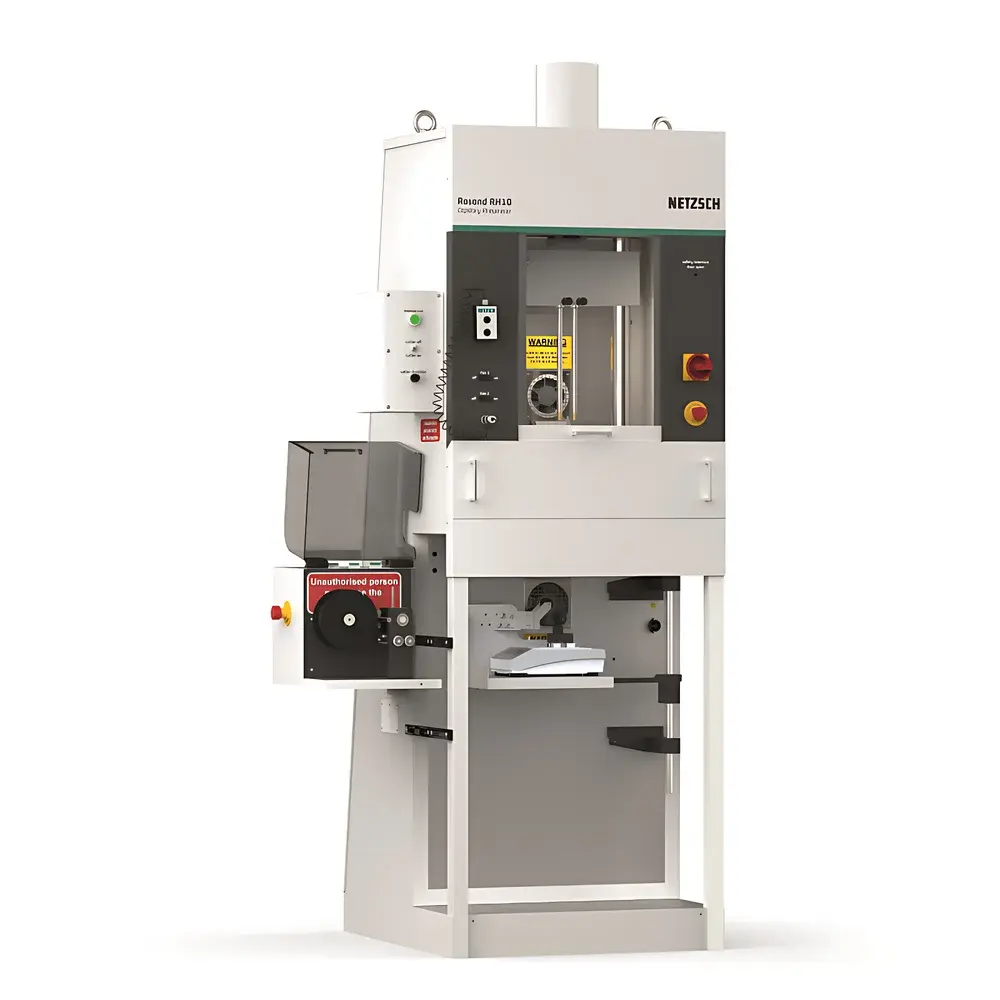
Netzsch Kinexus Rosand RH10 Capillary Rheometer
| Brand | Netzsch |
|---|---|
| Origin | Germany |
| Model | Kinexus Rosand RH10 |
| Instrument Type | Capillary Rheometer |
| Sample State | Liquid |
| Minimum Extrusion Speed | 5 µm/min |
| Maximum Extrusion Speed | 1200 mm/min |
| Maximum Load | 100 kN |
| Die Diameter Range | 0.5–3 mm |
| Barrel Diameter (Standard) | 15 mm (Optional: 9.5, 12, 19, 24 mm) |
| Barrel Material | Nitrided Steel (Optional: Stainless Steel or Hastelloy) |
| Die Material | Tungsten Carbide |
| Speed Dynamic Range | 240,000:1 |
Overview
The Netzsch Kinexus Rosand RH10 Capillary Rheometer is a high-precision, vertically oriented capillary rheometry platform engineered for the quantitative characterization of polymer melts, thermoplastic compounds, and concentrated suspensions under realistic processing shear rates and thermal conditions. It operates on the fundamental principle of capillary flow rheology—measuring pressure drop across a precisely dimensioned die while controlling extrusion velocity—to determine shear viscosity, extensional viscosity (via melt strength or draw-down modules), elastic recovery (e.g., die swell ratio), and melt stability. Designed for industrial R&D and quality control laboratories, the RH10 delivers traceable, ISO 11443-compliant data essential for process simulation, material selection, and formulation optimization in extrusion, injection molding, fiber spinning, blow molding, and additive manufacturing applications.
Key Features
- H-frame mechanical architecture delivering exceptional longitudinal rigidity—significantly reducing deflection under high-load extrusion (up to 100 kN) compared with cantilever or C-frame designs, thereby enhancing measurement reproducibility and long-term calibration stability.
- Dual-barrel measurement capability enabling simultaneous testing with long and short dies—facilitating accurate Bagley correction for entrance pressure loss without interrupting experimental workflow.
- Digital dual-mode speed control system providing seamless transition between displacement-controlled and force-controlled modes, ensuring stable flow initiation and precise velocity tracking across the full dynamic range (240,000:1, from 5 µm/min to 1200 mm/min).
- Modular accessory ecosystem including tungsten carbide dies (0.5–3 mm diameter), slit dies, PVT measurement units, melt cutters, nitrogen purge systems, laser-based die swell analyzers, and melt strength draw-down fixtures—all mechanically and thermally integrated with the main frame.
- Intuitive Kinexus software interface with real-time parameter visualization, guided experimental setup wizards, and context-aware feedback during loading, temperature ramping, and extrusion phases—supporting both novice users and expert rheologists.
Sample Compatibility & Compliance
The RH10 accommodates thermoplastic polymers, elastomers, filled composites, hot-melt adhesives, ceramic/polymer slurries, and pharmaceutical melts in liquid or semi-molten states. All thermal zones (barrel, die, adapter) are independently controlled with ±0.1 °C stability over extended runs. The system complies with ASTM D3835, ISO 11443, and ISO 6721-6 for capillary rheometry, and supports GLP/GMP-aligned audit trails when configured with optional 21 CFR Part 11–compliant software modules. Material contact surfaces meet FDA-compliant finish standards where applicable; optional Hastelloy and stainless-steel barrels enable testing of corrosive or highly reactive formulations.
Software & Data Management
Kinexus software provides full instrument control, automated Bagley and Rabinowitsch corrections, time-temperature superposition (TTS) analysis, and export of rheological master curves (η*, G’, G’’, ε*) in industry-standard formats (CSV, Excel, RheoML). Raw pressure, temperature, position, and load data are timestamped and stored with metadata (operator ID, sample ID, calibration certificate ID, environmental logs). Audit trail functionality records all parameter changes, method edits, and user actions—enabling full traceability for regulatory submissions and internal QA reviews. Data encryption, role-based access control, and network backup integration are available via enterprise deployment options.
Applications
- Quantifying shear-thinning behavior and zero-shear viscosity of polyolefins, engineering resins, and biopolymers across processing-relevant shear rates (1–10⁵ s⁻¹).
- Evaluating melt fracture onset, thermal degradation kinetics, and viscoelastic recovery during high-speed extrusion or fiber drawing.
- Validating constitutive models (e.g., Giesekus, PTT) used in commercial CAE tools such as Moldflow or Polyflow.
- Assessing batch-to-batch consistency of masterbatches and compounded grades via normalized viscosity deviation indices.
- Supporting DOE-driven formulation development for hot-melt adhesives, battery electrode slurries, and 3D-printing filaments where extensional response dominates final part integrity.
FAQ
What is the maximum operating temperature of the RH10 barrel system?
Standard configuration supports up to 400 °C; high-temperature variants extend to 500 °C with specialized heating elements and insulation.
Can the RH10 perform extensional viscosity measurements?
Yes—when equipped with the optional Melt Strength Tester (MST) or laser-based draw-down module, it enables uniaxial extensional characterization per ISO 19977 and ASTM D7775.
Is Bagley correction performed automatically?
Yes—the dual-die measurement mode allows real-time calculation and application of Bagley correction during acquisition, eliminating post-processing dependency.
Does the system support automated cleaning protocols?
Kinexus software includes programmable purging sequences with configurable dwell times, backflush routines, and thermal soak profiles to minimize cross-contamination between samples.
How is calibration traceability maintained?
Each RH10 is supplied with NIST-traceable calibration certificates for load cell, displacement encoder, and temperature sensors; annual recalibration services include full mechanical and thermal verification against ISO/IEC 17025-accredited procedures.



