
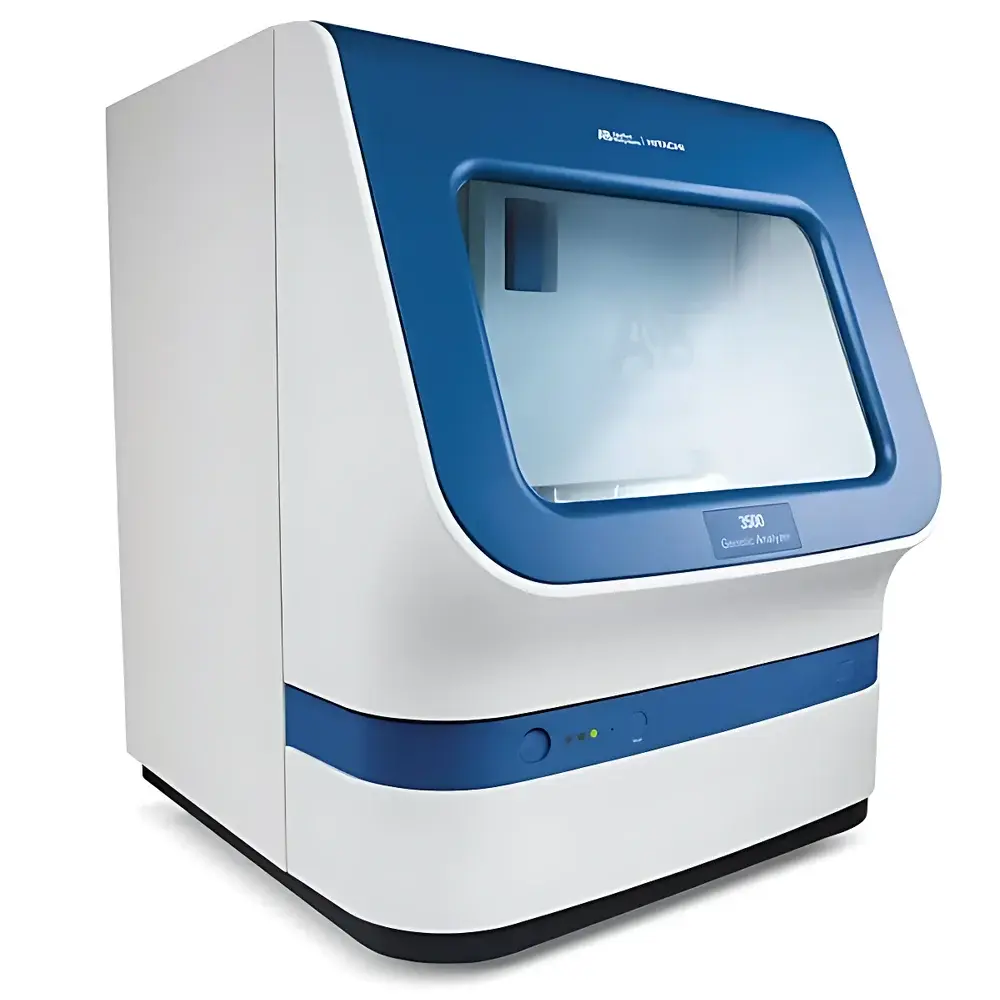
Thermo Fisher Applied Biosystems 3500/3500xL Genetic Analyzer
| Brand | Thermo Fisher Scientific |
|---|---|
| Origin | Japan |
| Manufacturer Type | Original Equipment Manufacturer (OEM) |
| Product Category | Imported Instrument |
| Model | 3500 / 3500xL |
| Instrument Type | First-Generation Sanger Sequencer |
| Throughput | 368 samples/day |
| Read Length | 1000 bp |
| Accuracy | 99.99% |
| Reproducibility | 90% |
| Run Time | 1000 bp per 125 min |
| Capillary Configuration | 8-capillary (3500) or 24-capillary (3500xL), field-upgradeable |
| Laser Source | 505 nm solid-state, air-cooled |
| Temperature Control Range | 18–70 °C |
| Electrophoresis Voltage | up to 20 kV |
Overview
The Thermo Fisher Applied Biosystems 3500/3500xL Genetic Analyzer is a capillary electrophoresis-based Sanger sequencing and fragment analysis platform engineered for high-fidelity DNA fragment separation under stringent regulatory and validation environments. It operates on the principle of size-based electrophoretic mobility in polymer-filled capillaries, coupled with laser-induced fluorescence (LIF) detection at 505 nm. Designed for compliance-critical workflows—including clinical diagnostics, forensic identity testing, and GLP/GMP-aligned research—the system delivers reproducible, traceable, and auditable data generation. Its architecture supports both de novo sequencing and targeted resequencing, as well as multiplexed fragment analysis applications such as microsatellite profiling, LOH, MLPA, AFLP, MLST, and SNP validation. The platform integrates seamlessly with Thermo Fisher’s BigDye® cycle sequencing chemistry and xTerminator™ purification kits, enabling end-to-end workflow optimization without manual intervention between run setups.
Key Features
- Modular capillary configuration: 8-capillary 3500 system or scalable 24-capillary 3500xL—upgradable in-field without hardware replacement
- Advanced thermal management system with dynamic temperature control (18–70 °C), ensuring consistent electrokinetic mobility across runs and capillaries
- 505 nm solid-state laser source with >10,000-hour lifetime, eliminating water-cooling requirements and minimizing signal drift between runs
- RFID-enabled consumables tracking: real-time monitoring of polymer bags, anode/cathode buffer reservoirs, and capillary arrays—including lot number, expiration date, usage count, and instrument-specific deployment history
- Six-color fluorescence detection capability supporting simultaneous analysis of up to six dyes (e.g., FAM, VIC, NED, PET, LIZ, ROX), enabling high-multiplex fragment sizing with reduced per-sample cost
- Pre-formulated, ready-to-load consumables—including pre-filled buffer reservoirs and factory-calibrated capillary arrays—eliminate manual reagent preparation and associated variability
- Intuitive Data Collection Software with embedded QC dashboard: real-time base-calling confidence scoring, peak shape assessment, and electropherogram quality metrics visible during acquisition
Sample Compatibility & Compliance
The 3500/3500xL platform accepts standard Sanger sequencing templates (PCR-amplified or plasmid-derived) and fluorescently labeled PCR products for fragment analysis. It supports all Applied Biosystems BigDye® chemistries (v1.1 through v3.1) and is validated for use with xTerminator™ purification protocols to maximize read length and base-call accuracy. The system meets critical regulatory expectations for instrument qualification, including IQ/OQ/PQ documentation support and full audit trail functionality compliant with FDA 21 CFR Part 11 requirements. Its design aligns with ISO/IEC 17025 principles for testing laboratories and supports GLP-compliant record retention for raw data, method parameters, and consumable metadata. All software modules—including Variant Reporter™, SeqScape®, GeneMapper®, and Sequencing Analysis—undergo periodic verification against reference datasets per CLIA and CAP guidelines.
Software & Data Management
Data Collection Software (DCS) serves as the central interface for instrument control, run scheduling, and real-time data visualization. It features a role-based access control framework, electronic signature support, and automated backup of raw .fsa files with embedded metadata (instrument ID, operator, date/time, capillary ID, polymer lot). DCS exports standardized output formats (.fsa, .txt, .csv) compatible with downstream analysis tools. Integration with Thermo Fisher’s broader bioinformatics ecosystem enables seamless transition from raw electropherograms to variant interpretation: Variant Reporter™ automates heterozygous call resolution and IUPAC ambiguity handling; SeqScape® performs comparative alignment against reference sequences (e.g., hg38, GRCh38); GeneMapper® provides allele binning, stutter filtering, and population frequency estimation for forensic and genetic mapping applications. All software packages maintain version-controlled release notes and are validated per internal SOPs aligned with GAMP5 standards.
Applications
The 3500/3500xL is deployed across diverse life science domains requiring high-confidence sequence confirmation or precise fragment sizing. In clinical molecular labs, it validates somatic mutations identified via NGS, confirms CRISPR editing outcomes, and screens for pharmacogenomic SNPs (e.g., CYP2C19, TPMT). Forensic laboratories use it for STR profiling in CODIS-compatible panels and mitochondrial DNA sequencing. Academic core facilities leverage its flexibility for bacterial strain typing (MLST), loss-of-heterozygosity (LOH) mapping in cancer models, and methylation-sensitive fragment analysis. Its robustness in low-input, high-complexity samples makes it suitable for degraded forensic DNA and formalin-fixed paraffin-embedded (FFPE) tissue extracts. The platform’s ability to run sequencing and fragment analysis on identical capillary arrays and polymer matrices reduces cross-application calibration overhead and accelerates method transfer.
FAQ
Is the 3500/3500xL compatible with third-party sequencing chemistries?
The system is optimized for Thermo Fisher BigDye® terminators and undergoes full performance validation only with these reagents. While some third-party dyes may generate detectable signals, their use voids warranty coverage and invalidates regulatory compliance documentation.
Can the 3500 be upgraded to 3500xL in situ?
Yes—field upgrade kits include new capillary array holder, high-voltage power supply module, and updated firmware. No chassis modification or service engineer dispatch is required beyond standard preventive maintenance intervals.
What data integrity safeguards are built into the software?
DCS enforces write-once archival of raw data files, maintains immutable timestamps for all user actions, logs all parameter changes with operator ID, and generates SHA-256 checksums for exported reports to prevent tampering.
Does the system support 21 CFR Part 11 compliance out of the box?
Yes—electronic signatures, audit trails, and role-based permissions are enabled by default. Full validation documentation (including UAT test scripts and protocol templates) is provided with each installation.
How often must the polymer be replaced?
Polymer bags are single-use per run; buffer reservoirs are designed for reuse up to 10 cycles when cleaned per Thermo Fisher’s SOP-AN-3500-02. RFID tracking automatically disables expired or overused consumables at runtime.






