
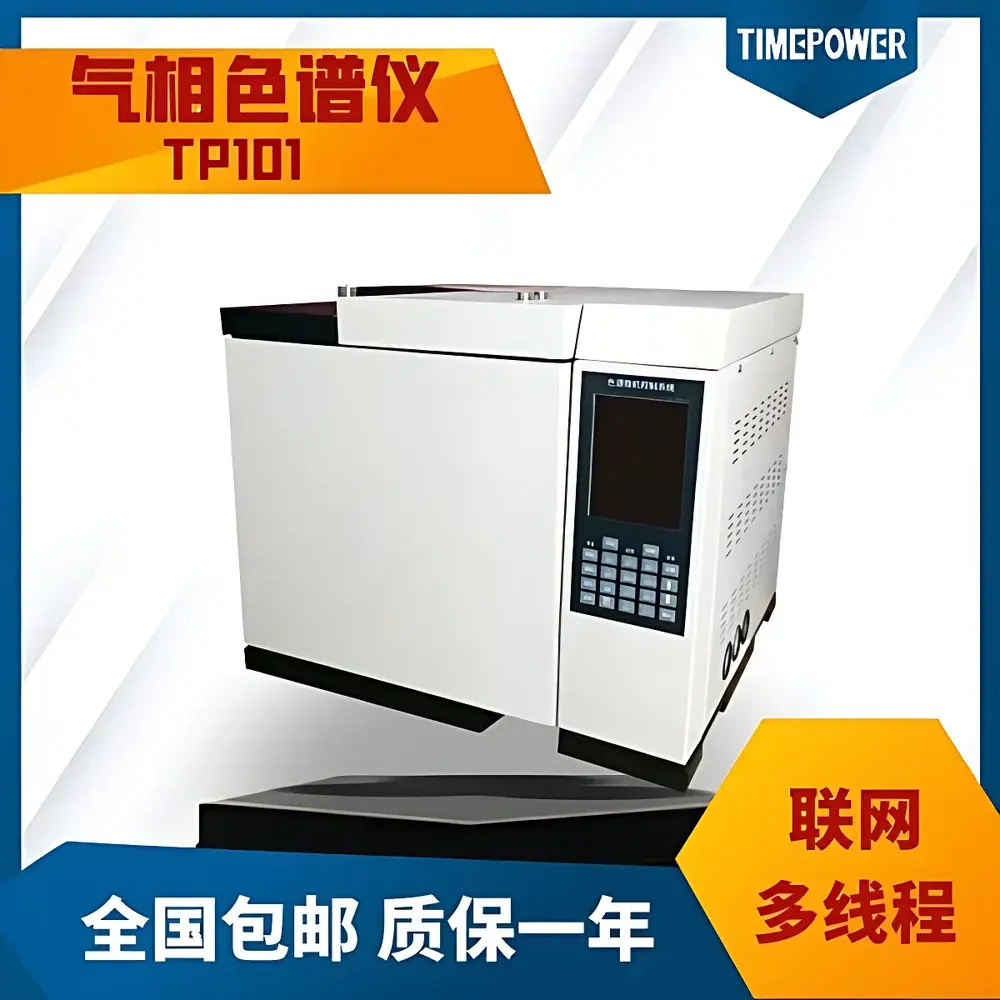
Gas Chromatograph TP101 by TimePower
| Brand | TimePower |
|---|---|
| Origin | Beijing, China |
| Manufacturer Type | Direct Manufacturer |
| Instrument Type | Laboratory Gas Chromatograph |
| Model | TP101 |
| Application Scope | General-Purpose |
| Carrier Gas | Nitrogen (standard configuration) |
| Detection Principle | Partition/Adsorption Equilibrium in Gas-Solid or Gas-Liquid Systems |
| Column Compatibility | Capillary and Packed Columns |
| Operating Mode | Temperature-Programmed and Isothermal Elution |
| Detection Systems Supported | FID, TCD (configurable per application) |
Overview
The TimePower TP101 Gas Chromatograph is a benchtop laboratory-grade analytical instrument engineered for precise separation, identification, and quantification of volatile and semi-volatile organic compounds. It operates on the fundamental principle of gas–solid or gas–liquid partition chromatography: analytes are vaporized in a heated inlet, carried through a temperature-controlled column by an inert carrier gas (typically nitrogen), and differentially retained based on their relative affinities for the stationary phase. This differential retention results in time-resolved elution—where compounds with higher volatility or lower polarity elute earlier—enabling high-resolution separation even in complex matrices. Designed for routine QC, method development, and research applications, the TP101 integrates robust thermal management, stable flow control, and modular detector compatibility to ensure reproducible retention times and peak area precision across extended operation cycles.
Key Features
- Thermally stable oven with programmable ramp rates (0.1–40 °C/min) and isothermal hold capability, supporting precise temperature gradients for optimized resolution of co-eluting peaks.
- Dual independent temperature zones: separately controlled inlet (up to 450 °C) and detector (up to 450 °C) for flexible method adaptation and enhanced sensitivity with thermally labile compounds.
- Electronic pressure control (EPC) for carrier gas, ensuring consistent linear velocity and improved retention time reproducibility (<0.02 min RSD over 24 h).
- Modular detector interface accommodating Flame Ionization Detector (FID) and Thermal Conductivity Detector (TCD) configurations—FID provides sub-picogram detection limits for hydrocarbons; TCD enables universal, non-destructive detection of permanent gases and light organics.
- Front-panel keypad and LCD display for standalone operation, supplemented by optional PC-based control via RS-232/USB interface and compliant driver software.
- Robust mechanical architecture with vibration-dampened column compartment and sealed electronics enclosure—engineered for long-term stability in shared laboratory environments.
Sample Compatibility & Compliance
The TP101 accepts liquid, gaseous, and headspace-derived samples via split/splitless injection or direct gas sampling valves. It supports standard 0.25–0.53 mm ID fused-silica capillary columns (e.g., DB-5ms, HP-INNOWAX) as well as packed stainless-steel or glass columns for legacy or specialized methods. Method validation workflows align with internationally recognized guidelines including ASTM D3606 (gasoline aromatics), ISO 10301 (petrochemical hydrocarbon analysis), and USP (chromatographic separations). The system’s hardware design and firmware architecture support audit-trail-enabled data acquisition when integrated with compliant LIMS or chromatography data systems (CDS), facilitating adherence to GLP and GMP documentation requirements per FDA 21 CFR Part 11 where electronic records and signatures are mandated.
Software & Data Management
TimePower GC Control Software (v3.2+) provides intuitive method setup, real-time chromatogram visualization, peak integration using tangent skim or valley-to-valley algorithms, and customizable reporting templates. Raw data files (.tdf) are stored in vendor-neutral formats compatible with third-party processing tools (e.g., OpenChrom, Chromeleon). All acquisition events—including method parameters, instrument status logs, user login timestamps, and manual integration edits—are recorded with immutable timestamps and operator IDs. Export options include CSV, PDF, and XML formats suitable for regulatory submission packages. Optional CDS integration enables centralized instrument scheduling, automated calibration verification, and cross-platform result comparison across multi-instrument labs.
Applications
The TP101 serves diverse analytical needs across regulated and research-driven sectors. In petrochemical laboratories, it quantifies benzene, toluene, ethylbenzene, and xylenes (BTEX) in gasoline per EPA Method 8021B. Pharmaceutical QC labs employ it for residual solvent analysis (ICH Q3C) in active pharmaceutical ingredients (APIs) using headspace-GC/FID. Environmental testing facilities apply it to detect chlorinated pesticides (e.g., DDT, lindane) in soil extracts following EPA Method 8081. Forensic toxicology units utilize its high specificity for volatile substance screening in blood or tissue homogenates. Additionally, it supports polymer additive profiling, flavor/aroma compound identification in food science, and purity assessment of synthetic intermediates in fine chemical manufacturing.
FAQ
What carrier gases are supported, and how is flow accuracy maintained?
Nitrogen is the default carrier gas; hydrogen and helium configurations are available upon request. Flow accuracy is ensured via embedded EPC modules calibrated against NIST-traceable flow standards, delivering ±0.5% full-scale repeatability.
Can the TP101 be used for method transfer from other GC platforms?
Yes—its standardized column dimensions, temperature programming syntax, and detector response linearity allow straightforward migration of validated methods from Agilent, Shimadzu, or Thermo platforms with minor retention time optimization.
Is the system compliant with 21 CFR Part 11 for regulated laboratories?
Out-of-the-box, the TP101 meets hardware-level requirements (audit trail logging, user authentication). Full Part 11 compliance requires deployment with validated CDS software and documented SOPs for electronic signature implementation.
What maintenance intervals are recommended for optimal performance?
Inlet liner replacement every 100 injections; septum change every 50–100 runs; column trimming every 2–3 months depending on sample cleanliness; detector cleaning quarterly for FID, biannually for TCD.
Does TimePower offer application support or method development assistance?
Yes—TimePower provides remote application consulting, on-site method optimization workshops, and custom column selection guidance based on analyte polarity, boiling point, and matrix complexity.



