
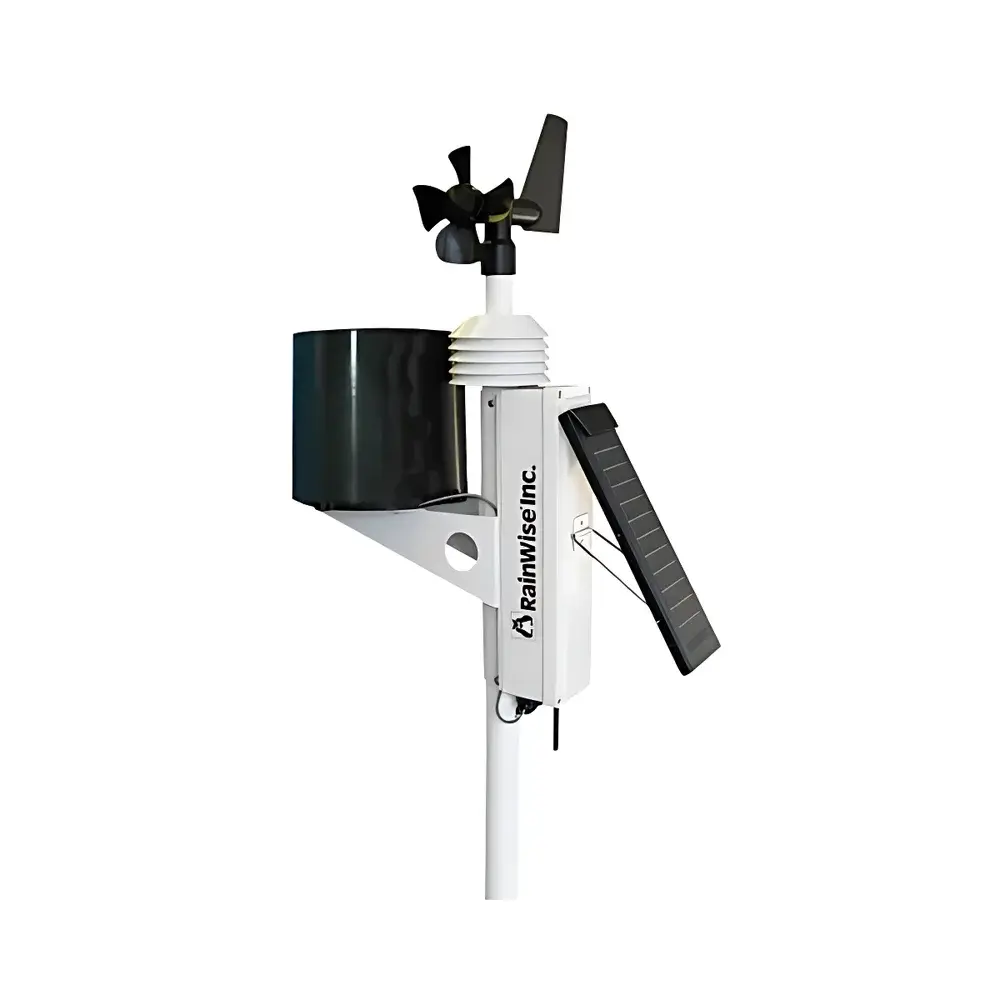
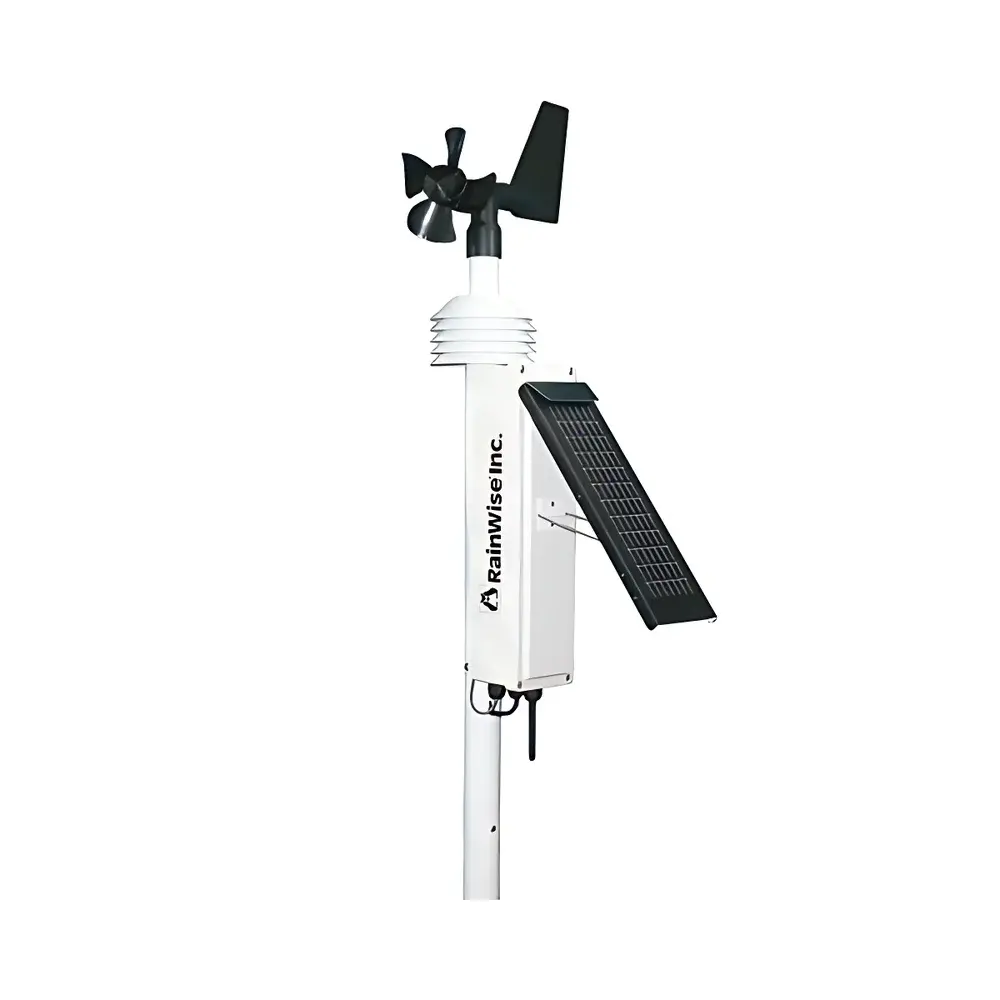
RainWise MK-III-LR Integrated Weather Sensor
| Brand | RainWise |
|---|---|
| Origin | USA |
| Model | MK-III-LR |
| Instrument Type | Portable Weather Station |
| Wireless Frequency | 2.4 GHz ISM Band |
| Max Transmission Distance | 1600 m (line-of-sight) |
| Wind Speed Range | 0–67 m/s |
| Wind Speed Resolution | 0.1 m/s |
| Wind Speed Accuracy | ±2% FS |
| Wind Start Threshold | 0.5 m/s |
| Wind Direction Range | 0–360° |
| Wind Direction Accuracy | ±3° |
| Wind Direction Resolution | 1° |
| Air Temperature Range | −54 to +74 °C |
| Temp Accuracy | ±0.5 °C |
| Temp Resolution | 0.1 °C |
| Relative Humidity Range | 0–100 %RH |
| RH Accuracy | ±2% (−40 to +85 °C) |
| Barometric Pressure Range | 300–1100 hPa |
| Pressure Accuracy | ±0.5 hPa @ 25 °C (temp-compensated from −40 to +85 °C) |
| Rainfall Collection | 8-inch tipping bucket |
| Rain Resolution | 0.25 mm |
| Rain Accuracy | ±2% |
| Solar-Powered Operation | Supports 60-day autonomy in darkness (latitudes <60°N/S) |
| Enclosure Materials | Stainless steel, fiberglass, UV-stabilized PVC |
| NIST-Traceable Calibration | Wind, temp, RH, pressure, dew point |
Overview
The RainWise MK-III-LR Integrated Weather Sensor is a field-deployable, solar-powered environmental monitoring system engineered for long-term reliability and metrological integrity in remote or infrastructure-limited settings. Designed around Couette-type propeller anemometry and precision thermistor/hygrometer elements housed in a NWS-standard aspirated radiation shield, the MK-III-LR delivers continuous, high-fidelity measurements of wind speed and direction (2-second update interval), ambient temperature, relative humidity, barometric pressure, and precipitation. Its 2.4 GHz ISM-band wireless transceiver enables robust telemetry over line-of-sight distances up to 1600 meters—ideal for distributed sensor networks across agricultural fields, wildfire-prone wildlands, coastal observatories, and transportation corridor monitoring sites. The unit’s compact monopole architecture (84 cm height, 3.2 kg sensor head weight) minimizes wind loading and simplifies mounting on tripods, poles, or building structures without requiring trenching or hardwired power infrastructure.
Key Features
- Proprietary industrial-grade propeller anemometer with dual-axis wind vane—engineered for low-threshold response (0.5 m/s start-up) and high reproducibility under turbulent flow conditions.
- NIST-traceable calibration certificates provided for all primary sensors: wind speed/direction, temperature, relative humidity, barometric pressure, and dew point—fully documented per ISO/IEC 17025 requirements.
- Passive, galvanically isolated sensor-to-transmitter architecture eliminates direct electrical pathways between exposed sensors and the data logger—mitigating lightning-induced surge damage and eliminating grounding loop risks.
- Integrated solar-charged lithium battery system supports continuous operation for up to 60 days without sunlight (valid at latitudes <60°), with automatic low-power mode activation during extended cloud cover.
- Weather-resistant enclosure fabricated from marine-grade stainless steel fasteners, UV-stabilized fiberglass housing, and corrosion-inhibiting PVC components—rated IP66 per IEC 60529 for dust and water ingress protection.
- Optional configurations: MK-III RTI-LR (includes 8-inch calibrated tipping-bucket rain gauge) and MK-III RTN-LR (rain gauge excluded), both sharing identical core sensor architecture and firmware.
Sample Compatibility & Compliance
The MK-III-LR is designed for outdoor atmospheric sampling in uncontrolled environments—from arctic tundra to tropical coastal zones. Its temperature and humidity sensors are mounted within a passive, double-louvered radiation shield conforming to NOAA/NWS Standard 101B specifications, ensuring minimal radiative heating error and representative ambient air characterization. All measurement outputs comply with WMO Guide to Instruments and Observing Methods (WMO-No. 8) recommendations for surface meteorological variables. The device meets FCC Part 15 Subpart C (USA) and ETSI EN 300 440 (EU) regulatory requirements for short-range devices. Pressure readings incorporate real-time temperature compensation across −40 to +85 °C, satisfying ASTM D6988-18 criteria for environmental pressure instrumentation stability.
Software & Data Management
Data output is delivered via RS-232 serial interface or 2.4 GHz wireless packet transmission using RainWise’s proprietary binary protocol—compatible with industry-standard SCADA platforms (e.g., Campbell Scientific LoggerNet, DTN WeatherLink, and custom Python/Node-RED ingestion pipelines). Time-stamped records include UTC synchronization via internal quartz oscillator (±2 sec/month drift). Firmware supports configurable reporting intervals (1–300 seconds), burst-mode logging, and alarm-triggered event capture. Raw sensor values are accompanied by diagnostic flags (e.g., voltage status, signal saturation, heater activation) to support GLP-compliant audit trails. While the MK-III-LR itself does not embed FDA 21 CFR Part 11-compliant electronic signatures, its data streams integrate seamlessly with validated third-party data acquisition systems that provide full audit-log functionality, user access controls, and electronic record retention per ISO 17025 Clause 7.5.2.
Applications
- Wildfire risk assessment networks—real-time wind gust detection and humidity-driven fuel moisture modeling.
- Agricultural microclimate monitoring—irrigation scheduling support via evapotranspiration (ET₀) calculation inputs.
- Aviation ground support—low-level wind shear and density altitude forecasting at general aviation airports.
- Renewable energy site assessment—long-term wind resource characterization for small-scale turbine feasibility studies.
- Climate resilience infrastructure—coastal flood early warning integration with barometric pressure trend analysis.
- Educational and citizen science deployments—modular design supports STEM curriculum-aligned data collection and visualization projects.
FAQ
Is the MK-III-LR suitable for permanent installation in salt-laden coastal environments?
Yes—the stainless steel hardware, fiberglass structural elements, and UV-stabilized polymer housings have undergone accelerated salt fog testing per ASTM B117, demonstrating no functional degradation after 1,000 hours of exposure.
Does the system support external data logging via USB or SD card?
No—the MK-III-LR is a sensor-transmitter only; local storage requires integration with a compatible RainWise or third-party datalogger (e.g., CR1000X, HOBO U30).
Can the tipping-bucket rain gauge be retrofitted to an RTN-LR unit?
No—RTI-LR and RTN-LR are mechanically distinct assemblies; the rain gauge is integrated into the base casting and cannot be added post-manufacture.
What is the expected service life of the solar panel and battery under continuous operation?
The monocrystalline solar module maintains ≥85% output after 10 years; the LiFePO₄ battery pack is rated for 2,000 cycles at 80% depth-of-discharge, translating to >5 years of typical field service life.
Are firmware updates available, and how are they deployed?
Yes—firmware revisions are distributed as signed binaries via RainWise’s secure customer portal and installed via serial connection using the RainWise Configuration Utility (Windows/macOS/Linux).







