
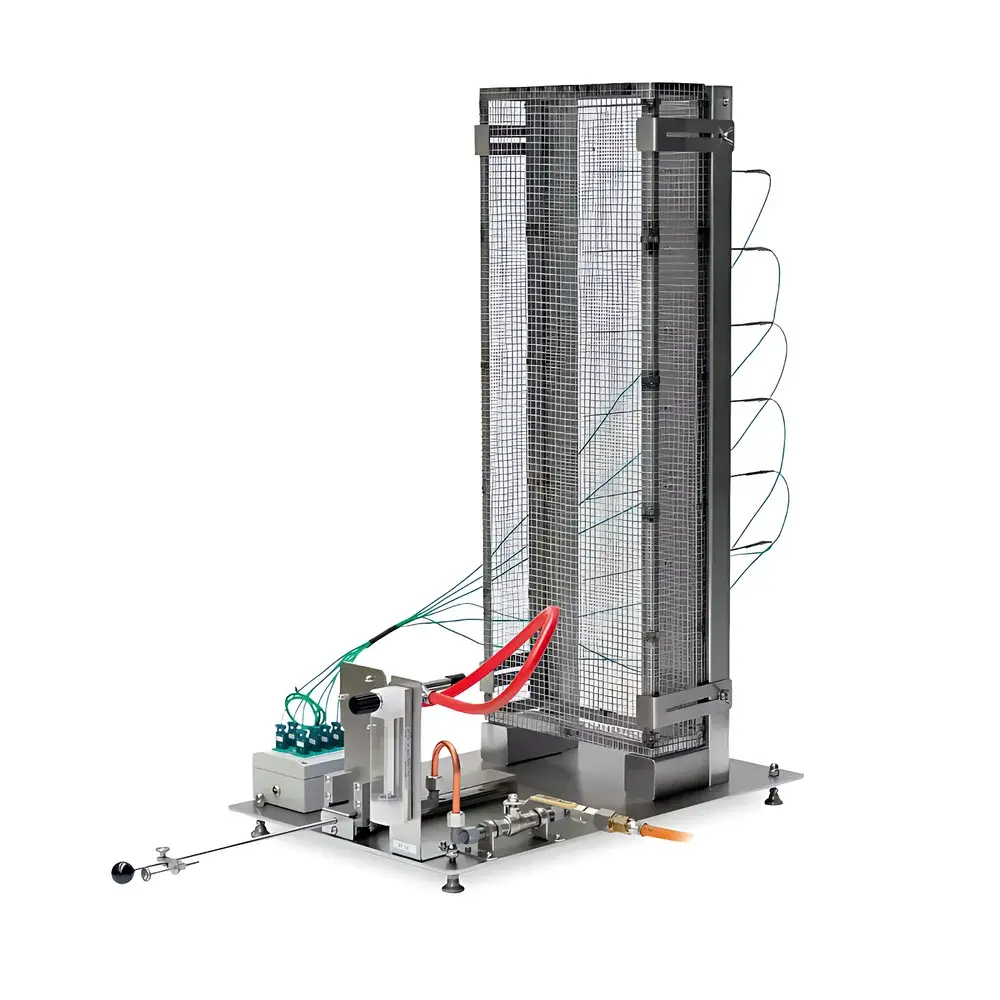
Netzsch TSP Smoldering Test Apparatus
| Brand | Netzsch |
|---|---|
| Origin | Germany |
| Model | TSP Smoldering Test Apparatus |
| Compliance Standard | DIN EN 16733 |
| Sample Dimensions | 800 mm (L) × 300 mm (W) × ≤100 mm (T) |
| Sample Holder Material | Stainless Steel |
| Thermocouple Type | K-type NiCr–Ni armored |
| Ambient Operating Temperature | +20 ± 10 °C |
| Fire Suppression Plate Material | Calcium Silicate |
| Gas Control | Front-mounted main gas valve and pressure regulator |
| Flow Control | Adjustable flow restrictor and variable-area rotameter |
| Safety Features | Integrated flame-quenching plate with certified thermal inertia |
Overview
The Netzsch TSP Smoldering Test Apparatus is a precision-engineered single-burner test system designed for the standardized evaluation of sustained smoldering combustion behavior in construction products. It operates in strict accordance with DIN EN 16733, a European standard specifying methodology for assessing the propensity of building materials to initiate and maintain smoldering ignition under controlled thermal exposure—particularly relevant for upholstered furniture, insulation composites, and sandwich panels containing organic foams or fibrous fillers. Unlike flaming combustion tests, this apparatus isolates the low-temperature oxidative degradation pathway characteristic of smoldering, where exothermic surface oxidation propagates without visible flame, often generating significant smoke and toxic gases. The system employs a calibrated radiant heat source combined with a defined propane-air diffusion flame impingement geometry to simulate realistic ignition conditions encountered in real-world fire scenarios. Its architecture ensures reproducible thermal flux distribution, precise gas stoichiometry control, and thermally stable test chamber boundary conditions—critical for inter-laboratory comparability and regulatory acceptance.
Key Features
- Stainless steel sample holder engineered for dimensional stability and corrosion resistance during repeated thermal cycling, accommodating specimens up to 800 mm in length, 300 mm in width, and 100 mm in thickness.
- Front-access main gas valve and integrated pressure regulator enable rapid, tool-free setup and real-time adjustment of fuel supply—minimizing procedural variability between operators.
- Adjustable mechanical stop blocks and a calibrated variable-area rotameter allow fine-tuned control over propane mass flow rate, ensuring compliance with the ±5% volumetric tolerance specified in DIN EN 16733 Annex A.
- Calcium silicate fire suppression plate positioned beneath the specimen mount provides rapid, non-reactive quenching by thermal mass absorption—eliminating post-test reignition risk while maintaining material integrity for subsequent analysis.
- K-type NiCr–Ni armored thermocouples mounted at prescribed locations (front face, rear face, and substrate interface per Clause 7.2 of DIN EN 16733) deliver traceable temperature monitoring with ±1.5 °C accuracy across the operational range.
- Modular enclosure design facilitates ISO/IEC 17025-compliant calibration verification and routine maintenance without disassembly of critical gas train components.
Sample Compatibility & Compliance
The TSP apparatus accepts flat, rigid, or semi-rigid construction products—including mineral wool boards, polyurethane and melamine foams, wood-based panels, textile laminates, and coated substrates—as long as they meet dimensional and mounting requirements defined in DIN EN 16733 Section 5. Specimens must be conditioned at +20 ± 10 °C and 65 ± 5 % RH for a minimum of 48 hours prior to testing. The system supports full traceability documentation required for CE marking under Construction Products Regulation (EU) No. 305/2011 and is routinely referenced in national fire classification schemes (e.g., German DIN 4102-1, French NF P 92-501). While not directly aligned with ASTM E84 or UL 723, its output parameters—smoldering onset time, propagation rate, and residual char depth—are admissible as supplementary data in extended fire safety assessments conducted under NFPA 286 or ISO 9705 protocols.
Software & Data Management
The TSP Smoldering Test Apparatus operates as a standalone hardware platform; however, it is fully compatible with third-party data acquisition systems compliant with IEC 61508 SIL2 and FDA 21 CFR Part 11 requirements. Analog outputs from thermocouples and pressure transducers are routed via shielded 4–20 mA or 0–10 V interfaces to external DAQ units supporting timestamped logging, audit trail generation, and electronic signature workflows. All raw thermal and gas flow records are retained in CSV or TDMS format for GLP/GMP-aligned review. Netzsch provides optional configuration support for integration into laboratory information management systems (LIMS) via OPC UA or Modbus TCP protocols—enabling automated report generation aligned with EN ISO/IEC 17025 Clause 7.8.2.
Applications
- Regulatory qualification of flame-retardant additives in flexible polyurethane foams used in contract furniture.
- Development and validation of intumescent coatings for steel-framed wall assemblies subject to smoldering ignition risk.
- Comparative assessment of char-forming behavior in bio-based insulation materials versus conventional petrochemical derivatives.
- Root-cause analysis of field-reported smoldering incidents in HVAC duct linings and acoustic ceiling tiles.
- Supporting technical dossiers for Building Information Modeling (BIM)-integrated fire safety engineering simulations.
FAQ
Does the TSP apparatus require external exhaust hood integration?
Yes. A dedicated fume extraction system with ≥0.5 m/s face velocity at the test chamber opening is mandatory to comply with DIN EN 16733 Clause 4.2 and ensure operator safety during smoke and CO evolution.
Can the system be used for vertical orientation testing?
No. The TSP apparatus is configured exclusively for horizontal specimen placement per DIN EN 16733 Section 6. Vertical smoldering assessment requires separate apparatus conforming to ISO 5659-2 or ASTM D7585.
Is calibration certification included with delivery?
Each unit ships with a factory-issued calibration certificate covering thermocouple linearity, gas flow meter accuracy, and radiant panel emissivity—traceable to PTB (Physikalisch-Technische Bundesanstalt) standards.
What maintenance intervals are recommended?
Gas train components require quarterly leak-checking per DIN EN 16733 Annex C; thermocouple verification is advised before each test series using a NIST-traceable reference junction.



