
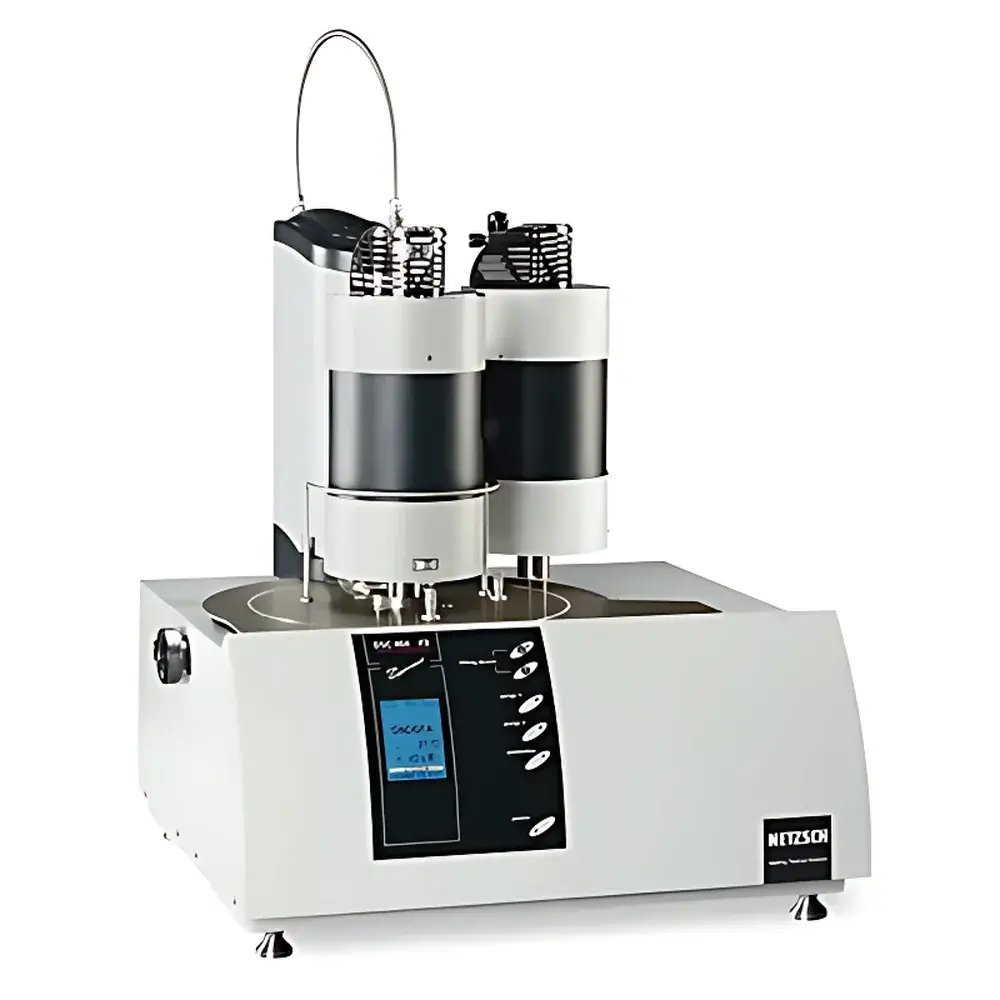
Netzsch DSC 404 F3 Pegasus Differential Scanning Calorimeter
| Brand | Netzsch |
|---|---|
| Origin | Germany |
| Model | DSC 404 F3 Pegasus |
| Temperature Range | −150 to 2000 °C |
| Temperature Accuracy | ±0.1 K |
| Heating/Cooling Rate | 0–50 K/min |
Overview
The Netzsch DSC 404 F3 Pegasus is a high-performance, modular differential scanning calorimeter engineered for precision thermal characterization across an exceptionally broad temperature range—from cryogenic conditions at −150 °C up to ultra-high temperatures of 2000 °C. Operating on the heat-flux DSC principle, it measures the difference in heat flow between a sample and an inert reference as both are subjected to identical, programmable temperature ramps under controlled atmospheric or vacuum conditions. This enables quantitative determination of enthalpic transitions—including glass transitions, melting, crystallization, solid-solid phase transformations, decomposition, and oxidative stability—across inorganic ceramics, metallic alloys, polymers, pharmaceuticals, composites, and food matrices. Its design adheres rigorously to international standards governing thermal analysis, including ISO 11357 (plastics), ASTM E967 (onset temperature), ASTM E968 (heat capacity calibration), ASTM E793 (enthalpy measurement), ASTM D3895 (oxidative induction time), ASTM D3417 (polymer melting), and ASTM D3418 (transition temperatures), ensuring data traceability and regulatory acceptability in R&D, quality control, and failure analysis workflows.
Key Features
- Modular furnace architecture supporting single- or dual-furnace configurations with motorized positioning for automated multi-sample analysis
- High-vacuum sealed system (≤10⁻⁵ mbar) with metal-sealed mass flow controllers (MFCs) for precise, contamination-free gas atmosphere management (inert, oxidizing, or reactive)
- Interchangeable sensor modules: high-sensitivity DSC sensors for −150 to 1650 °C; DTA sensors extending coverage to 2000 °C
- Optimized furnace geometry delivering exceptional temperature homogeneity and radial thermal symmetry—critical for baseline stability and reproducibility of transition onset and peak shape
- Ultra-low time constant sensors enabling high-resolution detection of weak or overlapping thermal events, even at rapid heating rates up to 50 K/min
- Automated 20-position sample changer compatible with a wide range of crucible materials (alumina, platinum, gold, graphite, sapphire) and geometries (hermetic, vented, high-pressure)
Sample Compatibility & Compliance
The DSC 404 F3 accommodates diverse sample forms—including powders, granules, films, fibers, bulk solids, and viscous pastes—with minimal preparation requirements. Its robust mechanical design and configurable crucible options support analyses under stringent environmental constraints, such as high-purity argon purging for moisture-sensitive organics or oxygen-rich atmospheres for oxidation kinetics. The instrument meets essential compliance frameworks for regulated industries: data integrity and audit trail functionality align with FDA 21 CFR Part 11 requirements when operated with NETZSCH Proteus® Software in validated mode; thermal calibration protocols satisfy ISO/IEC 17025 laboratory accreditation criteria; and thermal event reporting conforms to GLP and GMP documentation standards for pharmaceutical and material qualification dossiers.
Software & Data Management
Controlled exclusively via NETZSCH Proteus® Software—a platform validated for scientific and industrial use—the DSC 404 F3 provides full experimental setup, real-time monitoring, and advanced post-processing capabilities. Proteus® supports multi-step temperature programs, automatic baseline correction, peak deconvolution, kinetic modeling (e.g., Ozawa-Flynn-Wall, Kissinger), and heat capacity normalization. Raw data files (.ASC) are stored in ASCII format for long-term archival and third-party interoperability. Integrated reporting tools generate PDF or Excel outputs compliant with internal SOPs and external submission requirements (e.g., ICH Q5C, USP ). Optional modules enable remote diagnostics, instrument fleet monitoring, and electronic lab notebook (ELN) integration via API.
Applications
- Thermal stability assessment of battery cathode/anode materials under cycling-relevant heating profiles
- Polymorph screening and thermodynamic ranking of active pharmaceutical ingredients (APIs) per ICH Q5A guidelines
- Crystallinity quantification in semi-crystalline thermoplastics (e.g., PP, PET, PEEK) using enthalpy-of-fusion calibration
- Phase diagram construction for refractory metal alloys and oxide ceramics via high-temperature DTA mapping
- Oxidative induction time (OIT) and oxidative onset temperature (OOT) determination for polymer stabilization studies per ASTM D3895
- Low-temperature glass transition analysis of cryoprotectants and biopolymer hydrogels down to −150 °C
FAQ
What temperature calibration standards are recommended for routine verification?
Standard reference materials including indium (156.6 °C), zinc (419.5 °C), aluminum (660.3 °C), silver (961.8 °C), and gold (1064.2 °C) are used for temperature calibration; high-purity synthetic sapphire serves for heat capacity calibration.
Can the DSC 404 F3 perform simultaneous DSC-TGA measurements?
No—this is a dedicated DSC platform. For simultaneous thermal analysis, NETZSCH’s STA 449 F5 Jupiter or STA 409 series combine DSC and TGA in a single furnace configuration.
Is the system compatible with nitrogen dioxide or hydrogen sulfide atmospheres?
Yes—when equipped with corrosion-resistant MFCs, quartz or ceramic gas lines, and chemically inert crucibles (e.g., alumina or graphite), the system supports reactive gas environments under engineering supervision.
How is baseline drift minimized during extended high-temperature runs?
The symmetric furnace design, low-thermal-mass sensor mounting, and active furnace temperature stabilization collectively suppress baseline curvature, while software-based polynomial correction algorithms further refine long-term stability.
Does the instrument support Good Manufacturing Practice (GMP) workflows?
Yes—when deployed with Proteus® Software in 21 CFR Part 11-compliant configuration (user access controls, electronic signatures, audit trails), it fulfills core GMP data integrity requirements for QC laboratories.



