
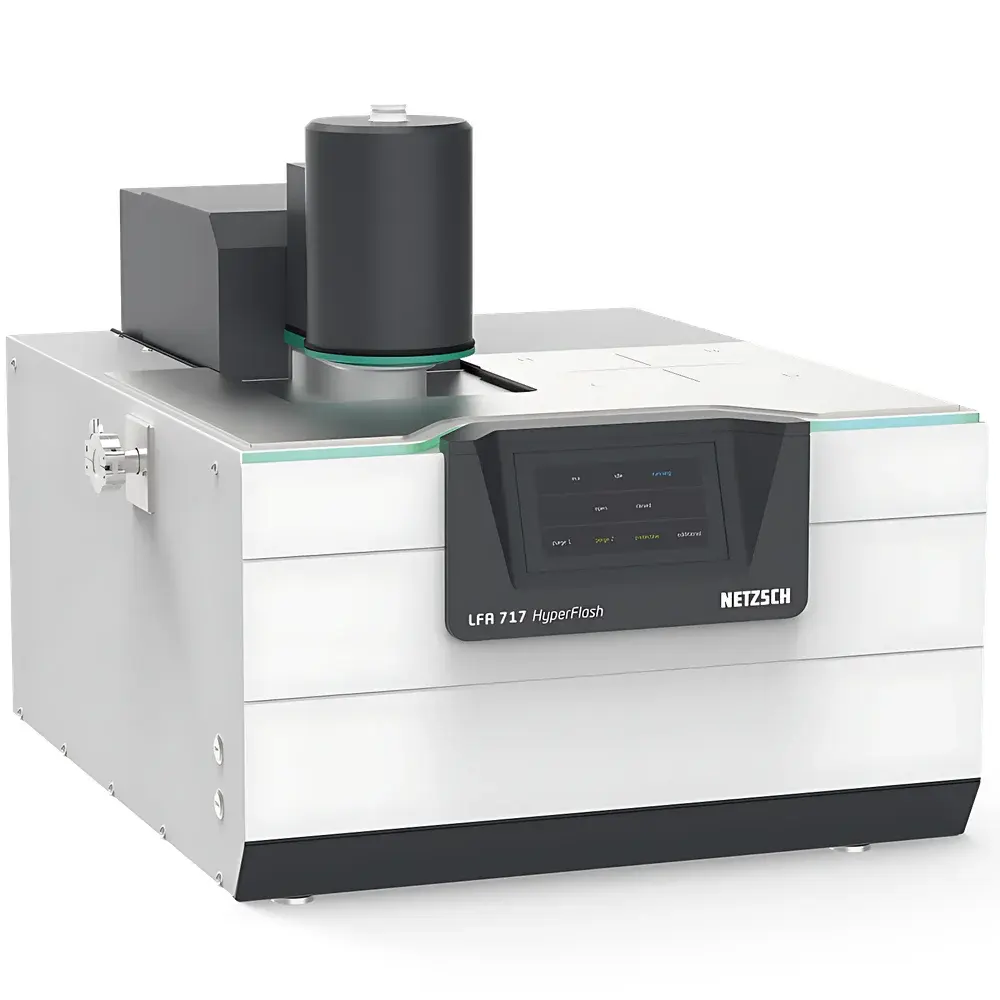
Netzsch LFA 467 HyperFlash HT Laser Flash Thermal Conductivity Analyzer
| Brand | Netzsch |
|---|---|
| Origin | Germany |
| Model | LFA 467 HyperFlash HT |
| Measurement Principle | Laser Flash Method (LFA) |
| Temperature Range | RT to 1250 °C |
| Thermal Conductivity Range | 0.1 – 4000 W/(m·K) |
| Accuracy | ±3% |
| Repeatability | ±2% |
| Pulse Source | Adjustable-energy xenon lamp, pulse width <2 µs |
| Detection Rate | up to 2 MHz |
| Sample Forms | Solid, liquid, powder, thin film |
| Atmosphere Options | Inert or oxidative (vacuum-tight chamber) |
| Dimensions (L×W×H) | 600 mm × 500 mm × 600 mm |
| Sample Capacity | Up to 4 positions with independent thermocouples |
| Compliance | ASTM E1461, ASTM E2585, ISO 22007-4, ISO 18755, ISO 13826, DIN EN 821-2, DIN 30905, DIN EN 1159-2 |
Overview
The Netzsch LFA 467 HyperFlash HT is a high-temperature laser flash thermal conductivity analyzer engineered for precision measurement of thermal diffusivity (α), specific heat capacity (cp), and derived thermal conductivity (λ = α·ρ·cp) across an extended operational range from ambient temperature to 1250 °C. Based on the standardized laser flash method (LFA), the instrument delivers quantitative thermophysical property data under controlled atmospheres—including inert (e.g., Ar, N2) or oxidative (e.g., air, O2) conditions—within a vacuum-tight furnace chamber. Its core measurement principle relies on transient thermal response: a short, uniform energy pulse from a high-intensity xenon lamp irradiates the front surface of a planar sample; an infrared detector then records the time-resolved rear-surface temperature rise. Mathematical deconvolution of this thermal wave yields thermal diffusivity, while simultaneous mass and geometry measurements—combined with density and cp data (optionally acquired via DSC or supplied externally)—enable full thermal conductivity determination.
Key Features
- ZoomOptics™ detection system: Patented optical focusing mechanism that dynamically adjusts field-of-view to exclude edge effects and peripheral thermal noise, significantly improving signal fidelity and measurement accuracy—especially critical for small, irregular, or low-emissivity samples.
- High-speed acquisition architecture: Real-time data capture at up to 2 MHz enables resolution of ultrafast thermal transients, supporting reliable characterization of highly conductive materials (e.g., copper, graphite, SiC) and thin films down to sub-millimeter thicknesses.
- Adjustable xenon flash source: Energy output and pulse duration (<2 µs minimum) are software-controlled, allowing optimization for diverse sample types—from low-diffusivity polymers to refractory ceramics—without hardware modification.
- Integrated four-position automatic sample changer (ASC): Each position features an individual K-type thermocouple embedded in the sample holder, minimizing thermal lag between measured furnace temperature and actual sample surface temperature—critical for high-accuracy cp derivation and cross-temperature reproducibility.
- Compact single-furnace design with active water cooling: Efficient internal circulation maintains structural integrity and detector stability at elevated temperatures, reducing reliance on cryogenic coolants and extending IR detector service intervals.
Sample Compatibility & Compliance
The LFA 467 HT accommodates disk-shaped (10 mm or 12.7 mm diameter), square (10 mm), powdered (pressed into pellets), thin-film (mounted on substrates), and even low-viscosity liquid samples (in sealed quartz crucibles). Sample thickness typically ranges from 0.5 mm to 5 mm, with optimal performance achieved when aspect ratio (diameter/thickness) exceeds 4:1. All measurements adhere to internationally recognized standards including ASTM E1461 (standard test method for thermal diffusivity by the flash method), ASTM E2585 (for high-temperature applications), ISO 22007-4 (plastics), ISO 18755 (ceramics), and DIN EN 1159-2 (advanced ceramics). The system supports GLP-compliant operation through configurable audit trails, electronic signatures, and user-access controls aligned with FDA 21 CFR Part 11 requirements.
Software & Data Management
The instrument operates under Netzsch Proteus® software—a modular platform supporting full instrument control, real-time visualization, automated calibration routines (including standard reference materials such as NIST SRM 736), and advanced data evaluation algorithms (e.g., Cowan, Freitas, and error-minimized iterative models). Raw thermal rise curves are stored in vendor-neutral ASCII format; processed results export directly to CSV, Excel, or PDF reports with traceable metadata (operator ID, timestamp, atmospheric conditions, pulse parameters). Optional modules include cp integration with DSC data, uncertainty propagation analysis per GUM guidelines, and networked deployment for centralized lab management systems.
Applications
This analyzer serves R&D and QA/QC laboratories in aerospace (thermal barrier coatings, CMCs), energy (nuclear fuel matrices, battery electrode materials), electronics (heat spreaders, substrate materials), metallurgy (superalloys, refractory metals), and advanced ceramics (Si3N4, Al2O3). It is routinely deployed for qualification of thermal interface materials (TIMs), validation of finite-element thermal models, aging studies under thermal cycling, and regulatory submissions requiring ISO/IEC 17025-compliant thermophysical data.
FAQ
What temperature calibration standards are supported?
NIST-traceable reference materials—including sapphire, nickel, and graphite—are preloaded in Proteus® with certified α(T) functions for automated furnace calibration verification across the full 25–1250 °C range.
Can the system measure anisotropic materials?
Yes—by orienting cut specimens to isolate in-plane vs. through-thickness thermal transport, and applying directional correction factors during data evaluation.
Is vacuum operation required for all measurements?
No—vacuum is optional and primarily used to eliminate convective heat loss or prevent oxidation; inert gas purging is sufficient for most ceramic and metallic samples.
How is sample emissivity accounted for in high-temperature measurements?
Proteus® includes emissivity correction tools based on multi-wavelength IR detection and reference blackbody calibration, minimizing radiative error above 600 °C.
Does the ASC support non-standard sample geometries?
Standard holders accept only 10 mm and 12.7 mm disks or 10 mm squares; custom fixtures for irregular shapes can be fabricated upon request and validated per ISO 17025 procedures.



