
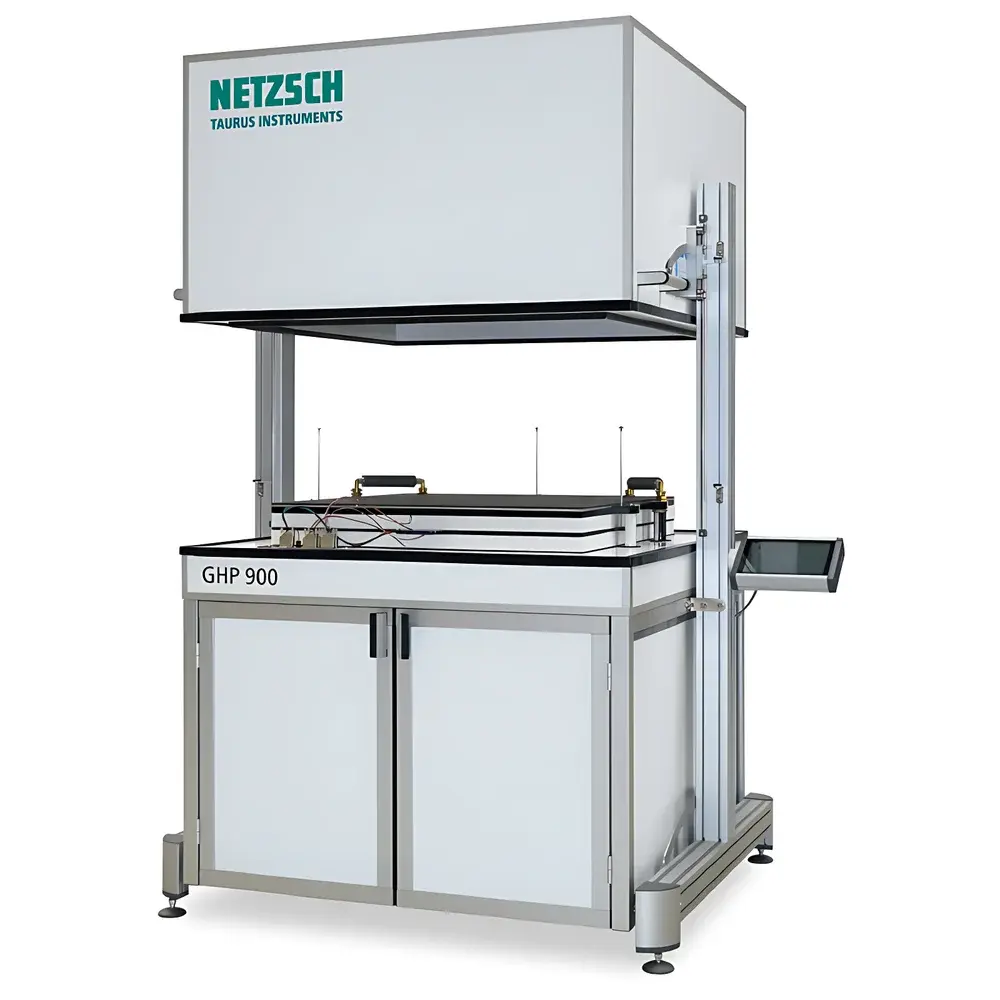
Netzsch TAURUS GHP 900 Guarded Hot Plate Thermal Conductivity Analyzer
| Brand | Netzsch |
|---|---|
| Origin | Germany |
| Model | TAURUS GHP 900 |
| Measurement Principle | Guarded Hot Plate (GHP) |
| Standard Compliance | ISO 8302, ASTM C177, EN 12664, EN 12667, EN 12939, EN 1946-2 |
| Thermal Conductivity Range | 0.005 – 2.0 W/(m·K) |
| Accuracy | ±1.0% |
| Repeatability | ±0.5% |
| Sample Thickness (Single-Sided) | 15 – 280 mm |
| Sample Thickness (Double-Sided) | 2 × 15 – 140 mm |
| Sample Area | 200 × 200 mm to 500 × 500 mm (optional up to 900 × 900 mm) |
| Cold Plate Temperature Range | −10 to +60 °C |
| Hot Plate Temperature Range | 0 to +70 °C |
| Chamber Dimensions (H × W × D) | 233 × 146 × 126 cm |
| Guarded Enclosure | Full adiabatic shielding with active temperature control |
| Automation | Motorized upper plate lift, adjustable heating area, multi-directional sample access |
Overview
The Netzsch TAURUS GHP 900 is a high-precision guarded hot plate (GHP) thermal conductivity analyzer engineered for absolute, steady-state measurement of thermal transport properties in low-to-moderate conductivity solid materials. Based on the fundamental principle of Fourier’s law under controlled one-dimensional heat flow, the instrument establishes a stable thermal gradient across a planar specimen sandwiched between a centrally heated hot plate and a symmetrically cooled cold plate, while actively suppressing lateral heat losses via a precisely temperature-regulated guard ring and insulated enclosure. This architecture ensures metrological traceability to national standards and delivers primary-standard-level accuracy—making the TAURUS GHP 900 a reference-grade solution for R&D laboratories, national metrology institutes, and quality assurance departments requiring certified thermal property data for regulatory submissions or material qualification.
Key Features
- Full adiabatic guarding system with independently controlled guard ring and perimeter insulation, minimizing edge losses and enabling reliable measurements on specimens up to 280 mm thick (single-sided mode)
- Motorized, programmable vertical actuation of the upper (cold) plate for precise gap control and repeatable sample loading without mechanical stress
- Adjustable heating area from 200 × 200 mm to 500 × 500 mm (with optional 900 × 900 mm configuration), supporting standardized test specimens as well as large-format building panels
- Dual-mode operation: configurable for single-specimen (hot plate–specimen–cold plate) or double-specimen (hot plate–specimen–cold plate–specimen–cold plate) arrangements per ASTM C177 and ISO 8302 protocols
- Integrated high-stability temperature control with Pt100 sensors (class A tolerance) and PID-regulated heating/cooling circuits ensuring thermal uniformity better than ±0.05 K across active surfaces
- Front-, side-, and top-access design enabling rapid specimen exchange and in-situ alignment verification without disassembly
Sample Compatibility & Compliance
The TAURUS GHP 900 is validated for heterogeneous, anisotropic, and low-density thermal insulators commonly used in construction, aerospace, and energy applications. Compatible materials include mineral wool, glass fiber batts, expanded and extruded polystyrene (EPS/XPS), polyurethane (PUR) foams, polyimide foams, vacuum insulation panels (VIPs), ceramic fiber boards, gypsum wallboard, oriented strand board (OSB), timber, cellular concrete, and multilayer composites. All measurements adhere strictly to internationally recognized standards—including ISO 8302 (thermal insulation—determination of steady-state thermal resistance), ASTM C177 (standard test method for steady-state thermal transmission properties), EN 12664 (building materials and products—thermal performance), EN 12667, EN 12939, and EN 1946-2—ensuring data acceptance in CE-marking dossiers, LEED documentation, and EU Construction Products Regulation (CPR) compliance reports.
Software & Data Management
Operation is managed via Netzsch’s proprietary TaurusControl software, a Windows-based platform compliant with FDA 21 CFR Part 11 requirements for electronic records and signatures. The software provides real-time visualization of temperature profiles, heat flux convergence monitoring, automatic equilibrium detection based on user-defined stability thresholds (e.g., ΔT < 0.02 K/h), and full audit trail logging—including operator ID, parameter changes, calibration events, and raw sensor outputs. Export formats include CSV, PDF test reports (with embedded metadata and uncertainty budgets), and XML for LIMS integration. Calibration certificates are digitally signed and traceable to PTB (Physikalisch-Technische Bundesanstalt) or NIST reference standards.
Applications
The TAURUS GHP 900 serves as a cornerstone instrument in thermal science laboratories engaged in building physics, passive house certification, fire-safe insulation development, cryogenic material screening, and thermal barrier coating validation. Typical use cases include: generating thermal resistance (R-value) data for ASTM C518-compliant product labeling; validating thermal performance claims for green building certifications (e.g., BREEAM, DGNB); characterizing aging effects on VIP core materials under accelerated humidity exposure; benchmarking novel aerogel composites against industry baselines; supporting ISO 10456-compliant thermal property databases; and performing interlaboratory comparison studies under ILAC-MRA frameworks.
FAQ
What standards does the TAURUS GHP 900 support for accredited testing?
It fully complies with ISO 8302, ASTM C177, EN 12664, EN 12667, EN 12939, and EN 1946-2—enabling ISO/IEC 17025-accredited laboratories to issue certified test reports.
Can the system measure anisotropic materials such as wood or fiberboard?
Yes—the GHP method inherently accommodates directional conductivity differences when specimens are oriented consistently relative to their natural grain or fiber alignment; optional in-plane thermal mapping accessories are available upon request.
Is the instrument suitable for testing at sub-zero temperatures?
The cold plate operates from −10 °C to +60 °C, permitting low-temperature thermal resistance evaluation relevant to refrigerated logistics or cold-climate building envelope design.
How is measurement uncertainty quantified and reported?
Uncertainty budgets follow the ISO/IEC Guide 98-3 (GUM) framework and include contributions from temperature measurement error, dimensional tolerances, power measurement drift, and environmental thermal gradients—all automatically calculated and documented in final reports.
Does the system support GLP or GMP environments?
Yes—software features include role-based access control, electronic signature workflows, version-controlled method templates, and immutable audit trails meeting GLP (OECD Principles) and GMP (ICH Q7) data integrity requirements.



