
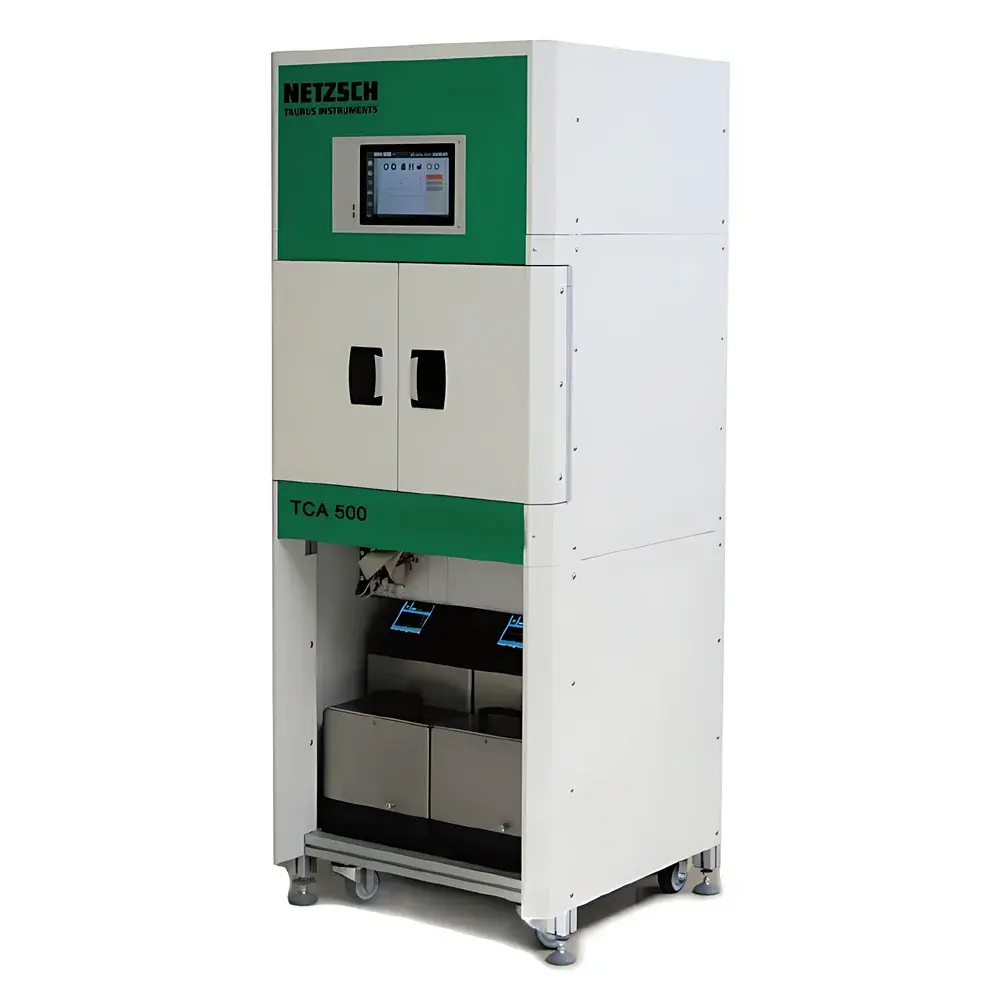
Netzsch TCA 500 Heat Flow Meter Thermal Conductivity Analyzer
| Brand | Netzsch |
|---|---|
| Origin | Germany |
| Model | TCA 500 |
| Measurement Principle | Heat Flow Meter Method (HFM) |
| Dimensions (H×W×D) | 179 × 80 × 90 cm |
| Thermal Conductivity Range | 0.005 – 1.0 W/(m·K) |
| Accuracy | ±1.0% |
| Repeatability | ±0.5% |
| Sample Size (L×W) | 250 × 250 mm to 500 × 500 mm |
| Sample Thickness (H) | 10 – 120 mm |
| Cold Plate Temperature Range | −20 °C to +60 °C |
| Hot Plate Temperature Range | −10 °C to +70 °C |
| Standards Compliance | ISO 8301, ASTM C518, DIN EN 1946-3, EN 12664, EN 12667, EN 12939 |
Overview
The Netzsch TCA 500 is a high-precision heat flow meter (HFM) thermal conductivity analyzer engineered for steady-state measurement of thermal transport properties in low-to-moderate conductivity solid materials. Operating on the principle of one-dimensional, guarded hot plate heat transfer, the instrument establishes a controlled temperature gradient across a flat, homogeneous sample sandwiched between a calibrated hot plate and a cold plate. Two symmetric, traceable heat flux sensors—mounted in direct thermal contact with the sample surfaces—quantify the axial heat flow under equilibrium conditions. The resulting thermal conductivity (λ, in W/(m·K)) is calculated per Fourier’s law using measured heat flux, temperature differential, and geometric sample thickness. Designed specifically for quality control, R&D, and regulatory testing in construction, insulation manufacturing, and advanced materials development, the TCA 500 delivers metrologically traceable data aligned with internationally recognized test protocols.
Key Features
- Motorized, programmable lift mechanism for precise, repeatable positioning of the hot plate—minimizing operator-induced variability and ensuring consistent contact pressure across diverse sample densities and compressibilities.
- Dual, NIST-traceable heat flux sensors mounted symmetrically on both sides of the sample stack, enabling real-time differential validation and compensation for lateral heat loss or sensor drift.
- Fully guarded, adiabatic test chamber architecture with active perimeter heating and high-performance insulation—reducing edge losses to <0.5% and supporting compliance with ISO 8301 Annex B requirements for guard zone performance.
- Independent dual-zone temperature control system: hot plate (−10 °C to +70 °C) and cold plate (−20 °C to +60 °C), each equipped with platinum resistance thermometers (Pt100) and PID-regulated heaters/cooler units for stable ΔT control within ±0.05 K.
- Modular sample stage accommodating specimens from 250 × 250 mm up to 500 × 500 mm in planar dimension and 10–120 mm in thickness—enabling characterization of standard building panels, VIPs, aerogels, and multi-layer composites without sectioning.
Sample Compatibility & Compliance
The TCA 500 is validated for heterogeneous, anisotropic, and compressible insulating materials commonly encountered in architectural, industrial, and transportation applications. Compatible specimen types include rigid and semi-rigid foams (PUR, EPS, XPS, polyimide), mineral wool, ceramic fiber blankets, vacuum insulated panels (VIPs), gypsum board, oriented strand board (OSB), wood-based composites, and layered structural insulating systems. All measurements adhere strictly to the boundary condition definitions and uncertainty evaluation frameworks specified in ISO 8301 and ASTM C518. The system architecture supports full audit trails, calibration certificate linkage, and environmental parameter logging—facilitating GLP-compliant reporting and readiness for ISO/IEC 17025 accreditation audits. Optional IQ/OQ documentation packages are available for regulated environments requiring FDA 21 CFR Part 11–compliant instrument qualification.
Software & Data Management
Control and analysis are executed via NETZSCH’s proprietary TA-Control software, a Windows-based platform featuring intuitive workflow navigation, automated test sequencing, and real-time thermal equilibrium monitoring. Software modules include dynamic convergence detection (based on slope thresholds of heat flux and ΔT time-series), automatic outlier rejection per ISO 8301 §7.4, and integrated uncertainty propagation per GUM (JCGM 100:2008). Export formats include CSV, XML, and PDF reports with embedded metadata (operator ID, calibration dates, ambient lab conditions, sensor serial numbers). Raw data archives are stored with SHA-256 checksum integrity verification and support time-stamped versioning for full traceability across product lifecycle stages.
Applications
- Thermal performance certification of building envelope components per EN 12664 and EN 12667 for CE marking and EPBD compliance.
- Development and validation of next-generation insulation materials—including nano-porous silica aerogels and phase-change composite boards.
- Quality assurance of VIP core integrity and aging behavior under accelerated thermal cycling (e.g., 500 cycles at ΔT = 40 K).
- Comparative thermal resistance (R-value) benchmarking of multi-layer assemblies used in HVAC ducting, refrigerated transport, and cryogenic infrastructure.
- Supporting ASTM E1530 fire barrier thermal modeling by providing validated λ(T) curves over operational temperature ranges.
FAQ
What standards does the TCA 500 directly support?
ISO 8301, ASTM C518, DIN EN 1946-3, EN 12664, EN 12667, and EN 12939—all verified through factory-installed reference materials and third-party metrological assessment.
Can the TCA 500 measure anisotropic materials such as fibrous insulation?
Yes; its symmetric dual-sensor configuration and guarded chamber design minimize directional bias, and optional in-plane alignment fixtures enable controlled orientation of orthotropic samples relative to the heat flow vector.
Is calibration traceable to national metrology institutes?
All heat flux sensors are individually calibrated against NPL (UK) or PTB (Germany)-certified reference standards, with certificates valid for 12 months and included in the delivery package.
How is thermal contact resistance managed during testing?
The motorized lift applies programmable, load-controlled compression (0.5–5 kPa range); compliant interface films (e.g., Kapton® or graphite foil) may be used per ASTM C177 Annex A4 guidelines to ensure uniform interfacial conductance.
Does the system support unattended overnight operation?
Yes; TA-Control includes auto-shutdown, email alerting on test completion or fault conditions, and continuous environmental logging—enabling robust 24/7 batch processing in shared laboratory environments.



