
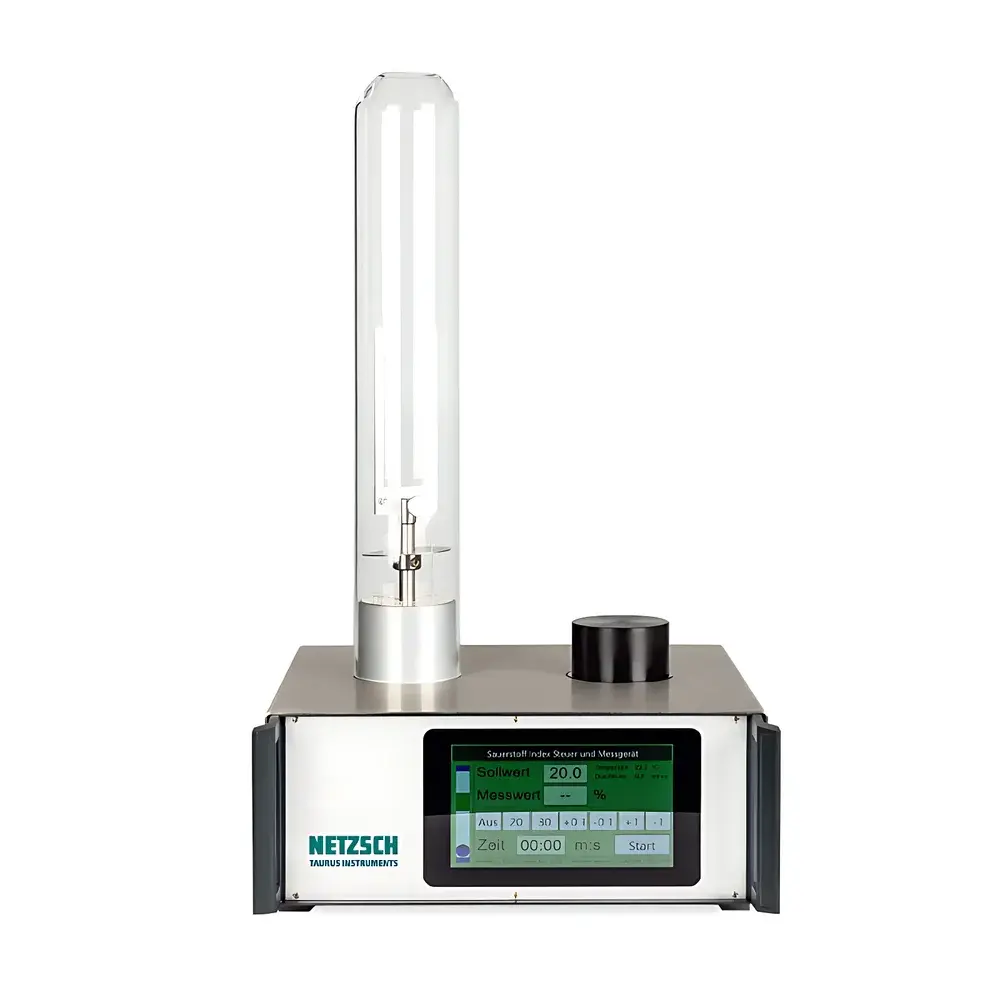
NETZSCH LOI Oxygen Index Analyzer
| Brand | NETZSCH |
|---|---|
| Origin | Germany |
| Model | LOI Oxygen Index Analyzer |
| Compliance | ISO 4589-2, DIN 22117, ASTM D2863 |
| Dimensions (W × D × H) | 360 × 360 × 630 mm |
| Glass Column Dimensions (Ø × H) | 75 × 450 mm |
| Test Accuracy | ±0.1% O₂ |
| Weight | 8.2 kg |
| Oxygen Sensor Type | Paramagnetic |
| Display | Color High-Resolution Touchscreen |
| Sample Holders | Supported & Unsupported Configurations |
| Data Interface | USB & Ethernet |
| Automation | Fully Automated Calibration & Test Sequence |
Overview
The NETZSCH LOI Oxygen Index Analyzer is a precision-engineered instrument designed to determine the Limiting Oxygen Index (LOI) of solid combustible materials according to internationally recognized combustion safety standards. Based on the principle of upward flame propagation in a vertically oriented sample column under controlled oxygen–nitrogen gas mixtures, the LOI value represents the minimum volume percentage of oxygen in the mixture required to support candle-like burning of the material for at least 3 minutes or over a defined length (typically 50 mm). This measurement provides a quantitative, reproducible indicator of relative flammability—critical for regulatory compliance, material development, and fire risk assessment in industrial R&D and quality control laboratories.
Key Features
- Paramagnetic oxygen sensor technology ensures high accuracy (±0.1% O₂) and long-term stability without sensor drift or frequent recalibration.
- Integrated color high-resolution touchscreen interface enables intuitive navigation, real-time gas composition monitoring, and direct access to test protocols and historical results.
- Automated calibration routine—including zero-point verification with nitrogen and span adjustment with certified reference gas—minimizes operator dependency and enhances inter-laboratory reproducibility.
- Dual sample holder configuration supports both supported (e.g., rigid plastics, films) and unsupported (e.g., foams, textiles, thin fibers) specimens, accommodating diverse geometries per ISO 4589-2 Annex A and B requirements.
- Compact benchtop design (360 × 360 × 630 mm) integrates a standardized 75 mm diameter × 450 mm height glass combustion column, optimized for laminar flow and uniform gas distribution during testing.
- Native USB and Ethernet connectivity enable seamless integration into laboratory networks, supporting remote operation, centralized data logging, and audit-ready export formats (CSV, PDF).
Sample Compatibility & Compliance
The LOI analyzer is validated for use across a broad spectrum of polymeric and fibrous materials—including thermoplastics, elastomers, polyurethane foams, cellulose-based papers, nonwovens, and synthetic textiles—as specified in ISO 4589-2:2017, ASTM D2863–22, and DIN 22117. Sample preparation follows strict dimensional tolerances (e.g., 150 mm × 10 mm × thickness ≤ 10.5 mm for rigid specimens), ensuring consistent heat feedback and flame dynamics. All hardware components—including gas manifolds, flow controllers, and ignition system—meet CE marking requirements and are constructed from corrosion-resistant stainless steel and borosilicate glass to maintain integrity under repeated thermal cycling and oxidative environments.
Software & Data Management
The embedded firmware implements full GLP-compliant data handling: each test record includes timestamped metadata (operator ID, ambient temperature/humidity, gas cylinder lot numbers, calibration history), raw O₂ concentration curves, and pass/fail determination logic aligned with standard acceptance criteria. Audit trails are immutable and exportable; optional software packages extend functionality to include statistical process control (SPC) charting, multi-instrument fleet management, and 21 CFR Part 11–compliant electronic signatures for regulated pharmaceutical and aerospace applications.
Applications
- Formulation screening of flame-retardant additives in polymer composites
- Comparative flammability ranking of textile blends for automotive interior specifications (e.g., FMVSS 302, UN ECE R118)
- Quality assurance of cable jacketing materials against IEC 60332–1–2 vertical flame spread requirements
- Regulatory submission support for building product classifications (EN 13501–1, ASTM E84)
- Research into pyrolysis kinetics and char-forming behavior of bio-based polymers
FAQ
What standards does the NETZSCH LOI analyzer comply with?
ISO 4589-2:2017, ASTM D2863–22, DIN 22117, and relevant clauses of EN ISO 11925–2 for preliminary ignitability screening.
Is the instrument suitable for testing thin films or low-density foams?
Yes—the dual-sample-holder system includes dedicated fixtures for unsupported specimens, and the paramagnetic sensor’s fast response time (<1 s) captures transient O₂ depletion during brief flaming events.
Can test data be integrated into LIMS or ERP systems?
Yes—via standard Ethernet TCP/IP protocols and configurable CSV/JSON export templates compatible with common laboratory informatics platforms.
Does the system require external gas cylinders or regulators?
It operates with standard compressed O₂ and N₂ supply lines; integrated mass flow controllers and pressure-sensing valves eliminate the need for external regulators.
How often must the oxygen sensor be calibrated?
Automated daily zero-and-span calibration is recommended; full sensor verification using traceable reference gases is advised every 6 months or after 200 test cycles, per ISO/IEC 17025 internal quality procedures.



