
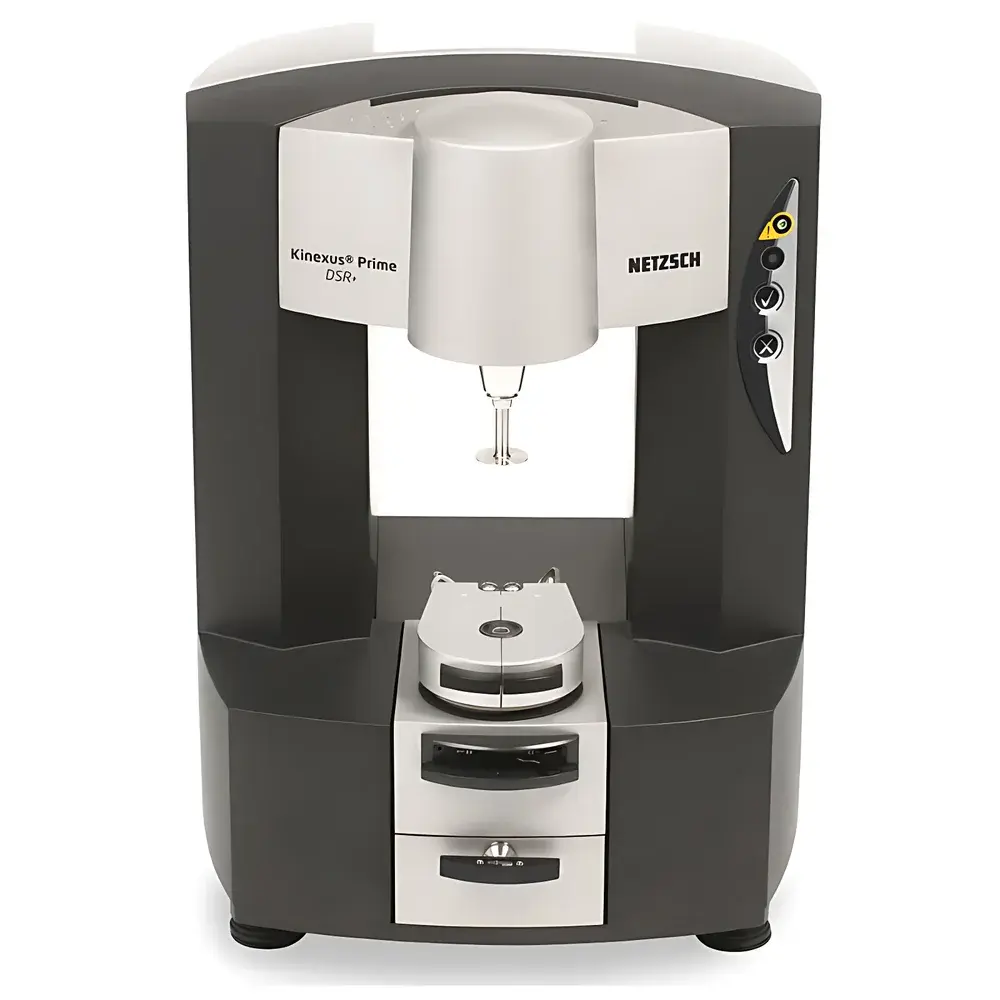
Netzsch Kinexus DSR+ Advanced Rotational Rheometer
| Brand | Netzsch |
|---|---|
| Origin | Germany |
| Model | Kinexus DSR+ |
| Instrument Type | Rotational Rheometer |
| Sample State | Liquid |
| Bearing Type | Air Bearing |
| Minimum Angular Velocity | 1 nrad/s |
| Maximum Angular Velocity | 500 rad/s |
| Frequency Range | 1 µHz – 150 Hz |
| Maximum Torque | 225 mNm |
| Torque Resolution | 0.1 nNm |
| Normal Force Range | 0.001 N – 50 N |
| Normal Force Response Time | <10 ms |
| Vertical Travel Speed | 0.1 µm/s – 35 mm/s |
| Vertical Travel Distance | 230 mm |
| Gap Resolution | 0.1 µm |
| Motor Inertia | 12 µN·m·s² |
| Control Modes | Rate, Stress, Strain |
Overview
The Netzsch Kinexus DSR+ Advanced Rotational Rheometer is a high-precision, modular rheological measurement platform engineered for rigorous viscoelastic characterization of complex fluids—particularly asphalt binders, polymer melts, coatings, pharmaceutical suspensions, and food emulsions. Based on Couette-type rotational rheometry, the system applies controlled shear deformation (via torque and angular displacement) to quantify material responses including storage modulus (G′), loss modulus (G″), complex viscosity (η*), yield stress, thixotropy, and time–temperature superposition behavior. Its design adheres to ASTM D7175 (DSR test for asphalt binders), AASHTO T315, and ISO 6721-10 standards, making it a reference-grade instrument for R&D laboratories, quality control departments, and regulatory-compliant testing facilities engaged in pavement engineering, polymer processing, and formulation development.
Key Features
- Air-bearing motor with ultra-low inertia (12 µN·m·s²): Enables exceptional low-torque sensitivity and high dynamic response across the full frequency range (1 µHz to 150 Hz), critical for accurate small-amplitude oscillatory shear (SAOS) measurements.
- Optical encoder-based position sensing: Delivers sub-nanoradian angular resolution, ensuring precise strain control and reproducible waveform fidelity during transient and oscillatory tests.
- Active normal force control system: Measures forces from 0.001 N to 50 N with <10 ms response time; continuously records vertical displacement, velocity, and normal load—essential for gap-sensitive measurements and soft-solid characterization.
- RFID-enabled intelligent tooling: All Kinexus-compatible geometries (cone-plate, parallel-plate, concentric cylinder, vane) feature embedded RFID chips that auto-load geometry dimensions, calibration history, and correction factors upon insertion—eliminating manual input errors.
- Plug-and-play environmental control units: Compatible with Peltier, liquid-circulating, and solvent-trap temperature modules; units are automatically recognized and parameterized by the software, supporting ISO 17987-compliant thermal ramping and isothermal stability (<±0.05 °C).
- True “one-touch” workflow architecture: Integrates SOP-driven operation with fully customizable experimental scripting—enabling both routine QC batch runs and advanced multi-step protocols (e.g., creep-recovery followed by frequency sweeps at multiple temperatures).
Sample Compatibility & Compliance
The Kinexus DSR+ accommodates liquid, semi-solid, and highly viscous samples—including unmodified and polymer-modified asphalt binders, thermoplastic elastomers, hydrogels, and non-Newtonian suspensions. Its wide torque range (0.001 µNm to 225 mNm) and dual-control architecture (rate/stress/strain) support both linear viscoelastic region (LVR) mapping and large-deformation nonlinear analysis. The system complies with GLP and GMP documentation requirements through audit-trail-enabled software logging, electronic signatures (21 CFR Part 11 compliant), and traceable calibration certificates per ISO/IEC 17025. All test methods align with ASTM D4402, ISO 3219, and EN 13398 for rheological performance validation.
Software & Data Management
Controlled via rSpace™ software—a Windows-based platform supporting intuitive drag-and-drop protocol building, real-time data visualization, and automated report generation. Raw data (torque, strain, temperature, normal force) are stored in vendor-neutral HDF5 format with embedded metadata (user, timestamp, instrument ID, calibration status). Integrated statistical tools enable batch comparison, master curve construction (WLF/Arrhenius), and model fitting (Maxwell, Kelvin-Voigt, Burgers). Data export supports CSV, Excel, and ASCII formats; API connectivity allows integration with LIMS and MES systems via OPC UA or RESTful endpoints.
Applications
- Asphalt binder grading and performance prediction (PG classification per AASHTO M320)
- Thermal stability and aging behavior of bituminous materials under oxidative conditions
- Rheokinetic analysis of curing resins and UV-curable coatings
- Yield stress and structural recovery profiling of drilling muds and cement slurries
- Viscoelastic fingerprinting of biopolymer solutions (e.g., xanthan, carrageenan) under shear and temperature gradients
- Quality assurance of surfactant-based formulations in personal care and agrochemical products
FAQ
What is the minimum measurable torque with the Kinexus DSR+?
The system achieves a torque resolution of 0.1 nNm, with a lower limit of 0.001 µNm in strain-controlled mode—suitable for characterizing ultra-dilute polymer solutions and low-viscosity solvents.
Does the instrument support time–temperature superposition (TTS) analysis?
Yes—rSpace™ includes automated TTS module with WLF and Arrhenius fitting options, validated against NIST SRM 2490c reference materials.
Can the Kinexus DSR+ perform controlled-stress creep tests?
Yes—its dual-mode controller enables true stress-ramp, stress-hold, and stress-relaxation protocols with active normal force compensation throughout the test duration.
Is calibration traceable to national metrology institutes?
All torque and normal force calibrations are performed using NIST-traceable reference standards, with certificates issued per ISO/IEC 17025 requirements.
How does the system handle sample evaporation during elevated-temperature tests?
Optional solvent-trap temperature units and hermetic environmental chambers minimize volatilization; real-time mass monitoring is available via optional integrated microbalance coupling.



