
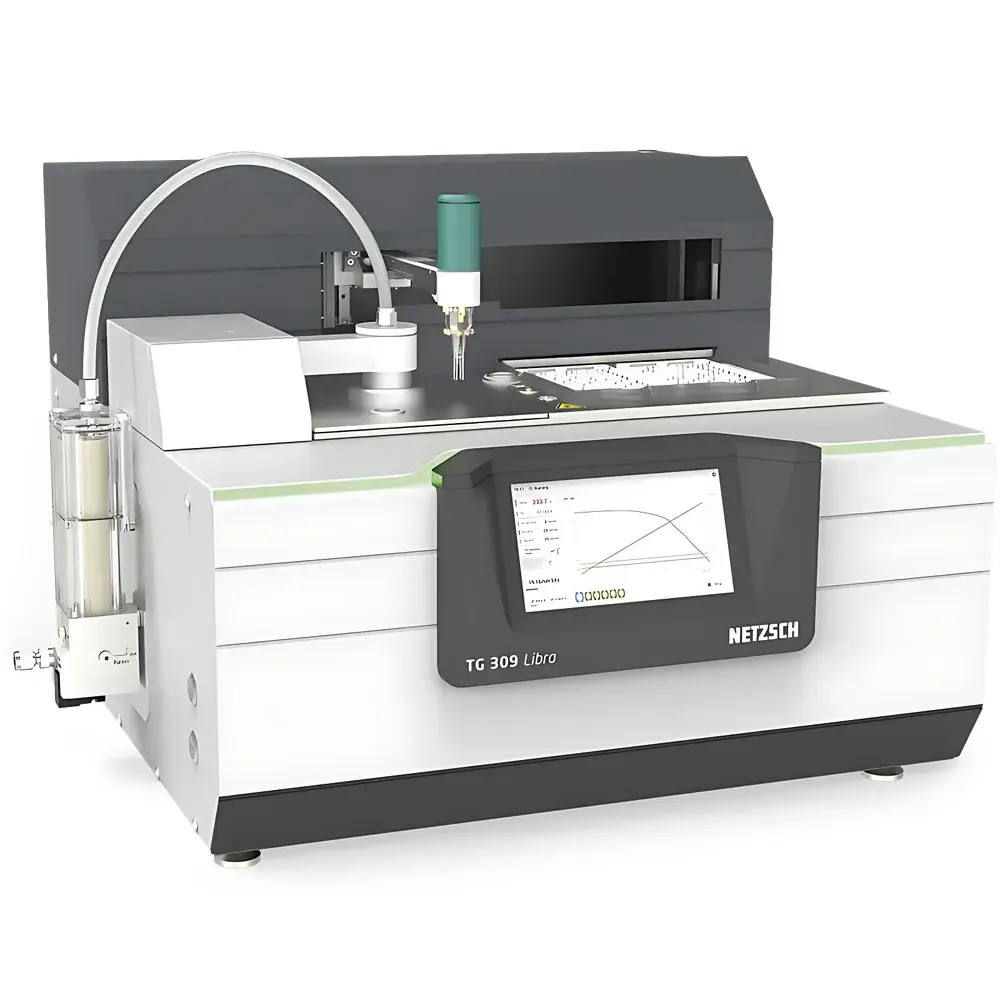
Netzsch TG 309 Libra Supreme Thermogravimetric Analyzer
| Brand | Netzsch |
|---|---|
| Origin | Germany |
| Model | TG 309 Libra Supreme |
| Temperature Range | 10 °C to 1100 °C |
| Temperature Accuracy | ±0.15 K |
| Heating/Cooling Rate | 0–200 K/min |
Overview
The Netzsch TG 309 Libra Supreme is a high-precision, modular thermogravimetric analyzer engineered for rigorous thermal stability, decomposition kinetics, and compositional analysis of solid and powdered materials under controlled atmospheric conditions. Based on the fundamental principle of measuring mass change as a function of temperature or time in a defined gas environment, the instrument employs a high-resolution microbalance (resolution ≤0.1 µg) integrated with a vacuum-tight, radiation-optimized furnace system. Its core architecture is designed for long-term baseline stability, minimal buoyancy effects, and robust thermal coupling between furnace, sensor, and sample chamber—critical for reproducible quantification of mass loss events across multi-step decomposition pathways. The system operates within an ambient-adjustable range from 10 °C (with optional cryo-cooling) up to 1100 °C, supporting both dynamic heating programs and isothermal holds, with programmable ramp rates spanning 0 to 200 K/min. This enables precise simulation of industrial thermal processes—including pyrolysis, oxidation, dehydration, and polymer degradation—while maintaining traceable metrological integrity.
Key Features
- Integrated c_DTA® technology (optional): Simultaneously records differential thermal activity alongside mass change, enabling real-time temperature calibration using reference transitions (e.g., Ni, In, Zn, Al₂O₃) and improving accuracy of onset/peak temperature assignment.
- Super-Res® algorithm (optional): Dynamically adjusts heating rate during active mass-loss intervals to enhance resolution of overlapping decomposition steps, particularly valuable for complex formulations such as composites, pharmaceuticals, and battery cathode materials.
- Modulated TGA (MTGA) capability (optional): Applies periodic temperature oscillations to decouple kinetic and diffusion-controlled contributions, facilitating advanced modeling of reaction mechanisms via Fourier-transformed DTG data.
- Active temperature-controlled balance housing: Equipped with a recirculating chiller-coupled water bath that maintains the microbalance at constant 25 °C ±0.1 K—eliminating thermal drift from furnace radiation and ensuring sub-microgram stability over extended runs (>48 h).
- Multi-atmosphere compatibility: Supports inert (N₂, Ar), oxidative (air, O₂), reducing (H₂, forming gas), and reactive (CO₂, NH₃) environments via mass flow controllers; vacuum operation down to 10⁻² mbar is achievable with integrated turbomolecular pumping.
- Three-tier sample holder system: Interchangeable crucible supports include standard ceramic, corrosion-resistant SiC-coated, and ultra-low-thermal-mass c_DTA®-optimized holders—each calibrated for specific thermal inertia and signal fidelity requirements.
Sample Compatibility & Compliance
The TG 309 Libra Supreme accommodates a broad spectrum of sample types—including polymers, ceramics, metals, pharmaceuticals, catalysts, soils, and energy materials—using crucibles fabricated from alumina, platinum-rhodium (Pt/Rh 90/10), quartz, graphite, and aluminum. Each crucible geometry is certified for thermal homogeneity and mass capacity (5–100 mg typical). The system complies with ASTM E1131 (standard test method for compositional analysis by TGA), ISO 11358 (polymer thermal degradation), and CEI/IEC 60695-7-1 (fire hazard testing). All calibration standards (Ni, In, Sn, Pb, Zn, Al₂O₃) are traceable to NIST SRMs and supplied with CoA documentation. Full audit trail functionality—including user access logs, parameter change history, and electronic signature support—is available to meet FDA 21 CFR Part 11 and EU Annex 11 requirements when paired with Netzsch Proteus® software in GxP mode.
Software & Data Management
Controlled exclusively via Netzsch Proteus® 9.x software, the instrument delivers fully integrated acquisition, processing, and reporting workflows. Real-time visualization includes synchronized TGA, DTG, c_DTA®, and gas evolution (when coupled to FTIR or QMS) traces. Automated baseline correction applies polynomial or segmental fitting algorithms prior to derivative calculation. Peak detection follows ISO 13783 guidelines, with customizable thresholds for onset, peak, and endpoint determination. Export formats include ASCII, CSV, XML, and proprietary .NETZ for seamless integration into LIMS, ELN, or MATLAB-based kinetic modeling platforms (e.g., Kinetics Neo). Data security protocols include role-based permissions, encrypted database storage, and configurable backup schedules aligned with GLP/GMP retention policies.
Applications
- Quantitative determination of filler content (e.g., CaCO₃, carbon black) in elastomers and thermoplastics per ASTM D6370.
- Decomposition kinetics of lithium-ion battery cathodes (NMC, LFP) under air/N₂ to assess thermal runaway thresholds.
- Moisture, volatile organic compound (VOC), and ash content profiling in pharmaceutical APIs and excipients per USP <1225>.
- Oxidation onset temperature (OOT) and activation energy (Eₐ) evaluation of antioxidants in lubricants and coatings.
- Thermal stability screening of MOFs, perovskites, and other emerging functional materials under controlled humidity or reactive atmospheres.
- Residue characterization in catalytic cracking residues, coal ash, and biomass char for energy sector compliance reporting.
FAQ
What is the minimum detectable mass change for the TG 309 Libra Supreme?
The system achieves a mass resolution of ≤0.1 µg under optimized conditions, with repeatability better than ±0.5 µg for 10 mg samples over repeated cycles.
Can the instrument perform simultaneous TGA-FTIR or TGA-MS coupling?
Yes—via standardized heated transfer line interfaces (150–300 °C) compatible with major OEM spectrometers; full synchronization of mass spectra with TGA events is supported in Proteus®.
Is c_DTA® functionality included as standard or optional?
c_DTA® is offered as a factory-installed option requiring dedicated sensor hardware and firmware licensing; it is not retrofittable post-delivery.
How does the ASC (Automatic Sample Changer) integrate with regulatory workflows?
The ASC-5000 module supports 50-position racks with barcode-assisted sample identification, auto-calibration before each run, and full electronic record generation compliant with 21 CFR Part 11 when configured with digital signatures and audit trail.
What maintenance intervals are recommended for long-term operational reliability?
Annual calibration verification using certified standards is advised; furnace insulation inspection every 2 years; microbalance sensitivity check every 6 months—detailed procedures are documented in the service manual and accessible via Proteus® diagnostics suite.



