
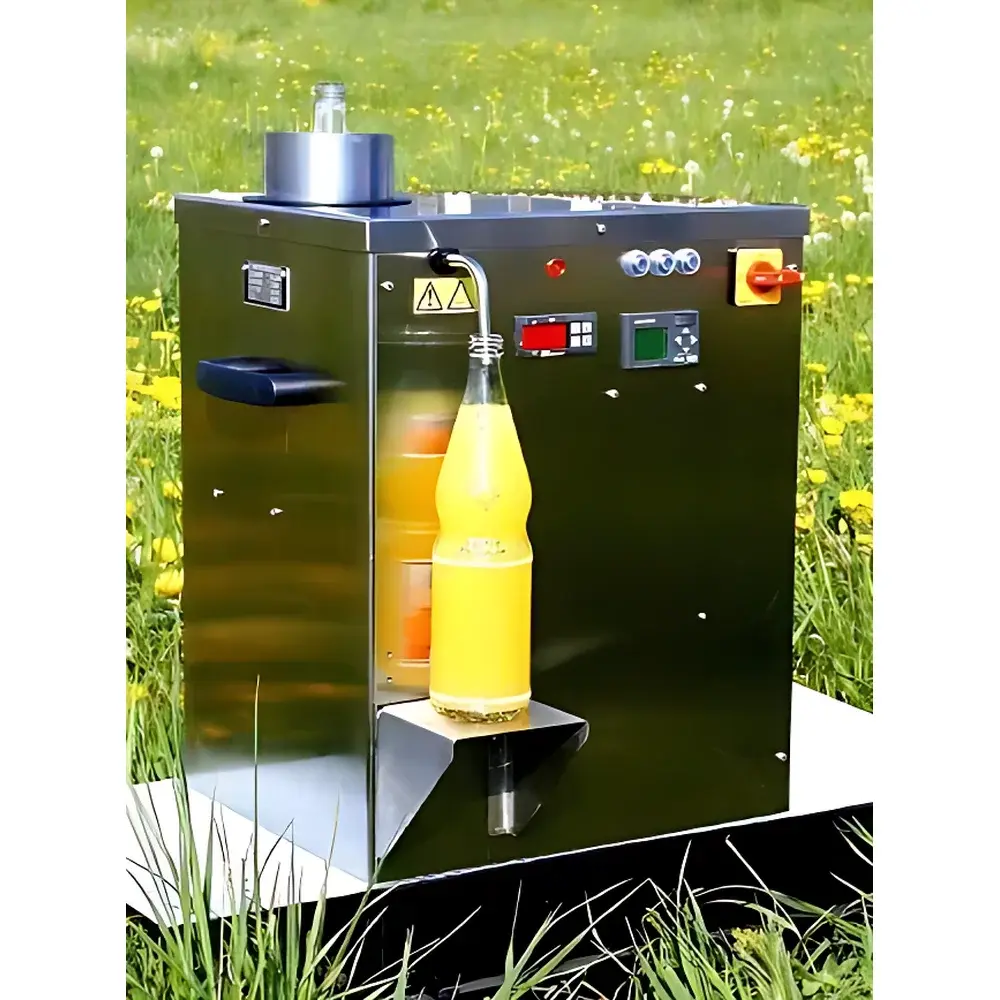
Laboratory-Scale Beverage Pasteurizer BX-10
| Origin | Shanghai, China |
|---|---|
| Manufacturer Type | Authorized Distributor |
| Origin Category | Domestic (China) |
| Model | BX-10 |
| Price | Upon Request |
| Capacity | 100 L/h |
| Minimum Batch Volume | 1000 mL |
| Pasteurization Temperature Range | 30–90 °C |
| Temperature Control Accuracy | ±1 °C |
| Filling Volume | Programmable & Auto-Quantified with Liquid-Level Sensing |
| Compatible Containers | PET bottles, PE bottles, glass bottles, and heat-resistant flexible packaging |
| Safety Interlock | Filling disabled unless product temperature reaches setpoint |
| Power Supply | 8.5 kW, 380 V, 3-phase 5-wire |
| Net Weight | 50 kg |
| Dimensions (L×W×H) | 550 × 450 × 500 mm |
Overview
The BX-10 Laboratory-Scale Beverage Pasteurizer is a compact, benchtop thermal processing system engineered to replicate industrial pasteurization conditions under controlled laboratory settings. It operates on the principle of continuous low-temperature holding (LTH) or high-temperature short-time (HTST) thermal treatment—depending on user-defined time–temperature profiles—to inactivate pathogenic and spoilage microorganisms while preserving sensory and nutritional attributes. Designed for process development rather than commercial production, the BX-10 enables precise validation of thermal lethality (F0 or PU values), kinetic modeling of microbial inactivation (e.g., D-value and z-value determination), and evaluation of thermal impact on enzyme activity (e.g., peroxidase, polyphenol oxidase) and heat-labile compounds (vitamins, anthocyanins, catechins). Its fully integrated flow-through configuration—including preheating, holding, and cooling zones—mirrors core elements of pilot- and production-scale pasteurizers, ensuring experimental scalability without revalidation.
Key Features
- Benchtop footprint (550 × 450 × 500 mm) optimized for ISO 17025-accredited lab environments with limited floor space
- Integrated electric heating system with PID-controlled stainless-steel jacketed tubes; no external steam boiler or chiller required
- Real-time temperature monitoring at inlet, holding tube, and outlet via calibrated Pt100 sensors (traceable to NIST standards)
- Automated fill-and-hold sequence with hardware-enforced safety interlock: filling initiates only when product temperature meets the programmed setpoint (±1 °C accuracy)
- Programmable volumetric dosing with capacitive liquid-level sensing—compatible with standard beverage containers (PET, PE, borosilicate glass, laminated pouches)
- Stainless-steel 316 wetted parts compliant with FDA 21 CFR §177.1520 and EC 1935/2004 food-contact material regulations
- Modular design supports optional integration with inline pH/conductivity probes or UV-C post-treatment modules for extended R&D workflows
Sample Compatibility & Compliance
The BX-10 accommodates Newtonian and mildly non-Newtonian aqueous liquids with viscosities up to 50 mPa·s and suspended solids content ≤5% w/w—covering fruit juices (orange, apple, pomegranate), dairy-based drinks (flavored milk, kefir), ready-to-drink teas, plant-based beverages (soy, oat, almond), and functional tonics. All contact surfaces meet ASME BPE-2022 surface finish requirements (Ra ≤ 0.8 µm). The system supports documentation protocols aligned with GLP (Good Laboratory Practice) and GMP (Good Manufacturing Practice) frameworks, including electronic audit trails for temperature logs, batch records, and operator actions—facilitating compliance with ISO/IEC 17025:2017 clause 7.8 and FDA 21 CFR Part 11 for electronic records and signatures.
Software & Data Management
The embedded control interface provides intuitive touch-screen operation with password-protected access levels (operator, supervisor, administrator). Process parameters—including target temperature, dwell time, flow rate, and fill volume—are stored as named recipes with version timestamps. All sensor data (temperature, flow status, fill cycle count) are logged at 1 Hz resolution and exportable in CSV or Excel-compatible formats. Optional Ethernet connectivity enables remote monitoring via Modbus TCP or OPC UA protocols, supporting integration into centralized LIMS or MES platforms. Raw data files include embedded metadata (date/time, operator ID, recipe name, firmware revision) to satisfy traceability requirements per ISO 9001:2015 clause 8.5.2.
Applications
- Determination of optimal pasteurization conditions for novel formulations (e.g., cold-pressed juice blends with probiotics)
- Accelerated shelf-life testing (ASLT) through controlled thermal stress followed by microbiological and chemical stability assessment
- Validation of preservative synergy (e.g., nisin + citric acid) under sub-lethal thermal exposure
- Colorimetric and turbidity analysis pre- and post-pasteurization to quantify browning kinetics or protein aggregation
- Development of aseptic filling protocols using thermally treated samples prior to sterile packaging trials
- Training platform for QA/QC personnel on thermal process validation fundamentals per ISO 22000 and Codex Alimentarius CAC/RCP 51-2003
FAQ
Does the BX-10 support validation of sterilization (not just pasteurization) processes?
No—the BX-10 is designed exclusively for pasteurization (log-reduction of vegetative microbes), not commercial sterilization (spore inactivation). Its maximum temperature (90 °C) and residence time range are insufficient for achieving F0 ≥ 3.0.
Can I use the BX-10 with viscous products like smoothies or pulpy juices?
Yes, provided particulate size remains below 1.5 mm and total suspended solids do not exceed 5% w/w. For higher-viscosity or fibrous matrices, optional upstream homogenization or pre-straining is recommended.
Is third-party calibration certification available?
Yes—factory-calibrated Pt100 sensors include a UKAS-accredited calibration certificate (ISO/IEC 17025) upon request; annual recalibration services are offered globally.
What maintenance intervals are specified for long-term reliability?
Daily: visual inspection of gasket integrity and drip tray cleaning. Quarterly: verification of temperature sensor drift and solenoid valve response time. Annually: full system performance qualification (PQ) per IQ/OQ/PQ protocol templates supplied with equipment.





