
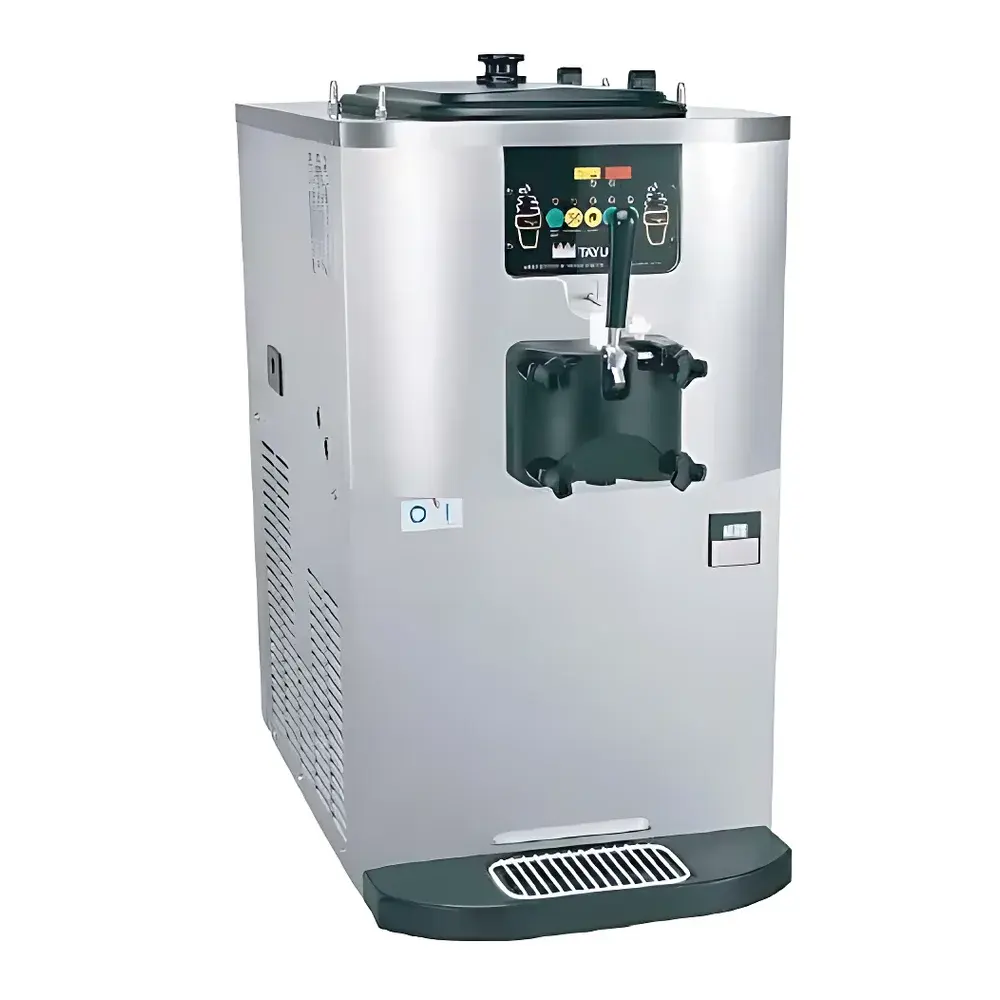
Carpigiani C706 Compact Laboratory-Scale Soft Serve Ice Cream Machine
| Origin | Shanghai, China |
|---|---|
| Manufacturer Type | Authorized Distributor |
| Regional Classification | Domestic (PRC) |
| Model | C706 |
| Output Capacity | 511 × 16 oz servings/hour |
| Freezing Cylinder Volume | 3.2 L |
| Hopper Capacity | 18.9 L |
| Compressor Cooling Capacity | 9,500 BTU/hr |
| Agitator Motor Power | 1.5 HP |
| Electrical Supply | 380 V AC, 12 A, 3-phase |
| Net Weight | 150 kg |
| Dimensions (W×L×H) | 464 × 864 × 860 mm |
Overview
The Carpigiani C706 Compact Laboratory-Scale Soft Serve Ice Cream Machine is an engineered solution for controlled, repeatable soft-serve production in research laboratories, dairy product development centers, and quality assurance facilities. Designed around a single-cylinder dynamic freezing system, it employs continuous-scraped-surface heat exchange—where refrigerant-cooled cylinder walls extract latent heat while rotating dashers continuously scrape and aerate the mix—to achieve precise control over ice crystal nucleation, overrun (air incorporation), and final texture consistency. Unlike batch freezers, the C706 operates in continuous flow mode, enabling real-time formulation testing, rheological profiling of frozen desserts under defined thermal and shear conditions, and scalable process validation from lab to pilot line. Its self-contained refrigeration architecture eliminates dependency on external chillers or glycol loops, making it suitable for ISO 17025-accredited labs with limited utility infrastructure.
Key Features
- Integrated R-404A or R-290 refrigeration system with 9,500 BTU/hr cooling capacity, optimized for rapid draw-down of dairy-based and non-dairy mixes (e.g., soy, oat, coconut) across viscosity ranges of 100–5,000 mPa·s at 4°C
- Single 3.2 L stainless-steel freezing cylinder with precision-ground internal surface finish (Ra ≤ 0.4 µm) to minimize localized shear heating and ensure uniform ice crystal distribution (target D90 < 45 µm per ASTM F2673-22)
- 18.9 L insulated hopper with level sensor and temperature monitoring (±0.3°C accuracy) to maintain mix stability prior to freezing
- 1.5 HP variable-speed agitator motor (0–120 rpm range) with torque feedback control, enabling systematic study of shear rate effects on air cell structure and meltdown resistance
- 380 V, 3-phase power interface compliant with IEC 61000-3-12 harmonic emission limits; built-in circuit protection and thermal cut-off for GLP-compliant operation
- Front-access service panel with diagnostic LEDs and standardized M12 connectors for integration with external data loggers or PLC-based process control systems
Sample Compatibility & Compliance
The C706 accommodates formulations meeting Codex Alimentarius Standard 221–2003 for frozen desserts, including low-fat (8% w/w), and plant-based alternatives. It supports validated protocols for microbial challenge testing (per ISO 11290-1) when paired with sterile-fill accessories. All wetted surfaces comply with FDA 21 CFR Part 177.2600 (food-contact polymers) and 3-A Sanitary Standards 3-A 12-07 (ice cream equipment). The unit is CE-marked per Machinery Directive 2006/42/EC and EMC Directive 2014/30/EU. Optional IQ/OQ documentation packages are available for GMP-aligned validation per Annex 15 of the EU Guidelines.
Software & Data Management
While the base C706 operates via analog controls, optional digital interface modules support RS-485 Modbus RTU communication for integration into LabVantage, STARLIMS, or custom SCADA environments. Temperature, motor speed, and runtime data can be timestamped and exported in CSV format for statistical process control (SPC) analysis. Audit trails—including operator ID, parameter changes, and fault codes—are retained for ≥90 days to satisfy FDA 21 CFR Part 11 requirements when used with validated electronic signatures.
Applications
- Dairy science research: Correlation of stabilizer type/concentration with ice recrystallization kinetics during storage (per ISO 21734)
- Product development: Rapid iteration of overrun (25–60%), draw temperature (−6°C to −12°C), and residence time to optimize mouthfeel and structural integrity
- QC/QA labs: Routine verification of mix freezing point depression and fat destabilization thresholds using calibrated reference standards
- Regulatory compliance testing: Generation of representative samples for sensory panels (ASTM E1958), compositional analysis (AOAC 988.12), and thermal conductivity mapping
- Food engineering education: Hands-on demonstration of non-Newtonian fluid behavior, phase transitions, and heat transfer coefficients in scraped-surface systems
FAQ
Is the C706 suitable for producing gelato or sorbet?
Yes—its adjustable dasher speed and precise draw temperature control allow optimization for denser, lower-overrun formulations typical of artisanal gelato and fruit-based sorbets.
Can the freezing cylinder be sterilized in place (SIP)?
No—SIP is not supported; however, the cylinder is fully disassemblable for CIP using food-grade alkaline and acid solutions per 3-A SSI guidelines.
What is the minimum recommended batch volume for reproducible results?
For method validation, a minimum of 12 L (≥63% hopper fill) is required to ensure consistent thermal loading and shear history across runs.
Does the unit meet NSF/ANSI 7 certification requirements?
The standard C706 does not carry NSF/ANSI 7 listing; however, NSF-compliant variants with modified gasket materials and drainage geometry are available upon request.
How frequently must the refrigeration oil be changed?
Under continuous lab use (≤8 hrs/day), compressor oil replacement is recommended every 3,000 operating hours or biannually—whichever occurs first—per manufacturer maintenance schedule 706-MNT-REV4.





