
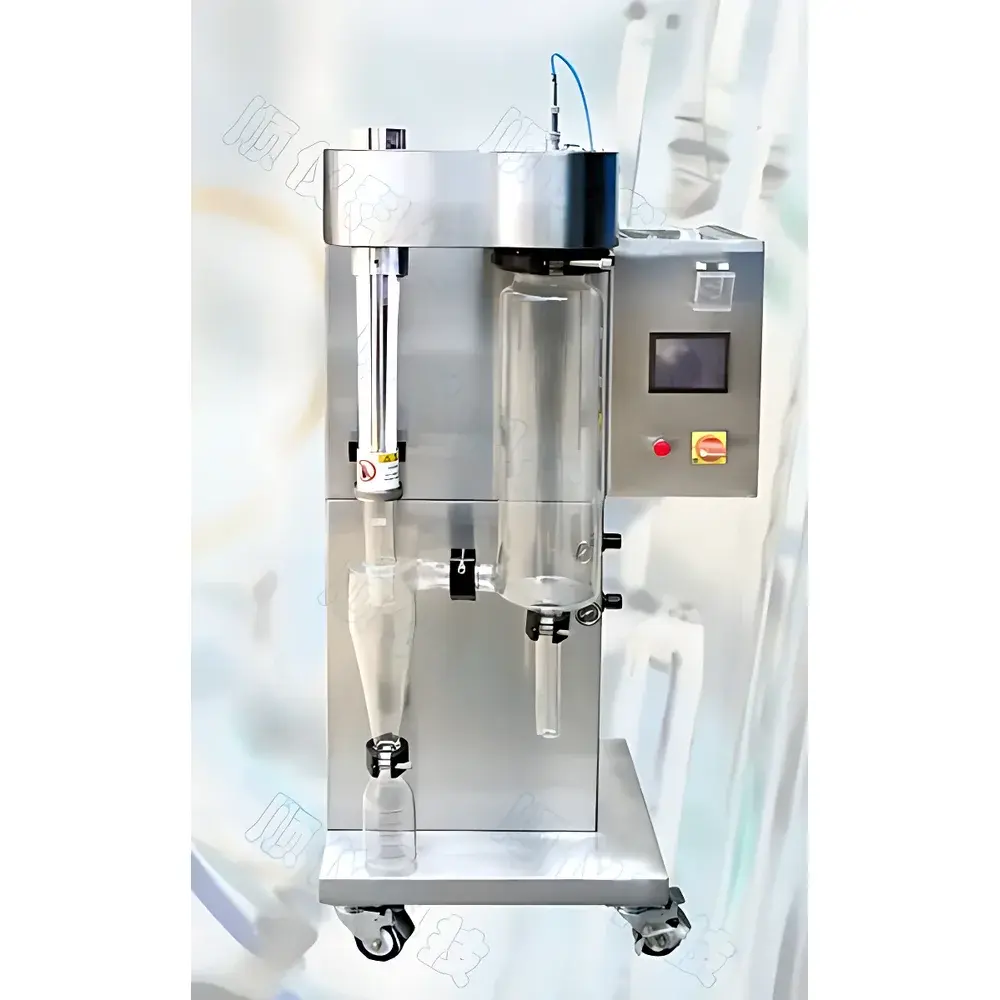
SUNYITECH SP-1500 Benchtop Spray Dryer
| Origin | Shanghai, China |
|---|---|
| Manufacturer Type | Authorized Distributor |
| Origin Category | Domestic (China) |
| Model | SP-1500 |
| Pricing | Available Upon Request |
| Evaporation Capacity | 1500 mL/h |
| Inlet Air Temperature Range | 30–280 °C |
| Outlet Air Temperature Range | 30–120 °C |
| Temperature Control Accuracy | ±1 °C |
| Drying Residence Time | 1.0–1.5 s |
| Feed Flow Rate (Peristaltic Pump) | 30–2000 mL/h |
| Airflow Capacity | 0–330 m³/h (Max), 686 Pa (Max Static Pressure) |
| Compressor Power | 0.2 kW, Air Output: 4.2 m³/h, Operating Pressure: 2–5 bar |
| Jet Cleaner (Needle) Supply | Internal 2.3 bar Compressed Air, Adjustable Frequency |
| Nozzle Configuration | Standard Dual-Fluid 0.75 mm Stainless Steel (316) Nozzle, Optional Sizes: 0.5–2.0 mm |
| Spray & Hot Air Direction | Co-current, Downward |
| Total Power Consumption | 3.5 kW |
| Electrical Supply | 220–240 V AC, 50/60 Hz, 13 A |
| Dimensions (L×W×H) | 650×500×1550 mm |
| Net Weight | 120 kg |
Overview
The SUNYITECH SP-1500 Benchtop Spray Dryer is a self-contained, laboratory-scale spray drying system engineered for precision, reproducibility, and operational transparency in R&D and pilot-scale formulation development. It employs co-current, downward-flow dual-fluid atomization—where liquid feed is dispersed by compressed air into fine droplets within a heated airstream—to achieve rapid, controlled solvent evaporation (typically within 1.0–1.5 seconds). This principle enables the continuous conversion of aqueous or organic solutions, suspensions, and emulsions into free-flowing, spherical dry powders with narrow particle size distribution. Designed for integration into GLP-compliant laboratories, the SP-1500 supports method development for pharmaceuticals, nutraceuticals, functional food ingredients, catalysts, and nanomaterial precursors—where thermal sensitivity, batch consistency, and scalability are critical.
Key Features
- Full-color 7-inch LCD touchscreen interface with bilingual (English/Chinese) navigation, supporting both fully automated PID-controlled operation and manual parameter override.
- PID-based inlet air temperature regulation with ±1 °C accuracy across the full 30–280 °C range, ensuring thermal stability essential for heat-labile biomolecules and polymers.
- Entire drying chamber, cyclone separator, and collection vessel fabricated from borosilicate glass (Schott Duran®-grade equivalent), enabling real-time visual monitoring of atomization, droplet trajectory, wall deposition, and powder formation.
- Dual-fluid nozzle assembly constructed from electropolished ASTM F138-grade 316 stainless steel; standard 0.75 mm orifice with optional 0.5–2.0 mm configurations to tune median particle diameter (d50) and span.
- Automated jet cleaner (‘needle’) mechanism with adjustable frequency (0.1–5 Hz), driven by integrated 2.3 bar oil-free compressed air—preventing nozzle clogging during high-solids or viscous feed applications.
- Calibrated peristaltic feed pump (30–2000 mL/h range) permitting minimal sample consumption (as low as 30 mL total volume) without compromising process fidelity.
- Interlocked safety architecture: heater activation is hardware-gated by blower status; airflow must be confirmed before thermal ramp-up initiates.
- Built-in oil-free scroll compressor (4.2 m³/h @ 2–5 bar) operating at ≤50 dB(A), eliminating external air supply dependencies and contamination risks from lubricated systems.
- HEPA-class inlet air filtration (ISO Class 5 compliant) upstream of the heating coil, minimizing particulate carryover and preserving product purity for sterile-critical or regulatory submissions.
Sample Compatibility & Compliance
The SP-1500 accommodates a broad spectrum of feed materials—including protein solutions (e.g., insulin, albumin), polymer dispersions (PLGA, chitosan), ceramic precursors (silica, titania sols), and active pharmaceutical ingredients (APIs) dissolved in water, ethanol, acetone, or dichloromethane. Its design aligns with foundational requirements of ICH Q5C (stability of biotechnological products), USP <1151> (dosage forms), and ISO 29541:2011 (spray drying terminology and performance criteria). While not certified for GMP manufacturing, its closed-loop architecture, audit-ready parameter logging, and traceable temperature/flow records support Stage 1–2 process validation under FDA 21 CFR Part 11–compliant software environments (when paired with validated third-party data acquisition systems).
Software & Data Management
The embedded SUNYITECH temperature and flow control firmware logs all critical parameters—including inlet/outlet temperatures, feed rate, airflow, and compressor pressure—at 1 Hz resolution. Data export is supported via USB 2.0 to CSV format for post-processing in MATLAB®, Python (Pandas), or statistical analysis platforms. Optional Ethernet connectivity enables remote monitoring and integration into LabVantage or Thermo Fisher SampleManager LIMS via Modbus TCP. All setpoints, alarms, and system events are timestamped with UTC synchronization and retain ≥30 days of local history—facilitating root-cause analysis during troubleshooting or regulatory review.
Applications
- Pharmaceutical: Development of inhalable dry powder formulations, amorphous solid dispersions, and vaccine stabilizers.
- Food Science: Encapsulation of probiotics, flavors, omega-3 oils, and anthocyanins for enhanced shelf-life and bioavailability.
- Materials Research: Synthesis of spherical LiFePO4 cathode precursors, mesoporous silica nanoparticles, and metal-organic framework (MOF) microspheres.
- Academic & Government Labs: Teaching unit operations in chemical engineering curricula; validating CFD models of droplet drying kinetics.
- Quality Control: Rapid moisture content verification and particle morphology screening prior to lyophilization or tableting.
FAQ
What is the minimum feed volume required for a valid drying run?
The system supports experimental runs starting from 30 mL total feed volume using the calibrated peristaltic pump—ideal for precious or synthetically limited compounds.
Can the SP-1500 handle organic solvents safely?
Yes, when operated within specified temperature limits (e.g., ≤60 °C inlet for acetone; ≤40 °C for ethanol) and with proper ventilation. The glass chamber and stainless-steel wetted parts are chemically resistant; however, explosion-proof electrical certification is not included—external fume hood use is mandatory for Class I flammable solvents.
Is the collected powder suitable for direct analytical characterization?
Absolutely. The co-current downward flow minimizes thermal degradation and wall adhesion; >95% of recovered material falls within a tight d50 ±15% span, enabling immediate SEM, XRD, or BET surface area analysis without sieving or milling.
Does the system meet any international electrical safety standards?
It complies with IEC 61010-1:2010 (Safety Requirements for Electrical Equipment for Measurement, Control, and Laboratory Use) and carries CE marking for EMC and Low Voltage Directive conformity.
How is calibration traceability maintained for temperature sensors?
Inlet and outlet RTDs are factory-calibrated against NIST-traceable references; users may perform field verification using a calibrated thermocouple probe inserted through designated access ports—procedures documented in the supplied IQ/OQ protocol template.



