
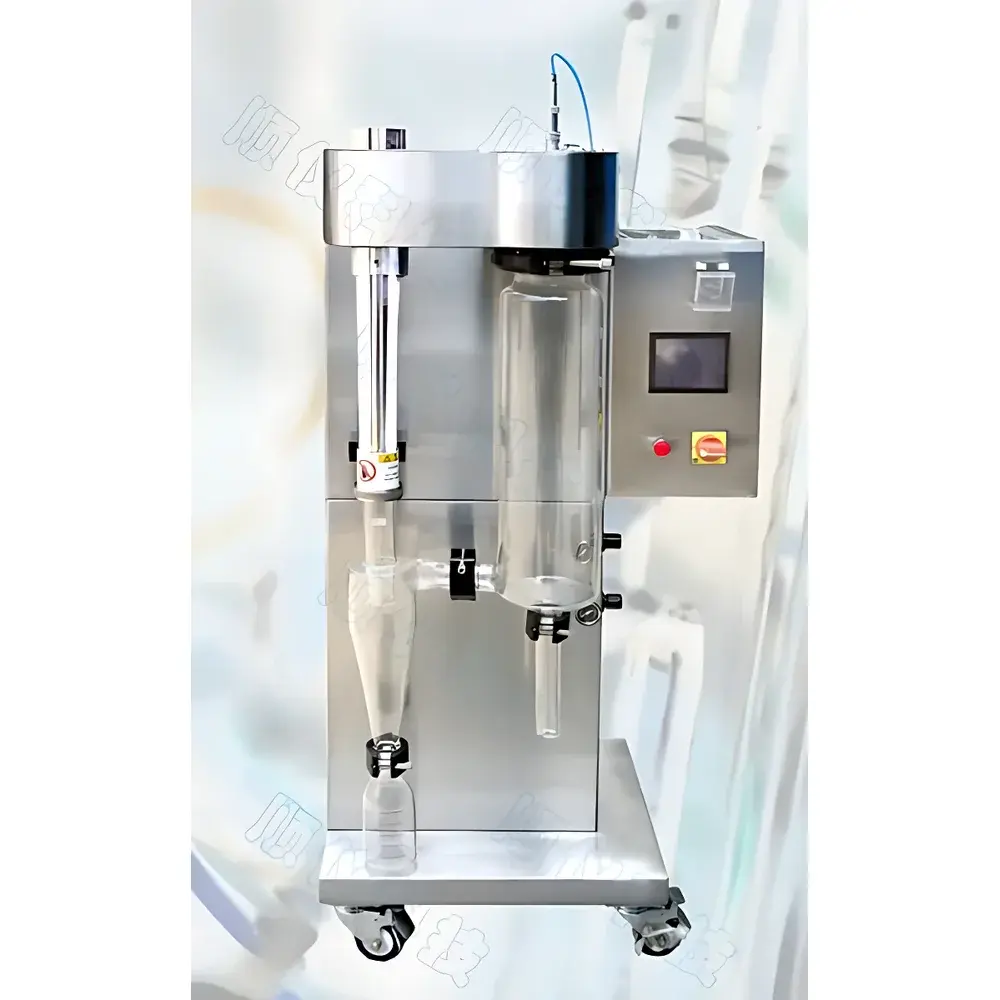
SUNYITECH SP-1500 Laboratory Spray Dryer
| Origin | Shanghai, China |
|---|---|
| Manufacturer Type | Authorized Distributor |
| Origin Category | Domestic (PRC) |
| Model | SP-1500 |
| Pricing | Available Upon Request |
| Evaporation Capacity | 1500 mL/h |
| Inlet Air Temperature Range | 30–280 °C |
| Outlet Air Temperature Range | 30–120 °C |
| Temperature Control Accuracy | ±1 °C |
| Drying Residence Time | 1.0–1.5 s |
| Feed Rate (Peristaltic Pump) | 30–2000 mL/h |
| Drying Air Flow Rate | 0–330 m³/h (Max Static Pressure: 686 Pa) |
| Compressor Power | 0.2 kW |
| Compressed Air Output | 4.2 m³/h at 2–5 bar |
| Jet Cleaner (Needle) Operating Pressure | 2.3 bar (Adjustable Frequency) |
| Nozzle Configuration | Dual-Fluid Atomizer (Standard 0.75 mm Orifice |
| Heating System Power | 3.5 kW |
| Electrical Supply | 220–240 V AC, 50/60 Hz, 13 A |
| Dimensions (L×W×H) | 650 × 500 × 1550 mm |
| Net Weight | 120 kg |
Overview
The SUNYITECH SP-1500 Laboratory Spray Dryer is a self-contained, benchtop-scale spray drying system engineered for reproducible pilot-scale powder synthesis and process development in pharmaceutical, food science, materials chemistry, and nanotechnology laboratories. It operates on the principle of rapid solvent evaporation via concurrent-flow atomization: liquid feed is pneumatically atomized into fine droplets using a dual-fluid nozzle, then exposed to a controlled stream of heated drying air. With residence times under 1.5 seconds and precise thermal management, the SP-1500 enables gentle, scalable conversion of heat-sensitive solutions, suspensions, or emulsions into free-flowing, spherical dry powders—without requiring external air compressors, chillers, or exhaust ducting.
Key Features
- Integrated full-oil-free air compressor (4.2 m³/h @ 2–5 bar) with noise emission <50 dB(A), eliminating dependency on facility-supplied compressed air;
- High-transparency borosilicate glass drying chamber, cyclone separator, and collection vessel—enabling real-time visual monitoring of atomization pattern, droplet trajectory, and powder deposition;
- Dual-fluid nozzle assembly fabricated from ASTM A276 Grade 316 stainless steel, supporting interchangeable orifices (0.5–2.0 mm) for systematic optimization of particle size distribution;
- Automated jet-cleaning (‘needle’) mechanism with adjustable frequency and internal 2.3 bar air supply—preventing nozzle clogging during continuous operation with viscous or particulate-laden feeds;
- PID-controlled inlet air temperature regulation with ±1 °C accuracy across 30–280 °C range, ensuring thermal consistency critical for amorphous solid dispersion stability and protein conformational integrity;
- Intuitive 7-inch color LCD touchscreen interface with bilingual (English/Chinese) menu navigation, supporting both fully automated sequences and manual parameter override;
- Safety interlock architecture: heater activation is physically inhibited until blower reaches operational airflow threshold—preventing thermal runaway or glass fracture;
- HEPA-grade inlet air filtration (ISO Class 5 compliant) to minimize environmental particulate ingress and ensure product purity in GMP-adjacent workflows;
- Peristaltic feed pump with linear 30–2000 mL/h range, validated for minimum sample volume of 30 mL—ideal for high-value biologics or novel excipient screening.
Sample Compatibility & Compliance
The SP-1500 accommodates aqueous and organic solvent-based feeds—including aqueous polymer solutions (e.g., PVP, HPMC), protein formulations (e.g., insulin, lysozyme), nanoemulsions, colloidal silica suspensions, and ceramic precursors (e.g., alumina, titania sols). Its downward concurrent-flow configuration minimizes thermal stress on thermolabile actives while promoting narrow particle size distribution (PSD): >95% of recovered powder falls within a single D50±15% band, as verified by laser diffraction (ISO 13320). The system supports documentation practices aligned with GLP and pre-GMP environments, including parameter logging, user access control, and timestamped event records—facilitating traceability required for regulatory submissions (e.g., FDA IND/IMPD dossiers).
Software & Data Management
Equipped with SUNYITECH’s proprietary temperature and flow control firmware, the SP-1500 logs all critical process variables—including inlet/outlet temperatures, feed rate, air flow, and compressor status—at 1-second intervals to internal non-volatile memory. Data export is supported via USB 2.0 to CSV format for post-run analysis in MATLAB, JMP, or Python-based DOE platforms. While the base system does not include 21 CFR Part 11-compliant electronic signatures or audit trail modules, its architecture permits integration with third-party LIMS or MES systems via Modbus RTU (RS-485) protocol for centralized data governance in validated environments.
Applications
- Pharmaceutical development: Preparation of inhalable dry powders, amorphous solid dispersions, and nanoparticle-loaded microparticles;
- Food & nutraceutical R&D: Encapsulation of probiotics, omega-3 oils, and heat-labile vitamins;
- Advanced materials synthesis: Production of battery cathode precursors (e.g., NMC, LFP), catalyst supports, and mesoporous metal oxides;
- Academic research: Fundamental studies of droplet drying kinetics, crust formation dynamics, and glass transition behavior during rapid dehydration;
- Quality-by-Design (QbD) workflows: Design-space mapping of atomization pressure, inlet temperature, and feed concentration to optimize residual moisture (<2.5%) and flowability (Carr Index <25%).
FAQ
What is the minimum sample volume required for a valid run?
The system is calibrated and validated for feed volumes ≥30 mL using the integrated peristaltic pump.
Can the SP-1500 handle organic solvents such as ethanol or acetone?
Yes—when configured with optional explosion-proof electrical components and nitrogen inerting kit (sold separately), it supports Class I, Division 2 solvent handling per NFPA 497 guidelines.
Is the glassware resistant to thermal shock during rapid temperature ramping?
All borosilicate glass components conform to DIN ISO 3585 specifications (coefficient of thermal expansion: 3.3 × 10⁻⁶/K) and are rated for continuous use up to 280 °C.
Does the system comply with ISO 22000 or USP <1118> for spray drying validation?
While not pre-certified, its design basis—including calibrated temperature sensors (traceable to NIST standards), closed-loop PID control, and deterministic airflow measurement—provides the foundational attributes required for user-led validation per ISO 22000 Annex H or USP <1118> Section 5.2.
What maintenance intervals are recommended for the compressor and nozzle?
The oil-free compressor requires no scheduled lubrication; annual desiccant replacement and intake filter cleaning are advised. The 316SS nozzle should be inspected and ultrasonically cleaned after every 50 hours of cumulative operation.



