
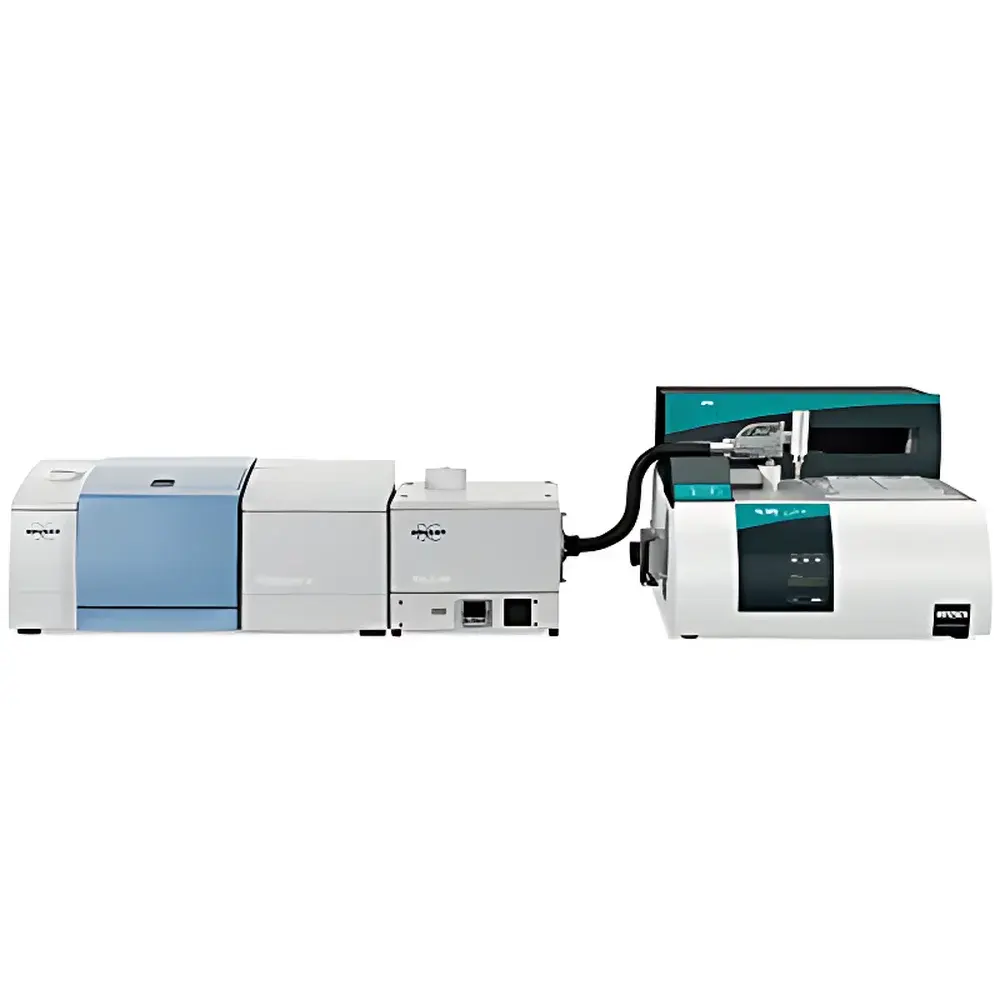
Netzsch STA/TG-FTIR Coupled Thermal Analysis System
| Brand | Netzsch |
|---|---|
| Origin | Germany |
| Model | STA/TG-FTIR |
| Operating Temperature Range | RT to 350 °C |
| Gas Transfer Path | Heated Entirely (Prevents Condensation) |
| Gas Residence Time | Short |
| Carrier Gas Flow Rate | Low (Minimizes Dilution Effect) |
| Measurement Mode | Synchronized Simultaneous STA–FTIR Acquisition or Independent Operation |
| Software Architecture | Fully Integrated, Core-Embedded Control with Hardware-Automated Triggering |
| Sample Introduction | Top-Loading Vertical TGA Configuration (Ensures Quantitative Evolved Gas Transfer) |
Overview
The Netzsch STA/TG-FTIR Coupled Thermal Analysis System integrates simultaneous thermogravimetric analysis (TGA), differential scanning calorimetry (DSC) — as part of the simultaneous thermal analyzer (STA) platform — and Fourier-transform infrared (FTIR) spectroscopy into a single, rigorously engineered hyphenated instrument. This system enables real-time, molecular-level identification of gaseous species evolved during controlled thermal decomposition, oxidation, reduction, or desorption processes. Unlike sequential or offline coupling approaches, the STA/TG-FTIR employs a direct, heated gas-transfer interface between the STA furnace and the FTIR spectrometer’s light path, ensuring quantitative transport of volatile and condensable analytes without fractionation or wall adsorption. The vertical top-loading TGA design minimizes dead volume and guarantees near-complete transfer of evolved gases—critical for stoichiometric correlation between mass loss events and spectral signatures. The system operates across a standard temperature range from ambient to 350 °C, optimized for polymer degradation, catalyst precursor transformation, pharmaceutical excipient stability, and inorganic solid-state reaction kinetics.
Key Features
- Top-loading vertical TGA geometry ensures minimal gas-phase residence time and eliminates gravitational segregation or channeling effects during sample heating.
- Fully heated gas transfer line (up to 350 °C) prevents condensation of semi-volatiles such as carboxylic acids, aldehydes, or low-molecular-weight oligomers—preserving spectral fidelity and quantitative response.
- Low-flow carrier gas configuration (typically N2 or synthetic air) reduces dilution while maintaining laminar flow dynamics, enhancing signal-to-noise ratio for trace-evolved species detection.
- Core-embedded software architecture synchronizes thermal ramping, mass change acquisition, and interferogram collection at the firmware level—enabling sub-second temporal alignment between weight loss steps and IR absorbance onset.
- Modular design supports standalone operation: the FTIR module may be used independently for routine gas-phase spectroscopy; the STA unit functions as a high-stability thermobalance or DSC/TGA platform without coupling.
Sample Compatibility & Compliance
The system accommodates solid, powdered, and thin-film samples (typically 1–20 mg) in standard alumina or platinum crucibles. It is routinely applied to polymeric matrices, metal–organic frameworks (MOFs), battery cathode precursors, pharmaceutical co-crystals, and ceramic green bodies. From a regulatory standpoint, data acquisition adheres to principles aligned with ASTM E1131 (standard test method for compositional analysis by evolved gas analysis), ISO 11358 (polymer thermogravimetry), and USP (residual solvents). Audit-trail-enabled software versions comply with FDA 21 CFR Part 11 requirements when configured with electronic signature modules and role-based access control—supporting GLP and GMP environments where traceability of thermal event attribution is mandatory.
Software & Data Management
NETZSCH Proteus® software serves as the unified control and analysis environment. It provides synchronized visualization of derivative thermogravimetry (DTG), heat flow, and time-resolved FTIR spectra (e.g., 32 cm−1 resolution, 4–1000 cm−1 spectral window). Spectral libraries (e.g., Hummel Polymer Library, NIST Chemistry WebBook) are embedded for automated peak assignment of CO2, H2O, NH3, SO2, hydrocarbons, and carbonyl-containing volatiles. All raw interferograms, calibrated absorbance time-courses, and metadata (ramp rate, purge gas composition, crucible type) are stored in vendor-neutral HDF5 containers, enabling interoperability with third-party chemometric tools (e.g., MATLAB, Python scikit-learn) for multivariate curve resolution (MCR) or principal component analysis (PCA) of evolving gas profiles.
Applications
- Elucidating multi-step decomposition mechanisms in flame-retardant polymers via correlation of DTG peaks with characteristic C=O stretch evolution.
- Quantifying residual solvent content (e.g., DMF, THF) in MOF activation processes under dynamic vacuum–inert gas switching protocols.
- Distinguishing oxidative vs. pyrolytic pathways in carbon black formation from sucrose precursors using O2/N2 atmosphere switching and real-time CO/CO2 ratio tracking.
- Monitoring in-situ ligand loss in transition-metal complexes during calcination—linking mass loss steps to amine or acetate band attenuation in FTIR.
- Validating thermal stability windows of active pharmaceutical ingredients (APIs) per ICH Q1A(R2), identifying deamidation or lactonization byproducts not detectable by DSC alone.
FAQ
Can the FTIR module operate independently of the STA unit?
Yes—the FTIR spectrometer is a fully functional benchtop instrument with its own source, interferometer, and detector; it may be operated standalone for gas-cell measurements or library matching.
What is the typical gas residence time between the TGA furnace and the FTIR cell?
Under standard operating conditions (50 mL/min N2, 300 °C transfer line), residence time is ≤1.2 seconds—validated via inert tracer gas pulse experiments.
Is the system compatible with reactive atmospheres such as O2 or H2?
Yes—gas inlet manifold supports up to three independent mass flow controllers; reactive gas lines include stainless-steel construction and optional catalytic scrubbers for post-analysis cleanup.
Does the software support automated peak deconvolution of overlapping IR bands?
Proteus® includes constrained iterative least-squares fitting for multi-component spectral unmixing, particularly effective for resolving overlapping ν(C=O) and ν(O–H) features in humid evolved gas streams.
How is calibration traceability maintained for quantitative evolved gas analysis?
System-level calibration uses certified gas standards (e.g., NIST-traceable CO2/N2 mixtures) and reference materials with known decomposition stoichiometry (e.g., CaCO3 → CaO + CO2).



