
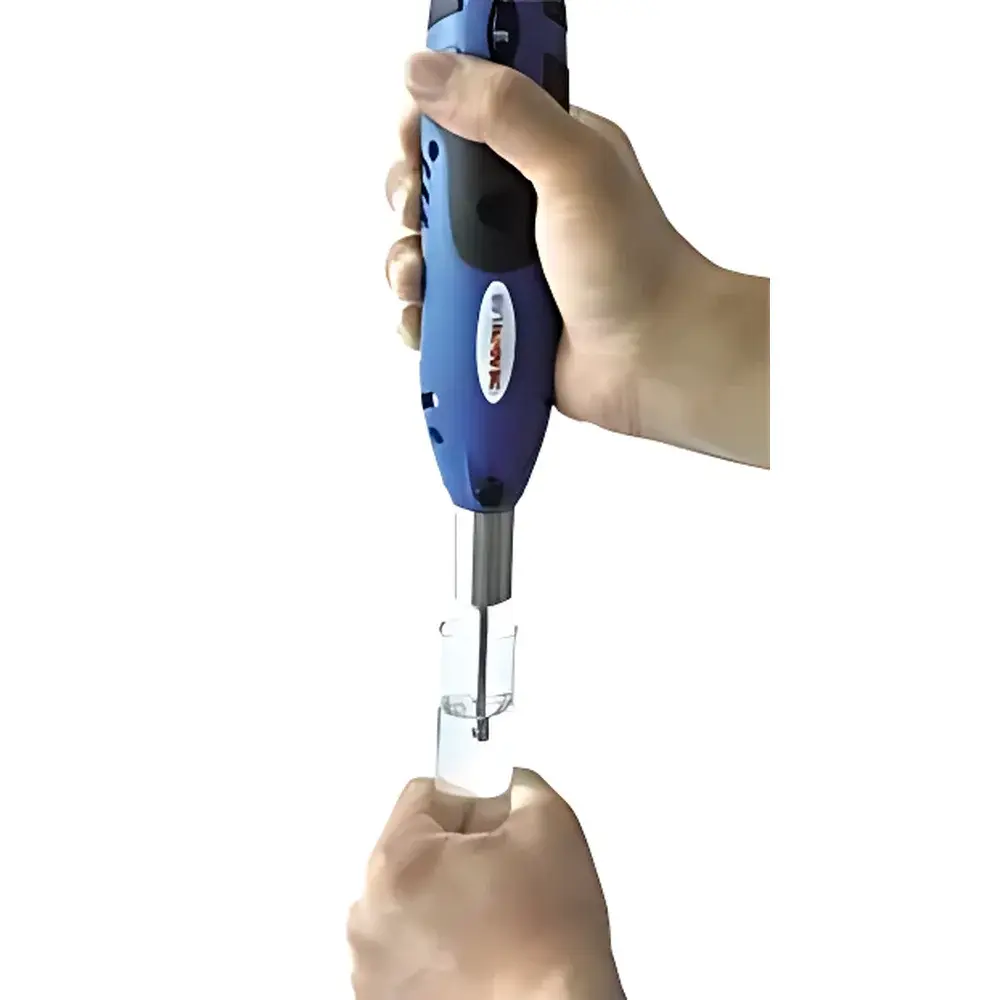
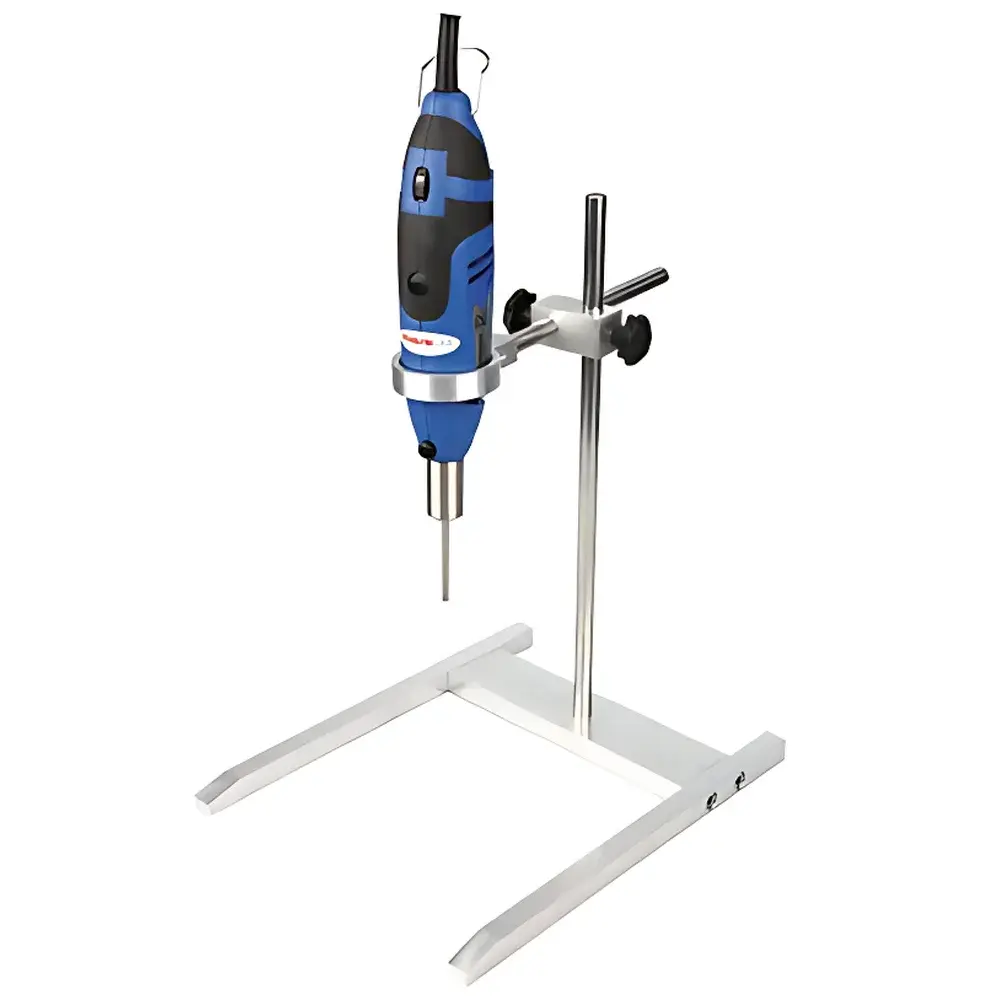
DLAB D-160 Handheld High-Shear Homogenizer
| Brand | DLAB |
|---|---|
| Model | D-160 |
| Type | Handheld High-Shear Rotational Homogenizer |
| Power Input/Output | 160 W / 110 W |
| Rated Voltage/Frequency | 220 V / 50 Hz |
| Speed Range | 8,000–30,000 rpm |
| Rotor Tip Speed | 6.3–14 m/s |
| Speed Settings | 6-step mechanical dial |
| Processing Volume (H₂O) | 0.1–50 mL (with DS-160/5 probe) or 1–250 mL (with DS-160/10 probe) |
| Max. Viscosity | 5,000 mPa·s |
| Wetted Materials | 316L stainless steel + PTFE |
| Weight | 0.6 kg |
| Noise Level | 72 dB(A) |
| Operating Ambient | 5–40 °C, ≤85% RH |
| Duty Cycle | Continuous (100%) |
| IP Rating | IP30 |
| Dimensions (D×W×H) | 46 × 55 × 230 mm |
Overview
The DLAB D-160 Handheld High-Shear Homogenizer is an engineered solution for rapid, reproducible sample homogenization, dispersion, and emulsification in laboratory-scale applications. It operates on the principle of high-shear rotor-stator interaction: liquid or semi-solid samples are drawn into the narrow clearance between a rapidly rotating rotor and a fixed stator, where intense hydrodynamic shear forces—generated by tip speeds up to 14 m/s—induce cell lysis, particle size reduction, and phase stabilization. This mechanism enables complete tissue homogenization (e.g., liver, muscle, mammary tissue) within 10–30 seconds, making it suitable for time-sensitive workflows in molecular biology, biopharmaceutical development, and materials science. Unlike ultrasonic or bead-beating systems, the D-160 delivers consistent mechanical energy input without introducing exogenous heat spikes or nucleic acid shearing artifacts—critical for downstream RNA integrity or enzymatic activity preservation.
Key Features
- Compact handheld form factor (0.6 kg) with ergonomic grip design for single-hand operation and precise maneuverability in confined spaces such as fume hoods or biosafety cabinets.
- High-efficiency brushless motor delivering stable torque across the full speed range (8,000–30,000 rpm), with six fixed-speed settings selected via tactile mechanical dial—no software dependency or calibration drift.
- Interchangeable rotor-stator probes (DS-160/5 and DS-160/10) optimized for distinct volume ranges: 0.1–50 mL and 1–250 mL respectively, enabling method scalability from microscale lysates to preparative emulsions.
- Chemically resistant wetted components fabricated from ASTM-certified 316L stainless steel and FDA-compliant PTFE—validated for repeated autoclaving (121 °C, 20 min) and compatibility with aggressive solvents (e.g., chloroform, ethanol, acetone).
- Robust mechanical architecture rated IP30 for protection against solid ingress; continuous-duty rating ensures uninterrupted operation during extended batch processing without thermal shutdown.
Sample Compatibility & Compliance
The D-160 accommodates diverse sample matrices including soft animal tissues, bacterial pellets, polymer dispersions, oil-in-water emulsions, and nanoparticle suspensions. Its shear-dominated mechanism avoids cavitation-induced degradation, preserving protein conformation and colloidal stability. All wetted surfaces comply with ISO 8573-1 (compressed air purity) and USP for plastic component safety. The device meets CE marking requirements under Directive 2014/30/EU (EMC) and 2014/35/EU (LVD). While not intrinsically certified for GMP environments, its cleanability, material traceability, and absence of electronic data logging make it suitable for GLP-aligned workflows where manual process documentation is standard practice.
Software & Data Management
The D-160 operates as a standalone electromechanical instrument with no embedded firmware, cloud connectivity, or digital interface. Speed selection is purely mechanical—eliminating firmware validation burdens and ensuring long-term operational consistency across laboratory sites. For regulated environments requiring audit trails, users may integrate the device into validated SOPs using external timing logs and probe usage records. No Part 11 compliance features are present; however, the absence of electronic records simplifies qualification protocols under ISO/IEC 17025 or ISO 9001 frameworks where analog instrumentation is explicitly permitted.
Applications
- Biological sample preparation: Rapid lysis of mammalian tissues, microbial cells, and plant material prior to nucleic acid extraction or proteomic analysis.
- Pharmaceutical formulation: Homogenization of nanoemulsions, liposomal suspensions, and polymeric micelles for preclinical dosage form development.
- Materials science: Deagglomeration of carbon nanotubes, graphene oxide, and metal oxide nanoparticles in aqueous or organic media.
- Food & cosmetic R&D: Emulsification of dairy-based creams, essential oil blends, and pigment dispersions with controlled droplet size distribution.
- Environmental testing: Extraction of hydrophobic contaminants (e.g., PCBs, PAHs) from soil or sediment slurries using solvent-assisted dispersion.
FAQ
What is the maximum recommended operating time per cycle?
Continuous operation is supported indefinitely (100% duty cycle); however, for viscous or thermally sensitive samples, intermittent use (e.g., 30 s on / 15 s off) is advised to minimize localized heating.
Can the D-160 be used for sterile applications?
Yes—both probe types are autoclavable at 121 °C for 20 minutes. Ensure complete drying before reuse to prevent steam entrapment damage.
Is calibration required?
No routine calibration is specified by the manufacturer. Speed accuracy is maintained via precision-machined gear train and motor winding tolerances; verification can be performed optically using a calibrated tachometer.
How does the D-160 compare to ultrasonic homogenizers for cell disruption?
It provides more uniform shear distribution and lower thermal load than sonication, but offers less subcellular fractionation control; optimal for total homogenate generation rather than organelle isolation.
Are replacement probes and spare parts available globally?
DLAB maintains authorized distribution channels across North America, EMEA, and APAC; probe part numbers (DS-160/5, DS-160/10) are standardized and stocked by regional technical support centers.



