
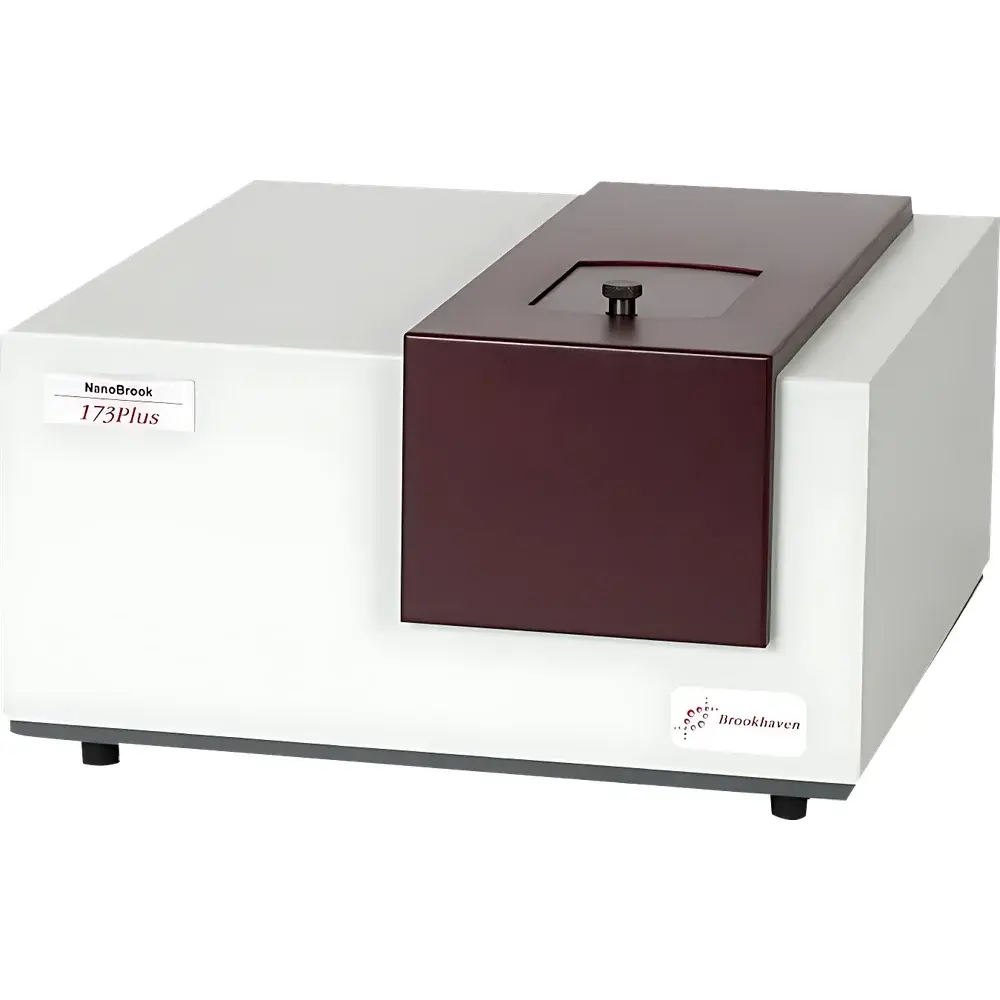
Brookhaven NanoBrook 173Plus Multi-Angle Dynamic Light Scattering (DLS) and Static Light Scattering (SLS) Particle Size Analyzer
| Brand | Brookhaven |
|---|---|
| Origin | USA |
| Model | NanoBrook 173Plus |
| Dispersion Method | Wet Dispersion |
| Instrument Type | Laboratory Laser-Based Particle Size Analyzer |
| Measurement Range | 0.3 nm – 10 µm |
| Repeatability | ±1% |
| Measurement Time | 1–2 min |
| Scattering Angles | 15°, 90°, 173° |
| Concentration Range | 0.1 ppm – 40% w/v |
| Temperature Control | −5 °C to 120 °C (±0.1 °C) |
| Laser Source | 40 mW Solid-State Laser (optional 5 mW He-Ne) |
| Detector | APD |
| Correlator | 4×10¹¹ Linear Channels, Dual-Channel Cross-Correlation Support |
| Sample Volume | 0.01–3 mL (with optional 50 µL and 10 µL micro-cells) |
| Molecular Weight Range | 342–2×10⁷ Da |
| pH Range | 1–14 |
| Software Compliance | 21 CFR Part 11 Ready |
Overview
The Brookhaven NanoBrook 173Plus is a high-performance, multi-angle dynamic light scattering (DLS) and static light scattering (SLS) analyzer engineered for precision characterization of nanoparticles, macromolecules, and colloidal dispersions in solution. Unlike conventional single-angle DLS instruments, the 173Plus integrates three distinct scattering geometries—15°, 90°, and 173°—within a single optical platform. This tri-angle configuration leverages both forward-scattered (15°), side-scattered (90°), and back-scattered (173°) signals to overcome inherent limitations in polydisperse or high-concentration systems. The 173° backscattering design enables robust measurements at concentrations up to 40% w/v—orders of magnitude higher than standard 90° DLS—without dilution-induced artifacts. Coupled with a high-sensitivity avalanche photodiode (APD) detector and a 4×10¹¹-channel digital correlator supporting dual-channel cross-correlation, the system delivers exceptional signal-to-noise ratio and statistical reliability across the full size range of 0.3 nm to 10 µm. Its solid-state 40 mW laser source ensures long-term stability and reduced maintenance, while optional 5 mW He-Ne laser compliance supports applications requiring Class II laser safety certification.
Key Features
- Triple-angle detection geometry (15°, 90°, 173°) for comprehensive angular resolution and optimized sizing of both sub-nanometer biomolecules and micron-scale aggregates
- Extended concentration tolerance: validated operation from 0.1 ppm to 40% w/v without sample dilution or centrifugation
- Precise thermostatic control from −5 °C to 120 °C with ±0.1 °C stability—critical for protein thermal unfolding studies and temperature-dependent aggregation kinetics
- Micro-volume capability: compatible with 10 µL and 50 µL quartz cuvettes to conserve precious biological or synthetic samples
- Integrated molecular weight determination via SLS calibration using Debye or Zimm analysis, covering 342 Da to 2×10⁷ Da
- Real-time trend analysis engine for automated monitoring of particle size, intensity, and polydispersity index (PDI) as functions of time, temperature, pH, or additive concentration
- Modular architecture supporting field-upgradable options including zeta potential measurement, microrheology, online GPC/SEC coupling, and 21 CFR Part 11-compliant software
Sample Compatibility & Compliance
The NanoBrook 173Plus accommodates a broad spectrum of colloidal and macromolecular systems—including proteins, peptides, liposomes, exosomes, polymer latexes, microemulsions, pigment dispersions, ceramic slurries, and wastewater colloids—provided they are suspended in optically transparent solvents. Its angular flexibility mitigates Mie scattering distortions in particles >500 nm and enhances sensitivity to small species (<2 nm) typically masked in 90° configurations. The instrument meets ISO 22412:2017 requirements for DLS-based particle sizing and supports GLP/GMP workflows through optional 21 CFR Part 11 software modules that enforce electronic signatures, audit trails, and role-based access control. All wetted components are chemically inert (quartz, PTFE, borosilicate glass), ensuring compatibility with aggressive solvents and low-pH or high-pH formulations (pH 1–14). Optional dielectric constant and viscosity modules enable direct solvent property input for rigorous refractive index and viscosity correction during data inversion.
Software & Data Management
Particle Solution™ software serves as the unified analytical interface for acquisition, modeling, and reporting. It implements non-negative least squares (NNLS) and CONTIN algorithms for intensity-weighted size distribution deconvolution, with built-in validation tools for correlation curve quality assessment (e.g., baseline drift, coherence, intercept deviation). Batch processing supports automated sequence runs across variable temperatures or titrant additions. Raw correlator data, intermediate fits, and final reports are stored in vendor-neutral HDF5 format with embedded metadata (timestamp, operator ID, instrument configuration, environmental logs). For regulated environments, the 21 CFR Part 11 software package provides electronic signature enforcement, user authentication, change tracking, and encrypted data integrity verification—fully auditable for FDA, EMA, and PMDA submissions. Export options include CSV, PDF, and XML for LIMS integration.
Applications
- Biopharmaceutical development: monitoring monoclonal antibody aggregation, thermal melt transitions (Tm), and formulation stability under stress conditions
- Nanomedicine: characterizing liposomal drug carriers, polymeric micelles, and extracellular vesicles for batch release and comparability studies
- Materials science: quantifying nanoparticle growth kinetics during sol-gel synthesis, dispersion stability of carbon black or ceramic slurries, and rheological onset in weak gels via microrheology add-on
- Quality control: rapid lot-to-lot verification of emulsion droplet size in cosmetics and food products, pigment dispersion homogeneity in coatings, and catalyst particle distribution in petrochemical processes
- Academic research: investigating supramolecular assembly, polymer conformation changes, and interfacial adsorption dynamics via time-resolved DLS/SLS coupling
FAQ
What scattering angles does the NanoBrook 173Plus support, and why are multiple angles beneficial?
The system measures at 15°, 90°, and 173° simultaneously. Multiple angles improve accuracy for polydisperse samples, extend measurable size range, and enable reliable sizing at high concentrations where 90° alone suffers from multiple scattering.
Can the instrument measure zeta potential?
Yes—via optional Zeta Potential Upgrade Kit, which adds electrophoretic light scattering (ELS) capability with integrated electrode cell and phase-analysis light scattering (PALS) algorithm.
Is the system compatible with GPC/SEC systems?
Yes—the 173Plus can be configured as an online detector for size-exclusion chromatography, providing real-time DLS/SLS signals synchronized with elution profiles to detect aggregation or conformational changes.
Does it support automated pH or conductivity titrations?
Yes—when coupled with the optional Auto-Titrator module, the system records particle size, intensity, and PDI continuously while varying pH, ionic strength, or surfactant concentration.
What regulatory standards does the software comply with?
The optional 21 CFR Part 11 software module satisfies FDA requirements for electronic records and signatures, including audit trail generation, user access controls, and data integrity assurance—validated for pharmaceutical and medical device QA/QC environments.



