
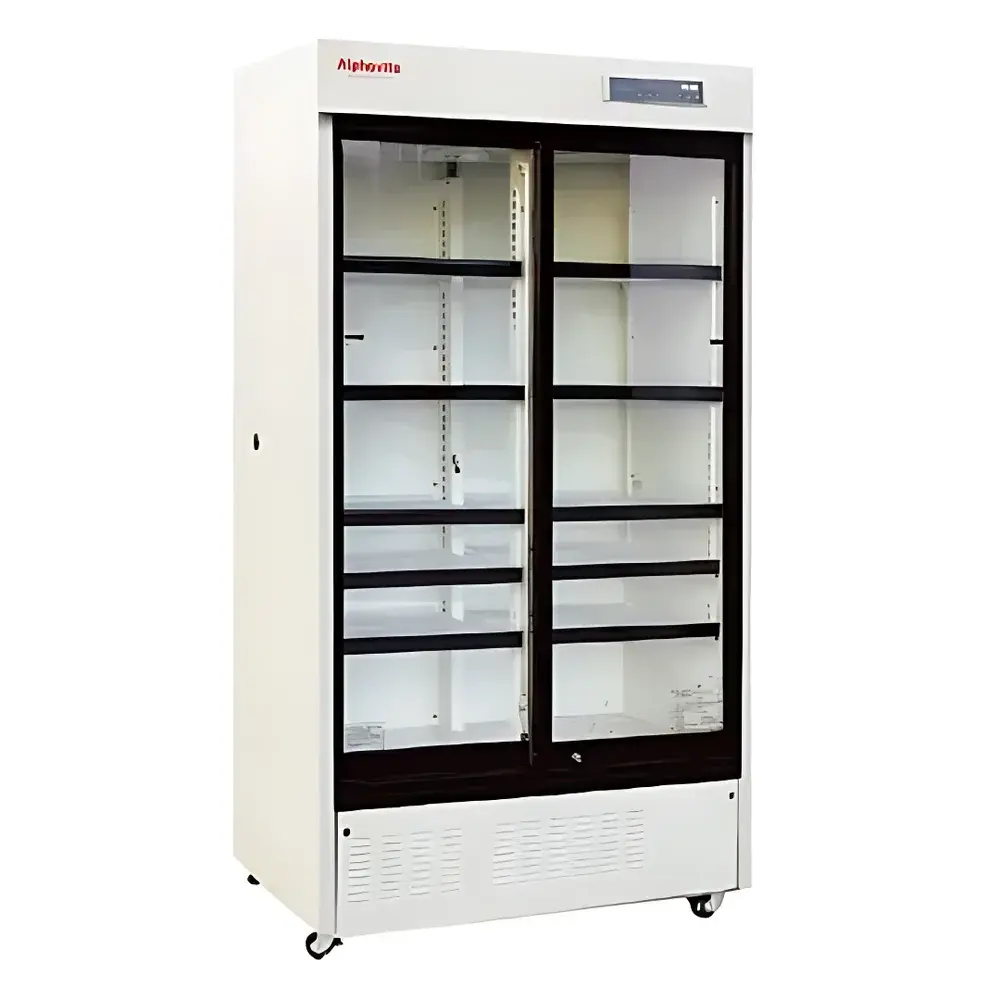
Alphavita MPR-712HI Medical Refrigerator
| Brand | Alphavita |
|---|---|
| Origin | Liaoning, China |
| Model | MPR-712HI |
| Refrigeration Temperature Range | 2–8°C |
| Effective Volume | 732 L |
| Internal Dimensions | 1120 × 523 × 1375 mm |
| External Dimensions | 1200 × 668 × 1950 mm |
| Refrigerant | R290 (hydrocarbon) |
| Cooling Rate Improvement | 20% vs. fixed-speed baseline |
| Temperature Uniformity | ≤3°C |
| Compressor Type | Inverter-driven, imported unit |
| Door Type | Double-glazed with heat-reflective film |
| Control System | Microprocessor-based non-volatile controller with real-time compressor status display |
| Defrost Method | Intelligent cyclic defrost |
| Data Logging | Up to 100,000 records via USB export |
| Power Consumption Reduction | 67% vs. comparable conventional units |
| Noise Level Reduction | 20% vs. conventional units |
Overview
The Alphavita MPR-712HI Medical Refrigerator is a purpose-built, high-reliability low-temperature storage system engineered for the secure preservation of temperature-sensitive biological materials in clinical laboratories, pharmacy dispensing units, blood banks, and vaccine distribution centers. Designed and validated to meet the stringent thermal stability requirements of ICH Guidelines Q5C and WHO Technical Report Series No. 961 (Annex 9), this unit maintains a tightly controlled operating range of 2–8°C—aligned with USP , CLSI GP44-A4, and ISO 15189:2022 Annex A.5.2 for refrigerated specimen and reagent storage. Its core thermodynamic architecture integrates an inverter-driven, imported hermetic compressor paired with R290 hydrocarbon refrigerant—a Class A3 flammable but globally recognized low-GWP (Global Warming Potential = 3) alternative compliant with EU F-Gas Regulation (EU) No 517/2014 and EPA SNAP Program acceptance for medical refrigeration. The system employs forced-air circulation with dual evaporator zones and precision PID feedback control to achieve ≤3°C internal temperature uniformity across the full 732 L working volume.
Key Features
- Inverter compressor technology enabling 20% faster pull-down time and enhanced energy efficiency—verified per IEC 62846:2017 test protocols
- R290 hydrocarbon refrigerant delivering 67% lower power consumption and 20% reduced acoustic emission (≤42 dB[A] at 1 m) versus legacy R134a systems
- Double-glazed door with integrated heat-reflective coating minimizing radiant heat ingress and UV transmission (<1% UVA transmittance)
- Microprocessor-based controller with non-volatile memory ensuring parameter retention during power interruption; real-time display of compressor on/off cycles, setpoint deviation, and alarm history
- Intelligent cyclic defrost algorithm preventing temperature excursions during defrost cycles—validated to maintain ≤±0.5°C deviation from setpoint throughout defrost sequence
- Comprehensive alarm suite: high/low temperature, door ajar (>30 s), power failure, compressor overload, and sensor fault detection—all with visual LED indicators and relay dry-contact outputs for BMS integration
- Interior constructed from electrophoretically coated steel with epoxy-polyester powder finish (corrosion resistance per ISO 9227 salt spray ≥720 h)
Sample Compatibility & Compliance
The MPR-712HI accommodates primary and secondary containers used for human diagnostic specimens (serum, plasma, CSF), unopened vials of insulin and monoclonal antibodies, lyophilized vaccines (e.g., mRNA-LNP formulations requiring 2–8°C interim storage), and GMP-grade reagents. Its interior layout—featuring adjustable stainless-steel wire shelves and modular partitioning—supports traceable rack-based organization compliant with ISO 20387:2018 biobanking requirements. All alarm events and temperature logs are timestamped and stored with audit-trail capability, satisfying FDA 21 CFR Part 11 electronic record integrity criteria when connected to validated data management software. Unit validation documentation includes IQ/OQ templates aligned with ASTM E2500-13 and EU Annex 15.
Software & Data Management
Temperature and operational data are logged at user-configurable intervals (1–60 min) and retained onboard for up to 100,000 entries. Data export occurs via standard USB 2.0 interface in CSV format, compatible with LIMS platforms including LabWare, STARLIMS, and Thermo Fisher SampleManager. Optional Ethernet/Wi-Fi modules enable SNMP-based remote monitoring and TLS 1.2-secured cloud synchronization. Firmware supports configurable alarm thresholds, password-protected parameter editing, and automatic generation of daily summary reports—including min/max/mean temperature, door-open duration, and defrost frequency—for GLP/GMP quality review.
Applications
- Clinical laboratory cold chain storage for hematology, microbiology, and molecular diagnostics specimens
- Pharmacy-controlled substance refrigeration under USP environmental monitoring requirements
- Vaccine staging and short-term holding prior to administration per CDC Vaccine Storage and Handling Toolkit (2023)
- Bio-banking of primary cell isolates and PBMCs requiring stable 2–8°C conditions between processing steps
- QC/QA storage of reference standards, calibrators, and stability-indicating reagents
FAQ
Is the MPR-712HI certified for use in regulated clinical environments?
Yes—it meets EN 61000-6-3 (EMC), EN 61000-6-1 (immunity), and carries CE marking under the EU Medical Device Regulation (MDR) Annex XVI classification for ancillary equipment supporting in vitro diagnostic procedures.
Can the unit be validated for GxP compliance?
Absolutely. Factory-supplied IQ/OQ protocols, temperature mapping templates, and calibration certificates (NIST-traceable PT100 sensors) support installation and operational qualification per ISPE Baseline Guide Vol. 5 and FDA Guidance for Industry: Process Validation.
What is the service life expectancy of the R290 refrigeration system?
Based on accelerated life testing per ISO 5171, the sealed R290 circuit demonstrates >15 years MTBF (Mean Time Between Failures) under continuous 2–8°C operation at 25°C ambient.
Does the microprocessor controller support remote access or network integration?
Standard configuration includes USB data export only; optional communication modules provide Modbus TCP, SNMPv3, or MQTT interfaces for integration into hospital-wide environmental monitoring systems (EMS).





