
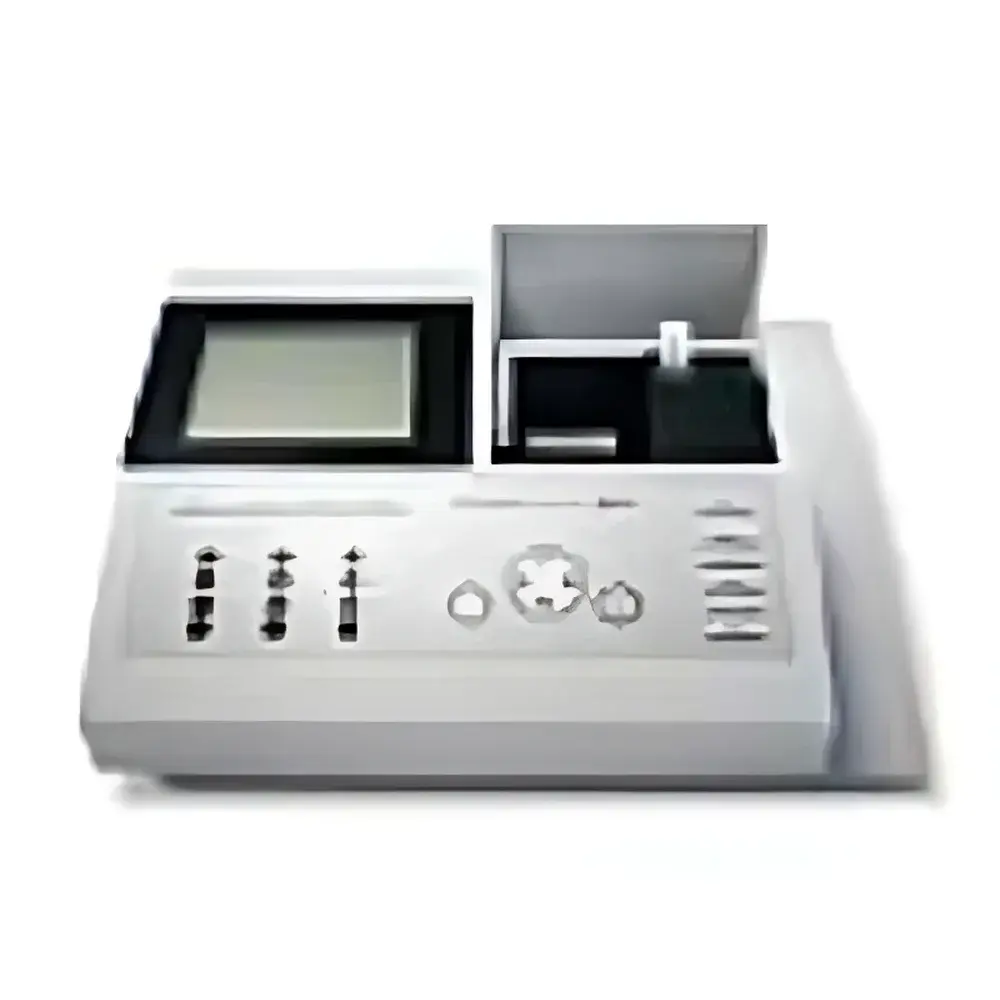
Millipore Spectroquant® Pharo 100 Visible-Spectrum Multifunctional Water Quality Analyzer
| Brand | Millipore |
|---|---|
| Origin | Germany |
| Model | Pharo 100 |
| Wavelength Range | 320–1100 nm |
| Light Source | Tungsten Halogen Lamp |
| Optical System | Stabilized Single-Beam |
| Spectral Bandwidth | 4 nm |
| Wavelength Resolution | 1 nm |
| Wavelength Accuracy | ±1 nm |
| Absorbance Range | ±3.3 A |
| Absorbance Resolution | 0.001 A |
| Absorbance Accuracy | ±0.003 A (A < 0.600) |
| Cuvette Compatibility | 16 mm round, 10/20/50 mm square (auto-recognized) |
| Scan Increment | 1 nm |
| Data Storage | 1000 measurement results + 4 MB for spectral/dynamic data |
| Interfaces | 1× USB-A, 1× USB-B, 1× RS-232 |
| IP Rating | IP31 |
| Operating Temperature | +10 °C to +35 °C |
| Dimensions | 404 × 197 × 314 mm (L×H×W) |
| Weight | ~3.7 kg |
Overview
The Millipore Spectroquant® Pharo 100 Visible-Spectrum Multifunctional Water Quality Analyzer is a laboratory-grade single-beam spectrophotometer engineered for precision, traceability, and regulatory compliance in environmental water analysis. Operating across a validated visible-to-near-IR wavelength range (320–1100 nm), it employs a stabilized tungsten halogen lamp and fixed 4 nm spectral bandwidth optics to deliver high reproducibility in absorbance-based quantification. Unlike dedicated photometers, the Pharo 100 integrates dual operational paradigms: as a certified water quality analyzer—preloaded with over 170 DIN- and USEPA-validated test methods for more than 50 parameters (e.g., COD, nitrate, phosphate, ammonia, heavy metals)—and as a general-purpose visible spectrophotometer supporting custom method development, full-spectrum scanning, multi-wavelength analysis, and kinetic assays. Its design adheres to core principles of analytical quality assurance (AQA), embedding three-tiered verification protocols directly into routine operation to ensure metrological integrity from instrument performance to sample matrix interference assessment.
Key Features
- Automated barcode recognition for all Spectroquant® pre-filled reagent vials and economical reagent kits—eliminates manual method selection errors and accelerates workflow.
- Intelligent cuvette detection system automatically identifies 16 mm round or 10/20/50 mm square cuvettes and applies corresponding pathlength correction and calibration logic without user intervention.
- Three-level Analytical Quality Assurance (AQA): AQA1 verifies wavelength accuracy via PhotoCheck or CertiPUR® UV/VIS standards; AQA2 validates full optical-path performance using CombiCheck solutions; AQA3 performs matrix interference screening via MatrixCheck functionality prior to sample analysis.
- Pre-installed method library compliant with DIN EN ISO 15923, DIN 38405, and U.S. EPA methods—including certified procedures for total phosphorus (EPA 365.3), nitrate+nitrite (EPA 353.2), and chemical oxygen demand (EPA 410.4).
- GLP-compliant data handling: timestamped measurements, operator ID assignment, audit-trail-capable storage (1000 results + 4 MB for spectral/dynamic datasets), and optional USB export for external archiving under 21 CFR Part 11–aligned systems.
- Firmware and method updates delivered via USB drive or PC connection—no hardware obsolescence; supports up to 100 user-defined methods and 20 custom scan/kinetic protocols.
Sample Compatibility & Compliance
The Pharo 100 accommodates standard aqueous environmental matrices including drinking water, surface water, wastewater effluents, and industrial process streams. Its optical architecture is optimized for low-turbidity samples but tolerates moderate particulate load when used with appropriate filtration or centrifugation pretreatment per ISO 5667-3. All factory-loaded methods are validated per ISO/IEC 17025 requirements for competence in testing laboratories and align with EU Water Framework Directive (2000/60/EC) parameter definitions. The instrument’s IP31 enclosure rating ensures protection against vertically falling droplets and incidental splashes during benchtop use, while integrated spill containment channels mitigate risks from cuvette breakage or overflow—supporting safe operation in GLP/GMP-regulated QC environments.
Software & Data Management
Data acquisition, visualization, and reporting are managed through an embedded graphical interface supporting six display languages (English, German, Spanish, French, Italian, Simplified Chinese). Measurement results include raw absorbance values, concentration outputs, calibration curve metadata, and AQA verification logs. Internal memory retains 1000 individual test records with full traceability (date/time, method ID, cuvette type, operator code). Spectral scans (e.g., 300–900 nm at 1 nm steps) and kinetic time-series (up to 150 data points per curve) are stored in proprietary binary format within the 4 MB dedicated buffer and exportable losslessly to USB mass storage devices. For enterprise integration, RS-232 and USB-B ports enable bidirectional communication with LIMS or ELN platforms; optional software drivers support automated data ingestion into validated laboratory informatics systems compliant with FDA 21 CFR Part 11 electronic record requirements.
Applications
- Routine compliance monitoring for municipal water utilities performing daily checks on nutrients (NO₃⁻, PO₄³⁻), oxidants (Cl₂, ClO₂), and organic load indicators (COD, TOC surrogate assays).
- Environmental laboratory accreditation under ISO/IEC 17025—leveraging built-in AQA routines and method validation documentation to satisfy technical scope requirements.
- Research applications requiring spectral fingerprinting of dissolved organic matter (DOM) or humic substances via full-scan absorbance profiling between 320–700 nm.
- Method development and validation studies where variable pathlength cuvettes (10–50 mm) enable dynamic linear range extension without dilution—critical for high-concentration wastewater characterization.
- Field-deployable analysis when paired with optional automotive power adapter or external battery pack (available since 2008), enabling rapid response during emergency spill assessments or remote site surveys.
FAQ
Does the Pharo 100 support UV-range measurements below 320 nm?
No. The Pharo 100 is configured exclusively for visible and near-IR spectroscopy (320–1100 nm) using a tungsten halogen lamp. For UV-capable analysis (190–320 nm), the Spectroquant® Pharo 300 model—equipped with a deuterium/tungsten dual-lamp system—is required.
Can third-party reagents be used with the Pharo 100’s barcode recognition system?
Barcode recognition is limited to original Merck Spectroquant® reagent vials and kits bearing licensed QR codes. Non-Merck reagents require manual method selection and calibration.
Is the 4 MB spectral storage capacity expandable via external media?
The 4 MB buffer is fixed internal memory dedicated to transient spectral and kinetic data. However, all acquired scans and curves can be exported in CSV or proprietary .SQC format to USB drives for long-term archival or post-processing in external software.
How frequently must AQA verification be performed?
Per ISO/IEC 17025 and internal QA policies, AQA1 (wavelength check) is recommended before each analytical session; AQA2 (system performance check) should be conducted daily or per batch; AQA3 (matrix interference check) is applied selectively—prior to analyzing unknown or complex wastewater samples.
Does the instrument meet electromagnetic compatibility (EMC) requirements for laboratory use?
Yes. The Pharo 100 complies with IEC 61326-1:2013 for EMC in laboratory environments and meets essential safety requirements per IEC 61010-1:2010, including protection against electric shock and mechanical hazards.







