
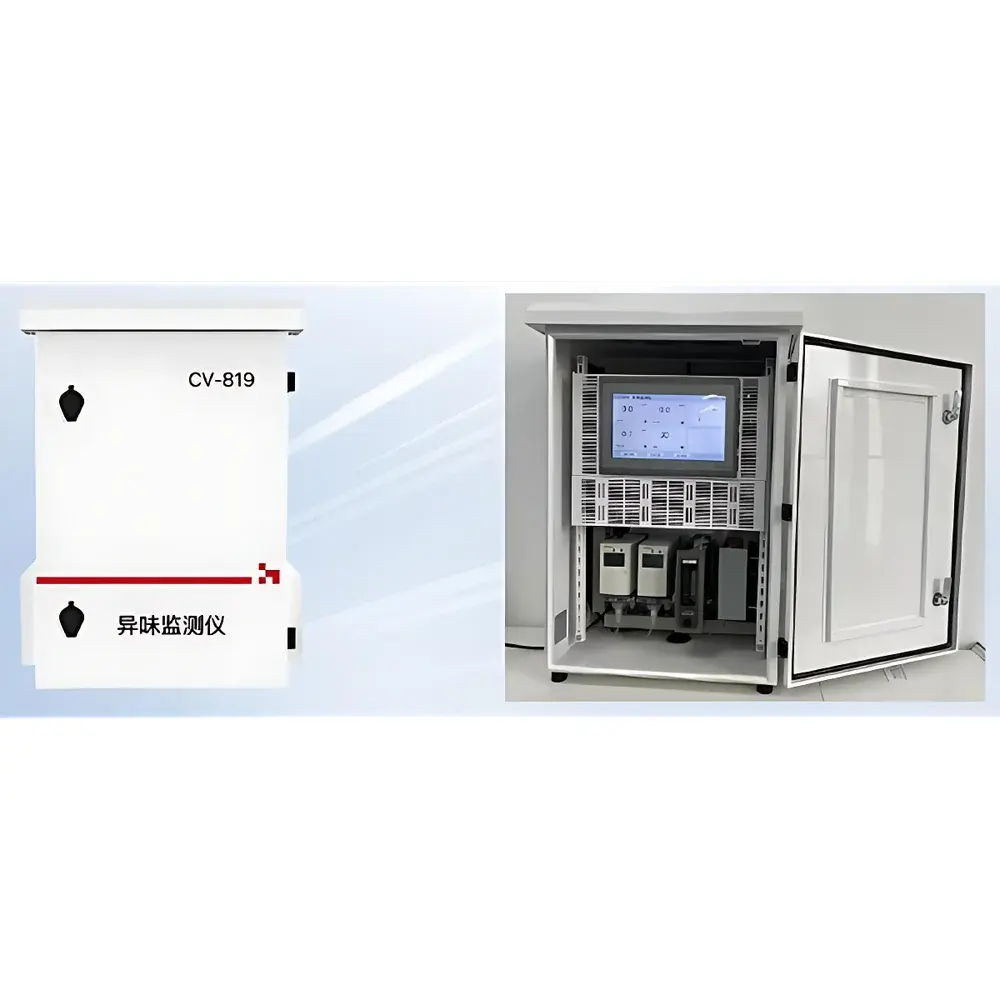
New Cosmos CV-819 Online Odor Concentration Monitor
| Brand | New Cosmos |
|---|---|
| Origin | Shanghai, China |
| Manufacturer Type | Authorized Distributor |
| Regional Classification | Domestic (China) |
| Model | CV-819 |
| Instrument Type | Online Monitoring System |
| Detection Principle | Hybrid Sensor Array (Metal Oxide Semiconductor – MOS, Electrochemical – EC, and Photoionization Detector – PID) |
Overview
The New Cosmos CV-819 Online Odor Concentration Monitor is an industrial-grade, continuous emission monitoring system engineered for real-time quantification of odor concentration (OUE/m³) in regulated exhaust stacks and ambient boundary zones. Unlike laboratory-based olfactometry methods—such as the standardized triangular forced-choice dynamic dilution olfactometry (EN 13725, ASTM D6904)—the CV-819 implements a field-deployable sensor fusion architecture grounded in physicochemical gas interaction principles. Its core detection methodology integrates three complementary transduction mechanisms: temperature-compensated metal oxide semiconductor (MOS) sensors optimized for volatile organic compound (VOC) and sulfur-containing odorants; electrochemical (EC) cells calibrated for reactive inorganic species including hydrogen sulfide (H₂S), ammonia (NH₃), and cyanide derivatives; and a low-power photoionization detector (PID) with 10.6 eV lamp for non-polar aromatic and aliphatic compounds. This multi-modal sensing strategy enables robust correlation to human olfactory response across diverse odorant profiles—particularly those dominated by mercaptans, indoles, skatole, dimethyl sulfide, and short-chain fatty acids—without requiring operator intervention or dilution calibration.
Key Features
- Proprietary hot-wire MOS sensor platform with >30 years of field-proven stability in odor monitoring applications—validated under fluctuating temperature (−20 °C to +50 °C) and relative humidity (10–95% RH, non-condensing) conditions.
- Dedicated electrochemical modules featuring fixed-potential electrolysis technology for selective detection of H₂S, NH₃, Cl₂, and HCN at sub-ppb sensitivity levels.
- Modular, physically isolated sampling and detection architecture—preventing cross-contamination between inlet gas stream and sensor chamber, and eliminating carryover artifacts during sequential measurement cycles.
- Diffusion-mode odor detection unit with passive inlet design—eliminating the need for consumable particulate filters or active pumping maintenance in low-dust environments.
- Adaptive odor intensity algorithm trained on empirical data from over 8,000 deployed units (as of August 2018), aligned with the three-point comparison olfactometric method (GB/T 14675, EN 13725) to ensure ≥85% concordance with certified human panel results.
- IP65-rated outdoor enclosure with corrosion-resistant aluminum alloy housing and integrated thermal management—certified for unattended operation in industrial perimeters, wastewater treatment plants, composting facilities, and rendering operations.
Sample Compatibility & Compliance
The CV-819 is validated for continuous monitoring of complex, humid, and particulate-laden gas streams typical of municipal and industrial waste processing. It accommodates sample matrices containing up to 90% relative humidity, total suspended particulates ≤10 mg/m³, and background VOC concentrations up to 100 ppmv without signal saturation. Pre-treatment configurations—including heated sample lines (up to 180 °C), cyclonic moisture separators, and stainless-steel catalytic scrubbers—are configurable per site-specific stack conditions. The system supports compliance reporting under China’s GB 14554–93 (Emission Standard of Malodorous Pollutants), Japan’s Ordinance on Prevention of Odor Pollution, and EU Industrial Emissions Directive (IED) Annex VII requirements for odor control. While not a replacement for accredited olfactometry in regulatory verification, it delivers trend analysis, alarm triggering, and process feedback control fully traceable to GLP-aligned data integrity protocols.
Software & Data Management
Embedded firmware (v3.2+) provides local data logging at 1-minute intervals with 32 GB onboard storage, supporting CSV export via USB or Ethernet. Remote access is enabled through Modbus TCP/RTU and optional MQTT integration for SCADA and cloud-based environmental dashboards. All measurement events—including zero/span checks, sensor diagnostics, and cleaning cycle logs—are timestamped and cryptographically signed to meet audit requirements under ISO/IEC 17025 and FDA 21 CFR Part 11 (when deployed with validated user access controls and electronic signature modules). Calibration history, sensor drift compensation coefficients, and adaptive algorithm weights are retained with full versioning for forensic traceability.
Applications
- Continuous odor concentration monitoring at regulated emission points: biogas flares, sludge dryers, anaerobic digesters, and chemical reactor vents.
- Perimeter air quality surveillance around landfills, composting yards, meat processing plants, and tanneries.
- Real-time feedback control for activated carbon adsorption systems and biofilter irrigation dosing.
- Trend-based early warning for process upsets—e.g., pH shifts in anaerobic digestion leading to elevated H₂S or VFA emissions.
- Supplemental data source for odor impact modeling (e.g., CALPUFF, AERMOD) and community complaint correlation studies.
FAQ
Does the CV-819 replace human olfactometry for regulatory compliance reporting?
No—it serves as a continuous screening and trending tool. Final compliance determination requires certified dynamic olfactometry per EN 13725 or GB/T 14675.
What maintenance intervals are recommended for field operation?
Sensor modules require annual verification; the diffusion inlet needs visual inspection every 3 months; no routine filter replacements are needed under standard operating conditions.
Can the system be integrated into existing plant DCS or EMS platforms?
Yes—via Modbus TCP, 4–20 mA analog outputs, or optional OPC UA gateway with engineering support for protocol mapping.
Is the odor concentration output expressed in European Odour Units (OUE/m³)?
Yes—the instrument reports real-time odor concentration calibrated against reference standards traceable to national metrology institutes, with selectable units including OUE/m³, ppmv-equivalent odor index, and individual component concentrations.
How does the system handle interference from high-moisture or corrosive gas streams?
Integrated heated sampling lines (optional), condensate traps, and chemically resistant sensor housings mitigate moisture-related drift and acid gas corrosion—validated per IEC 60068-2 environmental stress testing.







