
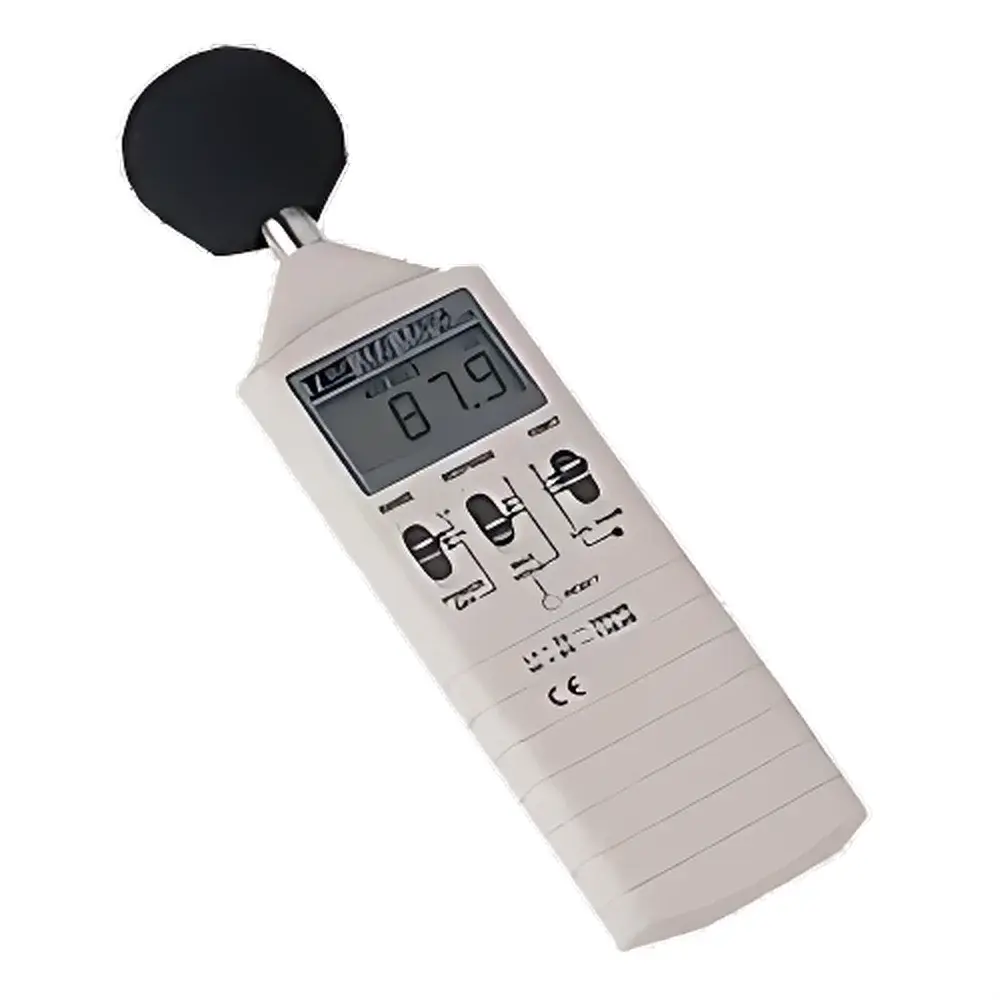
TES-1350A Digital Sound Level Meter
| Brand | TES |
|---|---|
| Origin | Taiwan |
| Model | TES-1350A |
| Measurement Range (A-weighted, LO) | 35–100 dB |
| Measurement Range (A-weighted, HI) | 65–130 dB |
| Measurement Range (C-weighted, LO) | 35–100 dB |
| Measurement Range (C-weighted, HI) | 65–130 dB |
| Frequency Range | 31.5 Hz – 8 kHz |
| Accuracy | ±2 dB |
| Resolution | 0.1 dB |
| Dynamic Range | 65 dB |
| Weighting Networks | A and C |
| Time Weighting | Fast & Slow |
| Max Hold Function | Yes |
| Microphone Type | Polarized Condenser |
| Calibration | Internal 94.0 dB Reference |
| AC Output | ~0.65 Vrms per range, 600 Ω impedance |
| DC Output | ~10 mV/dB (nominal), 100 Ω impedance |
| Operating Temperature | 0–40 °C, <80% RH |
| Storage Temperature | −10–60 °C, <70% RH |
| Display | 3½-digit LCD |
| Power Supply | 1 × 9 V battery |
| Dimensions | 240 × 68 × 25 mm |
| Weight | 215 g |
| Accessories | Carrying case, test rod, 9 V battery, instruction manual, windscreen |
Overview
The TES-1350A Digital Sound Level Meter is a precision-engineered, handheld acoustic measurement instrument designed for field and laboratory use in occupational health, environmental noise assessment, industrial hygiene, and facility compliance monitoring. It operates on the fundamental principle of converting sound pressure variations into proportional electrical signals via a polarized condenser microphone, followed by analog signal conditioning, frequency weighting (A or C), time weighting (Fast/Slow), and digital conversion with 0.1 dB resolution. Conforming to IEC 651 Class 2 specifications, the TES-1350A delivers traceable, repeatable measurements across a broad dynamic range—supporting both low-level ambient noise evaluation (35–100 dB) and high-intensity industrial source characterization (65–130 dB). Its compact form factor, battery-powered operation, and robust mechanical design make it suitable for extended deployment in diverse environmental conditions without compromising metrological integrity.
Key Features
- IEC 651 Type 2 compliance ensures adherence to internationally recognized performance criteria for general-purpose sound level meters.
- Dual-range measurement capability (LO/HI) enables seamless transition between ambient and high-noise environments without manual range switching errors.
- A- and C-frequency weightings provide flexibility for human-perception-weighted (A) and flat-response (C) spectral analysis—critical for regulatory reporting and machinery diagnostics.
- Fast and Slow time weightings align with ISO 8596 and ANSI S1.4 standards for transient and steady-state noise evaluation.
- Maximum Hold function captures and retains peak sound pressure levels during real-time monitoring—essential for identifying intermittent noise events.
- Internal 94.0 dB calibration reference allows rapid functional verification prior to and after measurement sessions, supporting GLP-aligned workflow practices.
- Dual analog outputs (AC and DC) enable integration with external data loggers, oscilloscopes, or SCADA systems for continuous noise trend analysis and archival.
- Low-power 3½-digit LCD display with auto-ranging and backlight-independent readability ensures reliable operation under variable lighting conditions.
Sample Compatibility & Compliance
The TES-1350A is optimized for air-coupled acoustic measurements in open-air, indoor, and semi-enclosed environments. It accommodates standard ½-inch polarized condenser microphone configurations and includes a foam windscreen to mitigate turbulence-induced artifacts at wind speeds up to 5 m/s. The device meets IEC 651:1979 (Type 2) requirements for frequency response linearity, time constant fidelity, and overload recovery behavior. While not certified to IEC 61672-1:2013 (the current primary standard for sound level meters), its documented performance envelope supports use in non-regulatory screening applications, pre-compliance surveys, and internal QA/QC protocols where Type 2 accuracy is acceptable. It is routinely deployed in accordance with OSHA 29 CFR 1910.95 and EU Directive 2003/10/EC for preliminary workplace noise mapping and engineering control validation.
Software & Data Management
The TES-1350A operates as a standalone analog-digital hybrid instrument with no embedded firmware-based software or USB connectivity. Data acquisition relies on external recording systems interfaced via its standardized AC (~0.65 Vrms) or DC (~10 mV/dB) analog outputs. When integrated with third-party data loggers compliant with IEEE 1057 or NIST-traceable acquisition hardware, measurement records can be timestamped, archived, and subjected to post-processing—including FFT spectral decomposition, Leq calculation, and statistical percentile analysis (L10, L50, L90). For auditability, users are advised to maintain manual logs documenting calibration dates, environmental conditions (temperature/humidity), microphone orientation, and measurement duration—consistent with ISO/IEC 17025 documentation expectations for accredited laboratories.
Applications
- Occupational noise exposure assessment in manufacturing, construction, and transportation sectors.
- Environmental noise baseline studies near airports, highways, rail corridors, and urban development zones.
- Product noise certification testing for consumer appliances, HVAC equipment, and power tools.
- Educational demonstrations of acoustics principles, including inverse-square law verification and barrier attenuation measurement.
- Preventive maintenance monitoring of rotating machinery (e.g., bearings, fans, compressors) through trending of broadband SPL deviations.
- Community noise complaint investigations conducted by municipal environmental health departments.
FAQ
Does the TES-1350A support data logging internally?
No—it lacks onboard memory or digital storage. Continuous recording requires connection to an external analog data logger or oscilloscope.
Is this meter suitable for legal noise enforcement?
It is not certified to IEC 61672-1 Class 1 or Class 2; therefore, it is not admissible as primary evidence in regulatory proceedings requiring metrological traceability to national standards.
What is the recommended calibration interval?
Annual calibration against an accredited acoustic calibrator (e.g., 94 dB/114 dB pistonphone) is advised, with functional checks using the internal 94.0 dB reference before each measurement session.
Can the microphone be replaced or upgraded?
The unit uses a fixed, factory-installed polarized condenser microphone; replacement requires service by authorized TES technical personnel to preserve calibration integrity.
Does it comply with FDA or EPA regulatory requirements?
It is not EPA-listed or FDA-regulated; however, its IEC 651 Type 2 conformity supports use in EPA Region-specific guidance documents for preliminary noise screening and community engagement activities.







