
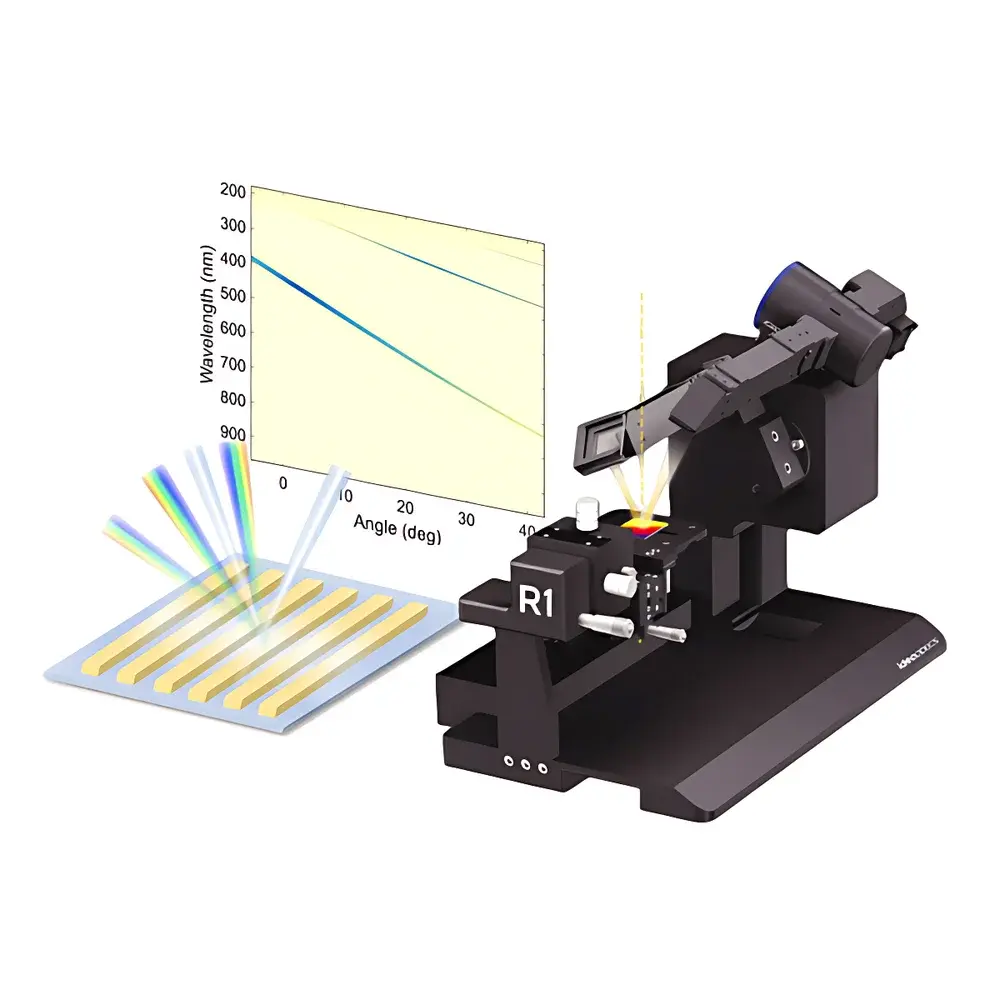
IdeaOptics R1-DFG Grating Diffraction Efficiency and Period Measurement System
| Brand | IdeaOptics |
|---|---|
| Origin | Shanghai, China |
| Manufacturer Type | Original Equipment Manufacturer (OEM) |
| Country of Origin | China |
| Model | R1-DFG |
| Pricing | Upon Request |
Overview
The IdeaOptics R1-DFG Grating Diffraction Efficiency and Period Measurement System is a benchtop optical characterization platform engineered for quantitative, non-destructive evaluation of planar diffractive gratings. It operates on the fundamental principles of angular-resolved spectral diffraction measurement—leveraging calibrated incident and collection optics to capture intensity distributions across discrete diffraction orders as a function of wavelength and angle. Designed for rigorous R&D and quality control environments, the system supports precise determination of two primary performance metrics: (1) absolute and relative diffraction efficiency per order (e.g., 0th, ±1st, ±2nd), and (2) effective grating period derived from Bragg condition validation or Fourier analysis of angular dispersion. Its architecture accommodates both conventional periodic structures—including blazed, rectangular, and trapezoidal gratings—and emerging metasurface-based gratings exhibiting anomalous diffraction behavior.
Key Features
- High-precision angular control: Dual-axis motorized goniometer with encoder feedback enables independent adjustment of incident angle (θi) and detection angle (θd) with resolution ≤ 0.02° and repeatability ±0.03° over ±45° range—supporting Littrow configuration, off-Littrow scanning, and arbitrary (θi, θd) mapping.
- Automated sample positioning: Motorized XYZ translation stage with integrated rotation axis ensures rapid alignment of grating surface normal and diffraction plane; software-guided auto-focusing and crosshair registration minimize operator-dependent setup variability.
- Broadband spectral compatibility: Optimized for UV–Vis–NIR operation (typically 400–1100 nm), compatible with standard tungsten-halogen and deuterium light sources, and spectrometer modules with <0.5 nm optical resolution.
- Modular optical path design: Interchangeable collimators, fiber-coupled detectors, and polarization-selective components allow adaptation for s/p-polarized measurements, Mueller matrix extension, or integration into larger optical test benches.
- Robust mechanical architecture: Aluminum alloy frame with vibration-damped optical breadboard base ensures thermal and mechanical stability during long-duration scans (e.g., wavelength-angle sweeps lasting >30 min).
Sample Compatibility & Compliance
The R1-DFG system accommodates planar substrates up to 100 mm × 100 mm and thicknesses from 0.5 mm to 10 mm—including fused silica, BK7, silicon, and polymer-based grating replicas. It supports tilted, slanted, and sub-wavelength meta-gratings where conventional interferometric methods fail. From a compliance perspective, measurement protocols align with ISO 15529:2010 (Optics and photonics — Test methods for diffraction gratings) and ASTM E2758-16 (Standard Practice for Measuring Diffraction Efficiency of Optical Gratings). Data acquisition workflows are structured to support GLP/GMP traceability: all hardware states (motor positions, lamp status, spectrometer integration time) are logged with timestamps and user annotations. Audit trails comply with FDA 21 CFR Part 11 requirements when paired with validated software deployment and electronic signature modules.
Software & Data Management
The proprietary GratingLab™ analysis suite provides both real-time monitoring and post-processing capabilities. During acquisition, users define multi-point angular/wavelength grids, trigger synchronized spectrometer captures, and visualize raw spectra with live diffraction order identification. Post-measurement, the software performs peak integration using adaptive baseline subtraction, calculates normalized diffraction efficiency per order referenced to incident power (measured via calibrated photodiode), and infers grating period via λ = d·(sin θm − sin θi)/m for m-th order. Export formats include CSV (with metadata headers), HDF5 (for large-scale parametric studies), and PDF reports containing instrument configuration, uncertainty estimates (based on angular and spectral calibration certificates), and pass/fail flags against user-defined specification limits. API access enables integration with LabVIEW, Python (via PyVISA), and MATLAB for automated batch processing.
Applications
- AR/VR waveguide characterization: Quantification of outcoupling efficiency, spectral uniformity, and angular crosstalk in surface-relief and volume holographic gratings used in diffractive combiners.
- Metagrating validation: Mapping of anomalous refraction angles and efficiency roll-off versus incidence angle—critical for beam steering and compact spectrometer design.
- Polarization-sensitive thin-film metrology: Angle-resolved reflectance and transmittance measurements of wire-grid polarizers and pancake lens coatings under variable polarization states.
- Grating fabrication process control: In-line verification of etch depth consistency, sidewall profile fidelity, and period uniformity across wafer-scale substrates.
- Academic photonic device research: Experimental verification of coupled-mode theory predictions, Floquet-Bloch analysis, and topology-driven diffraction phenomena.
FAQ
What grating types can the R1-DFG characterize?
It supports ruled, holographic, lithographically patterned, and dielectric/metallic metasurface gratings—provided they are planar and mounted on rigid substrates.
Does the system support polarization-resolved measurements?
Yes—when equipped with motorized rotating polarizers or liquid crystal variable retarders, it enables full s/p separation and Stokes parameter extraction.
Can I export raw data for third-party modeling tools like RCWA or FDTD?
Absolutely—the system exports angle-wavelength-intensity tensors in ASCII and HDF5 formats compatible with S4, GD-Calc, Lumerical, and custom Python/Matlab solvers.
Is calibration traceable to national standards?
Angular encoders are certified to ISO 230-2; spectral modules may be optionally supplied with NIST-traceable lamp calibration certificates.
How is measurement uncertainty quantified?
Uncertainty budgets follow GUM (JCGM 100:2008) methodology, incorporating contributions from angular repeatability, spectrometer wavelength accuracy, detector linearity, and reference detector calibration uncertainty.



