
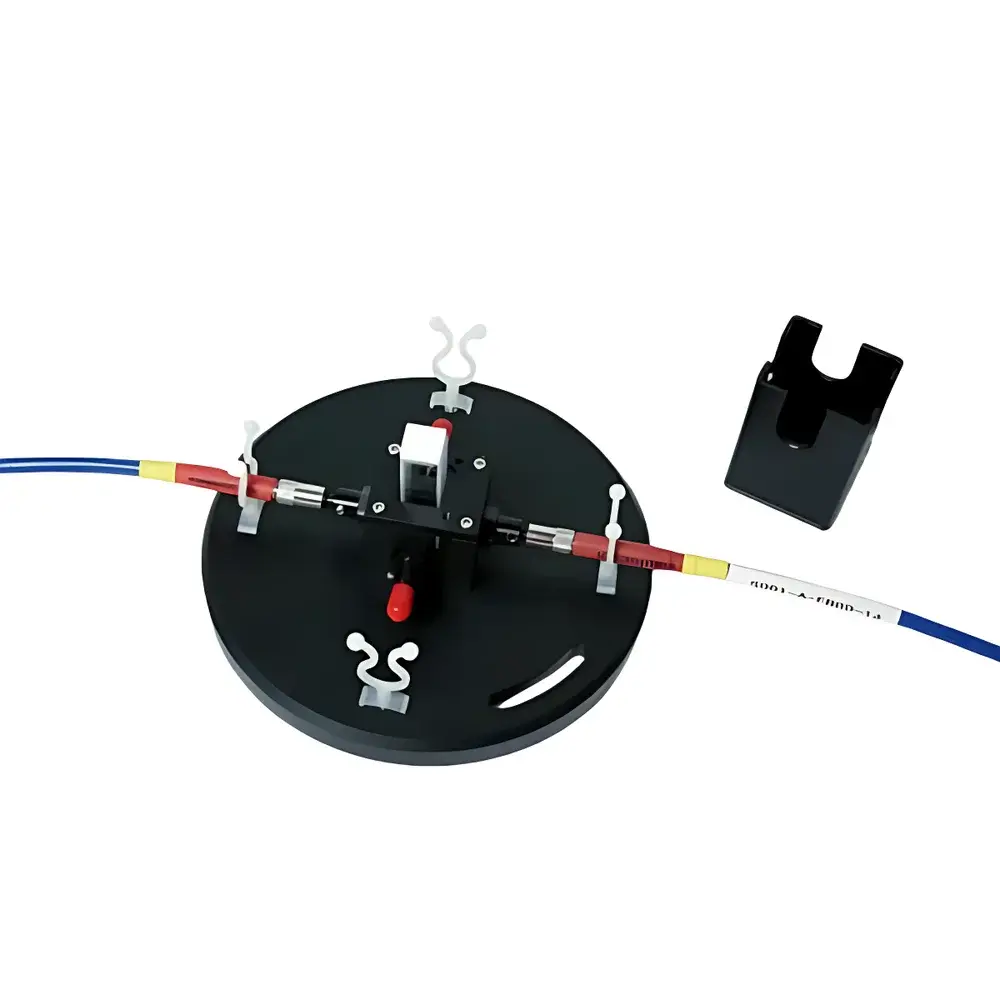
IdeaOptics R4 Cuvette Spectroscopy System
| Brand | IdeaOptics |
|---|---|
| Origin | Shanghai, China |
| Manufacturer Type | Original Equipment Manufacturer (OEM) |
| Country of Origin | China |
| Model | R4 |
| Pricing | Available Upon Request |
Overview
The IdeaOptics R4 Cuvette Spectroscopy System is a modular, benchtop optical platform engineered for quantitative spectral characterization of liquid samples contained in standard 10 mm pathlength cuvettes. It operates on fundamental principles of UV-Vis-NIR spectroscopy—leveraging fiber-coupled illumination and detection to enable precise measurement of transmittance, reflectance, absorbance, and fluorescence emission spectra. Unlike integrated spectrophotometers, the R4 adopts an open optical architecture based on collimated fiber-optic beam delivery, allowing users to reconfigure the geometry of excitation and collection paths without realignment. This design supports rigorous adherence to ASTM E308 (computing tristimulus values), ISO 13655 (spectral measurement of reflective/transmissive materials), and USP (UV-Vis spectrophotometric system suitability), making it suitable for method development, QC release testing, and academic spectroscopic research under GLP-compliant workflows.
Key Features
- Modular four-port collimator interface enabling rapid switching between transmission, reflection, fluorescence (90° orthogonal geometry), and enhanced-pathlength configurations
- Optimized optical path for 10 mm cuvette cells—ensuring minimal stray light and high photometric linearity across 200–1100 nm
- Integrated mounting points for long-pass excitation filters (e.g., OD6 cutoff at 400 nm, 450 nm, or 500 nm) to suppress Rayleigh and Raman scatter in fluorescence mode
- Compatibility with optional fluorescence-enhancing mirror assembly—increasing effective signal collection efficiency by up to 2.1× via double-pass illumination geometry
- Designed for seamless integration with IdeaOptics PG2000-Pro high-sensitivity CCD-based fiber optic spectrometer (0.1 nm optical resolution, TE-cooled detector) and iDH2000-BSC deuterium-halogen broadband source (200–2500 nm output)
- Passive thermal stabilization and kinematic optical mounts ensure alignment retention over extended acquisition periods (>8 h)
Sample Compatibility & Compliance
The R4 system accommodates standard square or rectangular quartz, fused silica, or UV-grade glass cuvettes (10 × 10 × 45 mm) with nominal 10 mm optical pathlength. It supports aqueous, organic, and viscous solutions—including nanoparticle colloids, dye-doped polymers, and biological buffers—provided sample turbidity remains below ISO 17025-defined scatter thresholds (<0.5% T at 550 nm for absorbance validation). All mechanical interfaces conform to Thorlabs SM1 (1.035"-40) threading standards, enabling direct coupling to third-party translation stages, motorized filter wheels, or environmental chambers. The system’s optical layout satisfies ICH Q5C photostability testing requirements when paired with calibrated irradiance sources and NIST-traceable reference standards.
Software & Data Management
Control and data acquisition are managed through IdeaOptics’ SpectraSuite Pro software (v4.2+), which provides instrument-agnostic spectral processing, baseline correction (asymmetric least squares), peak deconvolution (Gaussian-Lorentzian fitting), and export to ASTM E131-compliant .jdx format. Raw spectral datasets include embedded metadata per FDA 21 CFR Part 11 Annex 11 guidelines: operator ID, timestamp, instrument serial number, calibration certificate ID, and audit trail of all parameter modifications. Batch processing supports IQ/OQ documentation templates aligned with ISO/IEC 17025:2017 clause 7.8.2 for spectral instrument qualification.
Applications
- Quantitative absorbance-based concentration determination (Beer-Lambert law validation across 0.001–3.0 AU)
- Fluorescence quantum yield estimation using integrating sphere-coupled reference standards
- Time-resolved decay profiling when synchronized with pulsed LED or laser sources (via TTL trigger input)
- Reflectance-based thin-film thickness modeling for self-assembled monolayers on cuvette walls
- Photostability screening of pharmaceutical formulations per ICH Q1B guidance
- Teaching laboratory implementation of Jablonski diagram analysis and inner-filter effect correction
FAQ
What cuvette materials are supported?
Quartz, fused silica, and UV-transparent acrylic cuvettes with 10 mm pathlength and external dimensions compliant with DIN 13157 are fully compatible. Standard polystyrene cuvettes are restricted to visible-range measurements only.
Can the R4 be used for scattering particle sizing?
No—the R4 is not configured for dynamic or static light scattering; it lacks angular resolution and correlation hardware required for DLS or SLS. It is optimized for ensemble-averaged intensity spectroscopy only.
Is firmware update capability included?
Yes—field-upgradable firmware is delivered via USB-C and supports backward-compatible communication protocols (USB2.0 HID class, virtual COM port mode) for integration into LabVIEW or Python-controlled automated workflows.
Does the system meet GMP documentation requirements?
When deployed with optional IQ/OQ qualification kits and validated calibration procedures, the R4 satisfies GMP Annex 15 expectations for analytical instrument lifecycle management—including change control, periodic verification, and raw data integrity per ALCOA+ principles.



