
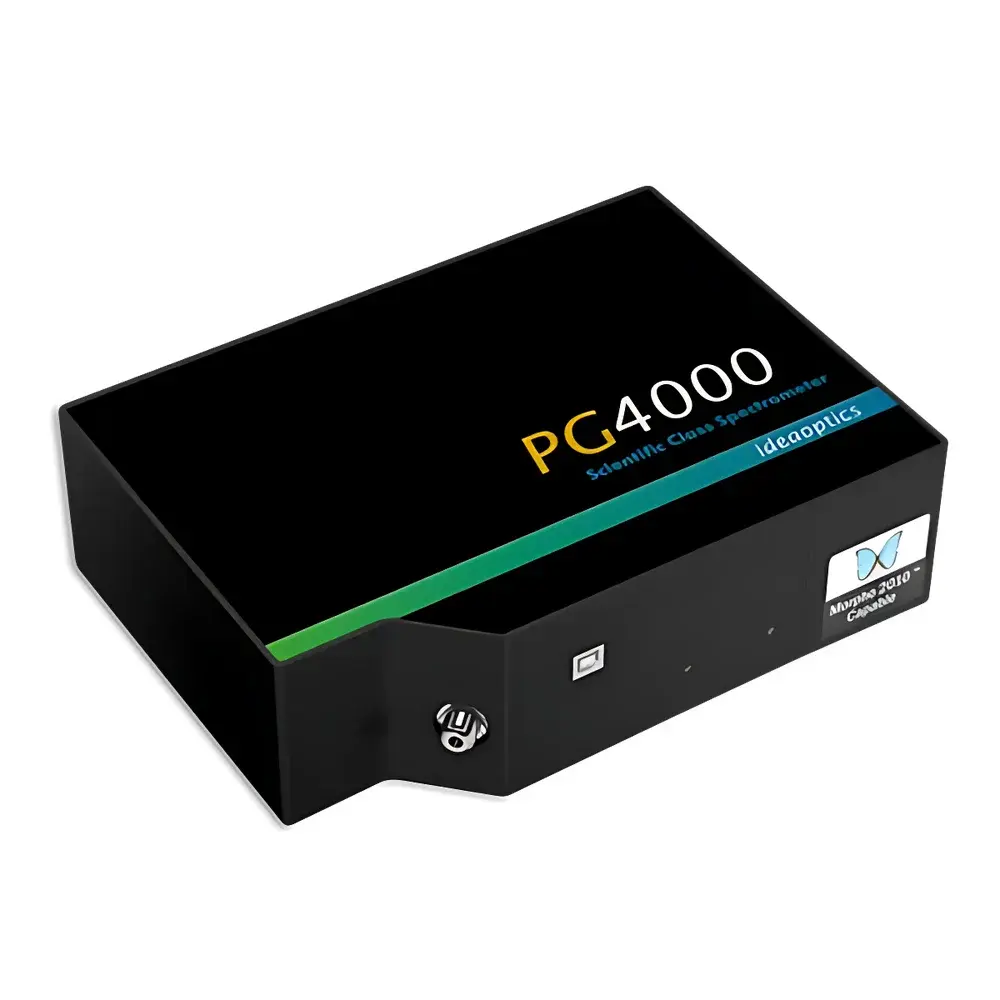
IdeaOptics PG4000 High-Resolution Fiber Optic Spectrometer
| Brand | IdeaOptics |
|---|---|
| Origin | Shanghai, China |
| Manufacturer Type | Original Equipment Manufacturer (OEM) |
| Product Origin | Domestic (China) |
| Model | PG4000 |
| Spectral Range | 200–1100 nm |
| Detector Type | CCD |
| Optical Resolution (FWHM) | 0.10–4.88 nm |
| System Sensitivity | 2 × 10⁸ |
| Single-Scan Dynamic Range | 1300:1 |
| Signal-to-Noise Ratio (SNR) | >400:1 (at saturation) |
| Overall Dynamic Range | >3000:1 |
| Stray Light | <0.1% (measured at 600 nm) |
Overview
The IdeaOptics PG4000 is a high-resolution fiber-coupled spectrometer engineered for demanding spectroscopic applications requiring precise wavelength discrimination and robust signal fidelity across the deep ultraviolet to near-infrared spectrum (200–1100 nm). Built upon a compact Czerny-Turner optical architecture with a 100 mm focal length and f/9.0 beam geometry, the PG4000 achieves an optimal balance between spectral resolution and optical throughput—without compromising physical footprint. Its core measurement principle relies on dispersive diffraction using precision ruled or holographic gratings, coupled with a thermoelectrically stabilized back-illuminated CCD detector. This configuration ensures high quantum efficiency (>60% in UV), low read noise (<15 e⁻ RMS), and minimal dark current drift—critical for quantitative intensity calibration and long-integration measurements in research and industrial QA/QC environments.
Key Features
- High-Resolution Optical Platform: Delivers configurable resolution down to 0.10 nm FWHM (dependent on slit width and grating selection), enabling fine-structure analysis of atomic emission lines, narrow Raman bands, and gas-phase absorption features.
- EX Dual-Blazed Grating Technology: Integrates two optimized blaze angles on a single grating substrate to maintain uniform spectral response across the full 200–1100 nm range—minimizing efficiency roll-off and suppressing higher-order diffraction artifacts.
- Deep-UV Enhanced CCD Option: Available with UV-phosphor-coated, back-thinned CCD sensors offering extended quantum efficiency below 220 nm—suitable for ozone monitoring, excimer laser characterization, and vacuum UV plasma diagnostics.
- Sub-Millisecond Integration Control: Supports hardware-triggered acquisition with integration time reconfiguration in ≤1 ms, facilitating synchronization with pulsed lasers (e.g., LIBS, LIF) and time-resolved kinetic studies.
- Low Stray Light Design: Achieves <0.1% stray light at 600 nm through optimized baffling, blackened internal surfaces, and order-sorting filters—ensuring accurate quantification of weak spectral features adjacent to intense peaks.
- Modular Fiber Interface: Equipped with SMA 905 connectors and compatible with standard 200–600 µm core diameter fibers; supports customizable input optics (collimators, focusing lenses) for OEM integration into analytical systems.
Sample Compatibility & Compliance
The PG4000 interfaces seamlessly with liquid, gas, and solid samples via fiber-optic probe configurations—including reflection probes, immersion probes, flow cells, and LIBS ablation chambers. It complies with ISO/IEC 17025 general requirements for competence of testing and calibration laboratories when operated under validated SOPs. While not intrinsically certified for hazardous locations, its optical head meets IP50 ingress protection standards. The instrument supports traceable calibration using NIST-traceable tungsten-halogen and mercury-argon lamps, and its spectral data output conforms to ASTM E131 and ISO 13321 standards for spectroscopic reporting formats.
Software & Data Management
The PG4000 is supported by IdeaOptics’ SpectraPro Suite—a cross-platform application (Windows/macOS/Linux) offering real-time spectral visualization, multi-channel averaging, peak fitting (Gaussian/Lorentzian/Voigt), and absorbance/transmittance conversion. All software modules support audit-trail logging per FDA 21 CFR Part 11 requirements when deployed in regulated environments (e.g., pharmaceutical QC labs). Raw data export is available in ASCII, CSV, and HDF5 formats; API libraries (C/C++, Python, LabVIEW, MATLAB) enable full remote control and integration into automated test benches or LIMS workflows. Firmware updates preserve backward compatibility and include enhanced dark-current compensation algorithms for improved low-light stability.
Applications
- Laser-induced breakdown spectroscopy (LIBS) for elemental mapping and alloy identification
- Gas-phase absorption spectroscopy (e.g., NO₂, SO₂, CH₄) in environmental monitoring and combustion diagnostics
- Plasma emission analysis in semiconductor process chambers and fusion research
- Fluorescence lifetime and quantum yield measurements in photophysics laboratories
- UV-Vis-NIR reflectance and transmittance characterization of thin films and nanomaterials
- Calibration source validation for radiometric and photometric standards laboratories
FAQ
What spectral calibration options are available for the PG4000?
NIST-traceable calibration services are offered for wavelength (±0.05 nm uncertainty) and radiometric response (±3% from 250–900 nm), with optional factory-certified certificates.
Can the PG4000 operate in triggered acquisition mode with external TTL signals?
Yes—it supports both rising-edge and falling-edge hardware triggering with jitter <100 ns, enabling precise synchronization with pulsed light sources or mechanical shutters.
Is the detector temperature stabilized during operation?
The CCD is actively cooled to −10 °C ± 0.5 °C using a two-stage Peltier element, reducing thermal dark current by >95% compared to ambient operation.
Does the PG4000 support spectral stitching across multiple grating positions?
Yes—via motorized grating turret (optional) and SpectraPro’s auto-stitching module, users can acquire contiguous spectra from 200–1100 nm with seamless overlap correction and intensity normalization.
How is data integrity ensured during long-term deployments?
The firmware implements cyclic redundancy checking (CRC-32) on all transmitted spectral frames and maintains non-volatile memory for configuration snapshots, supporting GLP-compliant restart recovery and version-controlled settings archiving.
Related Products






