
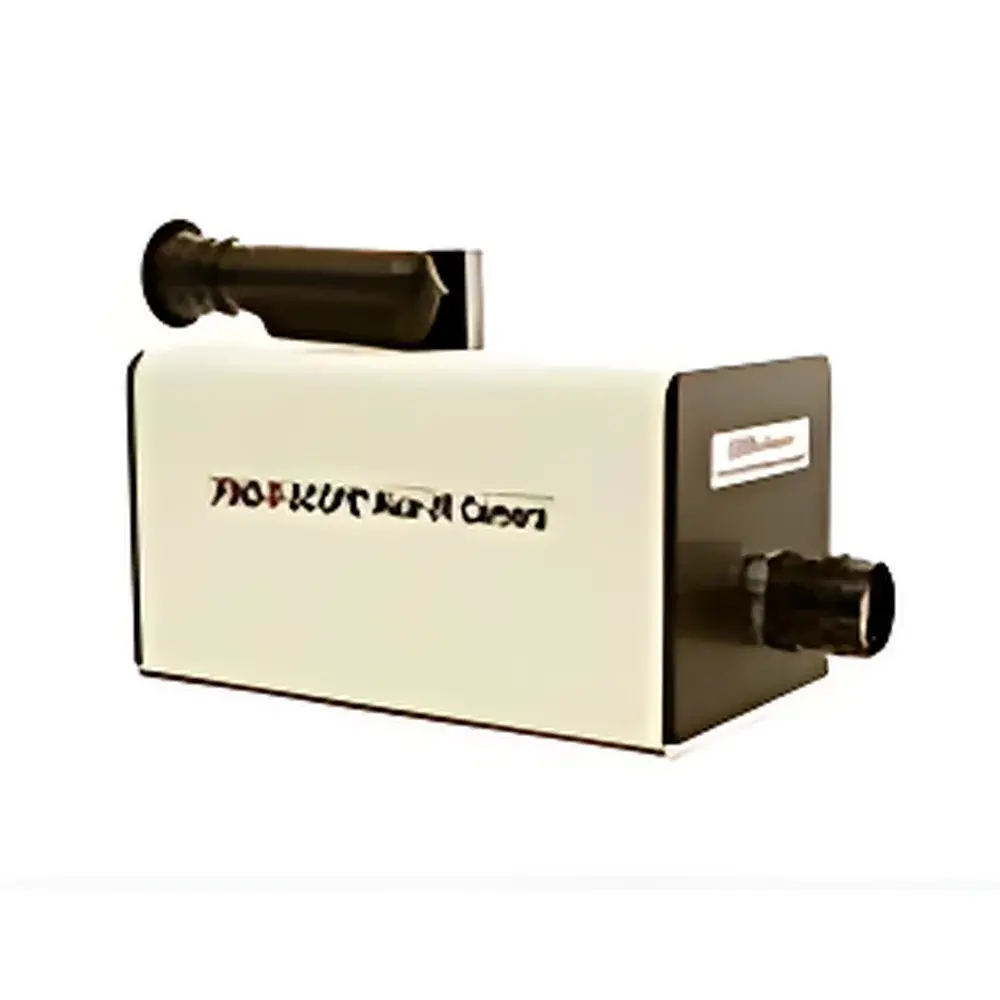
NewOpto FJW Infrared Camera Viewer
| Brand | FJW |
|---|---|
| Origin | USA |
| Manufacturer Type | Authorized Distributor |
| Import Status | Imported |
| Model | NewOpto 85720 / 85700 / 85726 / 85706 |
| Spectral Sensitivity | 400–1800 nm (85720/85700) / 400–2200 nm (85726/85706) |
| Displayed Regions | Visible, Near-IR, Mid-IR |
| Peak Sensitivity | 600 nm |
| Focal Range | 4 inches to infinity |
| Detector | 25 mm high-performance infrared vidicon |
| Standard Lens | C-mount, 25 mm, f/1.4, manual iris |
| Gain Control | Selectable auto-gain and 4 fixed gain levels |
| Signal-to-Noise Ratio | 68 dB |
| Horizontal Resolution | Up to 700 TV lines |
| Video Output | RS-170 via BNC connector |
| Dimensions | 110.3 × 111.2 × 216.4 mm³ |
| Optional Accessory | Electronic viewfinder module |
Overview
The NewOpto FJW Infrared Camera Viewer is a precision optical imaging instrument engineered for real-time visualization of near-infrared (NIR) and mid-infrared (MIR) radiation across a broad spectral band—from 400 nm in the visible range up to 2200 nm. Unlike thermal imaging systems based on microbolometer arrays, this viewer employs a high-sensitivity 25 mm infrared vidicon detector, optimized for coherent and incoherent light sources including laser beams, fiber-optic emissions, and biological fluorescence. Its core operational principle relies on photoconductive conversion within the vidicon target, enabling direct analog video output compatible with standard laboratory monitors and recording equipment. Designed for integration into R&D labs, optical alignment workstations, and clinical research environments, the system delivers high-fidelity spatial representation without requiring cryogenic cooling or complex calibration routines. The device operates under ambient conditions and supports both qualitative beam profiling and semi-quantitative intensity assessment—particularly valuable during laser safety verification, optical component characterization, and non-invasive biomedical signal detection.
Key Features
- Extended spectral response: Dual-model configuration covering 400–1800 nm (Model 85720/85700) and 400–2200 nm (Model 85726/85706), accommodating common NIR lasers (e.g., 785 nm, 1064 nm, 1550 nm) and emerging MIR sources.
- High-resolution analog imaging: Up to 700 TV lines horizontal resolution ensures accurate spatial delineation of beam profiles, mode structures, and scattering patterns.
- C-mount lens compatibility: Standard 25 mm f/1.4 lens with manual iris enables rapid adaptation to custom optics, collimators, or macro imaging configurations.
- Flexible gain architecture: Auto-gain mode maintains dynamic range across variable illumination intensities; four discrete fixed-gain settings allow repeatable exposure control for comparative measurements.
- RS-170 compliant video output: BNC-connected analog signal ensures seamless integration with oscilloscopes, frame grabbers, and legacy lab video recorders—no proprietary drivers or software required.
- Compact ergonomic housing: All-metal chassis measuring 110.3 × 111.2 × 216.4 mm³ supports benchtop, handheld, or tripod-mounted operation; optional electronic viewfinder enhances portability and field usability.
Sample Compatibility & Compliance
The NewOpto FJW Infrared Camera Viewer is compatible with a wide range of optically emissive or reflective samples—including semiconductor laser diodes, optical fibers, photonic integrated circuits, biological tissues stained with NIR fluorophores, and passive IR-reflective materials such as silicon wafers and germanium optics. It does not require sample preparation, vacuum environments, or external excitation beyond incident IR radiation. From a regulatory standpoint, the instrument complies with FCC Part 15 Class B emission limits for industrial scientific equipment and meets IEC 61000-6-3 immunity standards. While not a medical device per FDA 21 CFR Part 820, its use in preclinical imaging workflows aligns with GLP documentation practices when paired with validated video capture protocols and audit-trail-enabled recording systems.
Software & Data Management
As an analog-output imaging platform, the viewer operates independently of host software—ensuring deterministic latency and eliminating OS-dependent instability. However, when interfaced with third-party frame grabbers (e.g., National Instruments PCIe-1433, Epix XCAP), it supports time-stamped image acquisition, multi-frame averaging, and basic ROI-based intensity logging. For laboratories implementing 21 CFR Part 11 compliance, integration with validated digital acquisition software (such as MATLAB Image Acquisition Toolbox or LabVIEW Vision Development Module) enables electronic signatures, user access controls, and immutable audit trails—provided the full chain from analog capture through storage is formally qualified per organizational SOPs.
Applications
- Laser alignment and beam diagnostics in photonics manufacturing and university optics labs.
- Non-destructive inspection of fiber-optic connectors, splice points, and waveguide coupling efficiency.
- In-vivo small-animal imaging support for NIR-II fluorescence studies (e.g., IRDye800CW, CH1055).
- Quality assurance of IR-transmissive materials (CaF₂, ZnSe, sapphire) and anti-reflection coatings.
- Field-deployable surveillance of covert illumination sources in defense-related optical countermeasures testing.
- Educational demonstration of electromagnetic spectrum extension beyond human vision limits.
FAQ
Does this viewer provide quantitative radiometric calibration?
No—this is a relative-intensity imaging tool. Absolute irradiance measurement requires traceable calibration against NIST-standard sources and spectroradiometric correction, which is outside the scope of the base system.
Can it detect CO₂ laser emission at 10.6 µm?
No—the upper limit of spectral sensitivity is 2200 nm (2.2 µm); longer-wavelength thermal emissions fall outside its detection range.
Is the vidicon detector susceptible to burn-in from high-power lasers?
Yes—direct exposure to focused CW lasers exceeding 10 mW/mm² may cause temporary or permanent target damage. Use of neutral density filters and beam attenuation is strongly recommended during alignment procedures.
What is the minimum resolvable feature size at 1064 nm?
At optimal focus and with the standard lens, theoretical diffraction-limited resolution is ~15 µm; practical resolution depends on signal-to-noise ratio and display pixel density.
Is USB or HDMI output available?
No—only RS-170 composite video via BNC. Digital interface requires external analog-to-digital conversion hardware.



