
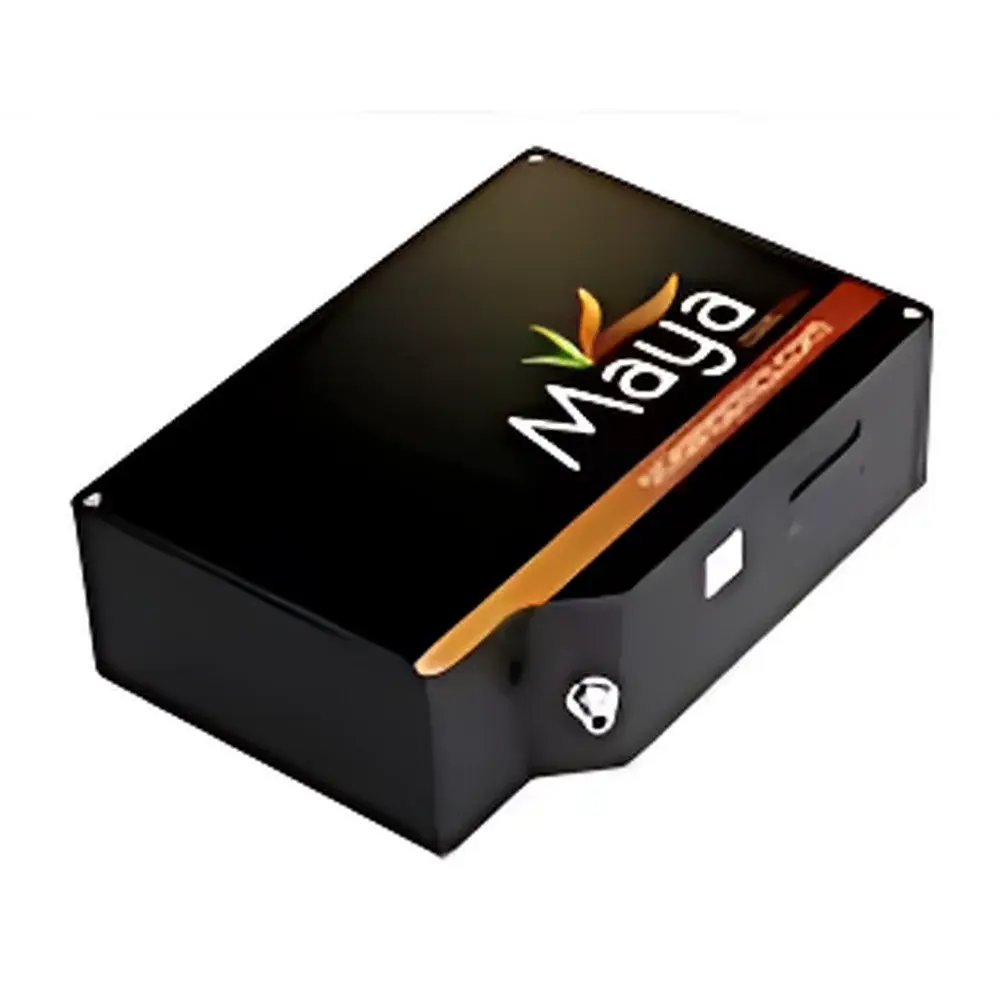
Ocean Optics Maya2000Pro Fiber Optic Spectrometer
| Brand | Ocean Optics |
|---|---|
| Model | Maya2000Pro |
| Detector Options | Hamamatsu S10420 (UV-Vis), S11510 (Vis-NIR) |
| Spectral Range | 165–1100 nm (S10420), 400–1180 nm (S11510), or 780–1180 nm (Maya2000Pro-NIR preset) |
| Optical Resolution (FWHM) | Configurable via grating and slit selection |
| Peak Quantum Efficiency | 75% @ 600 nm (S10420), 85% @ 700 nm (S11510) |
| SNR (full signal) | ~450:1 |
| Dynamic Range | 15,000:1 (typical) |
| Integration Time | 7.2 ms – 5 s |
| Interface | USB 2.0 & RS-232 |
| Operating Temperature | 0–50 °C |
| Dimensions | 182 × 110 × 47 mm |
| Weight | 1.18 kg |
| Fiber Connector | SMA 905 (NA 0.22) |
Overview
The Ocean Optics Maya2000Pro Fiber Optic Spectrometer is a high-performance, compact benchtop spectrometer engineered for precision spectral acquisition across the ultraviolet, visible, and near-infrared (UV-Vis-NIR) regions. Based on a Czerny-Turner optical design, it integrates a fixed-slit entrance, collimating and focusing optics, a holographic or ruled diffraction grating, order-sorting filters, and a back-thinned CCD detector. Its modular architecture supports two detector variants—Hamamatsu S10420 optimized for UV-Vis sensitivity (165–1100 nm) and S11510 optimized for extended Vis-NIR response (400–1180 nm)—enabling application-specific configuration without hardware redesign. The instrument operates on the principle of wavelength-dispersive detection: incident light, delivered via SMA 905 fiber (0.22 NA), is spatially separated by the grating and imaged onto the detector array, where photon counts are digitized and calibrated to intensity versus wavelength. This architecture delivers high quantum efficiency, low stray light, and robust thermal stability—critical for quantitative reflectance, transmittance, fluorescence, and Raman measurements in research and industrial QA/QC environments.
Key Features
- Back-thinned 2D CCD detectors with peak quantum efficiency up to 85% at 700 nm (S11510) and 75% at 600 nm (S10420), enabling high-sensitivity detection of weak optical signals
- Configurable optical resolution (FWHM) through interchangeable gratings and slit options—supporting trade-offs between resolution, throughput, and spectral coverage
- Dynamic range of 15,000:1 (typical) and signal-to-noise ratio of ~450:1 at full well capacity, ensuring reliable quantification across wide-intensity sample sets
- Flexible integration time control from 7.2 ms to 5 seconds, compatible with pulsed sources (e.g., lasers, LEDs) and continuous illumination
- Dual communication interfaces: high-speed USB 2.0 for lab-based data streaming and RS-232 for embedded or OEM system integration
- Four hardware trigger modes—including edge-triggered, level-triggered, and external sync—enabling precise temporal alignment with external events (e.g., laser pulses, motor position)
- Strobe synchronization function for gated detection, essential for time-resolved fluorescence or background suppression in ambient-light environments
- Rugged aluminum chassis (182 × 110 × 47 mm, 1.18 kg) rated for continuous operation from 0 °C to 50 °C at ≤90% non-condensing humidity
Sample Compatibility & Compliance
The Maya2000Pro interfaces seamlessly with standard optical fiber probes (SMA 905, 0.22 NA), supporting transmission, reflection, and emission geometries for solids, liquids, gases, and thin films. It is routinely deployed in ASTM E308-compliant color measurement, ISO 13406-2 display characterization, USP photometric assay validation, and GLP-aligned fluorescence quantitation. While the spectrometer itself does not carry CE or FDA 510(k) certification as a standalone analytical device, its firmware and data output protocols support audit-ready workflows when integrated into validated systems compliant with 21 CFR Part 11 (electronic records/signatures) and ISO/IEC 17025 (testing laboratory competence). All calibration files (wavelength, intensity, linearity) are traceable to NIST-traceable standards and stored in human-readable formats (e.g., .csv, .txt) for third-party verification.
Software & Data Management
OceanView spectroscopy software (v2.x+) provides full instrument control, real-time spectral visualization, batch acquisition, and export to CSV, ASCII, or HDF5. It supports automated dark/bias correction, pixel binning, spectral smoothing (Savitzky-Golay), and multivariate analysis plugins (PCA, PLS regression). For custom integration, Ocean Insight supplies comprehensive SDKs for Python, MATLAB, LabVIEW, C#, and C++—including memory-mapped I/O and callback-driven event handling. Raw detector frames and calibrated spectra retain full metadata (integration time, grating ID, temperature, serial number), facilitating reproducible analysis and compliance with ALCOA+ data integrity principles (Attributable, Legible, Contemporaneous, Original, Accurate, Complete, Consistent, Enduring, Available).
Applications
- Fluorescence lifetime screening and quantum yield estimation using time-gated acquisition
- Process monitoring of chemical reactions via UV-Vis absorbance kinetics (e.g., dye degradation, polymerization)
- NIR-based moisture and protein content analysis in agricultural and pharmaceutical powders (780–1180 nm variant)
- LED and OLED spectral power distribution (SPD) and chromaticity coordinate (CIE 1931) calculation
- Raman excitation profiling and Stokes/anti-Stokes band separation with notch-filter-coupled setups
- Plasmonic nanoparticle characterization via localized surface plasmon resonance (LSPR) peak tracking
- Environmental sensing: dissolved organic matter (DOM) fluorescence excitation-emission matrix (EEM) mapping
FAQ
What detector options are available for the Maya2000Pro, and how do they differ spectrally?
The Maya2000Pro supports two Hamamatsu back-thinned CCD detectors: the S10420 (optimized for UV-Vis, 165–1100 nm) and S11510 (optimized for Vis-NIR, 400–1180 nm). The S11510 is also used in the factory-configured Maya2000Pro-NIR variant, preset for 780–1180 nm with ~0.82 nm FWHM resolution.
Can the Maya2000Pro be synchronized with pulsed lasers for time-resolved measurements?
Yes—four hardware trigger modes and strobe synchronization enable precise gating relative to external TTL signals, supporting nanosecond-scale timing resolution when paired with appropriate delay generators.
Is radiometric calibration available, and is it NIST-traceable?
Radiometric calibration kits (e.g., HL-3-CAL, PX-2) are offered separately; all calibration data files include NIST-traceable uncertainty budgets and are compatible with OceanView’s calibration import workflow.
Does the spectrometer support OEM integration into automated instrumentation?
Yes—the RS-232 interface, deterministic USB command set, and cross-platform SDKs allow direct integration into robotic sampling platforms, inline process analyzers, and custom GUI applications.
How is thermal drift managed during long-duration acquisitions?
The sealed optical bench minimizes air currents, and internal temperature monitoring enables software-based dark current compensation; for ultra-stable applications, optional thermoelectric stabilization modules (e.g., TC-100) are available.




